
On the same stage where Indian Prime Minister Narendra Modi and President Emmanuel Macron had spoken earlier that day, Adobe CEO Shantanu Narayen used a word that his company, more than any other, helps to make necessary. Speaking alongside Maurice Lévy, honorary chairman of Publicis Groupe, he discussed personalization, copyright, and generative models—and then, without really being asked, he admitted that there would be “AI slop”—content produced in excess and of no interest—precisely because the tools his company puts into the hands of millions of creators make production infinite.
A Scene, a Confession
A few hours earlier, Emmanuel Macron had stopped by the L’Oréal booth, where he was shown, on a screen, what Adobe’s models can produce in a matter of moments. The scene sums up quite well where Adobe now stands in the luxury and beauty ecosystem: no longer just the maker of Photoshop, but the behind-the-scenes infrastructure enabling large-scale personalization for brands, each of which reaches millions of beauty enthusiasts simultaneously.
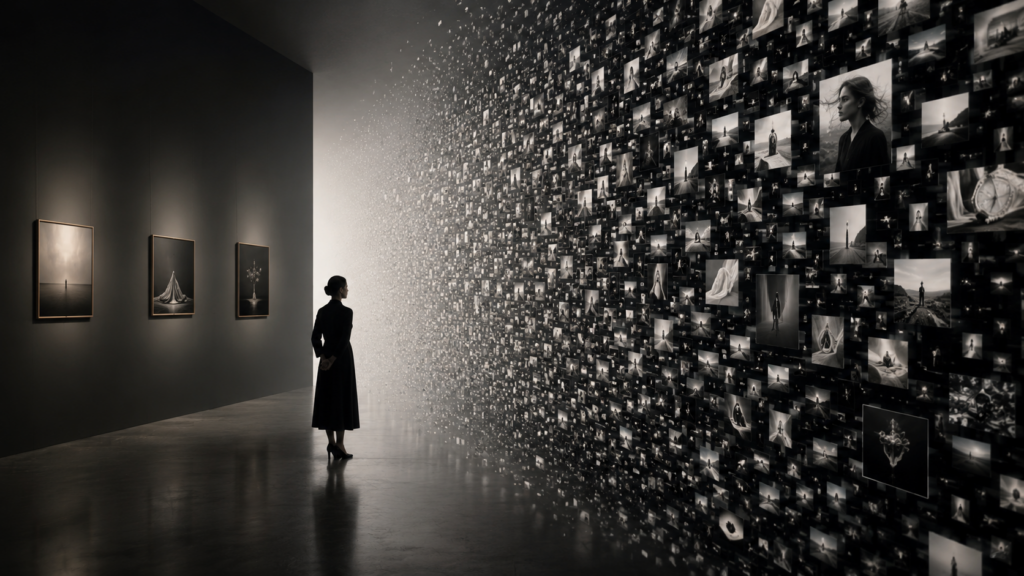
It is this stance that makes the rest of the conversation interesting. Narayen did not present himself as an uncritical evangelist. He willingly acknowledged the flip side of what he is selling: the more content production is automated, the more noise surrounds meaningful creation. “There’s going to be AI slop, because there’s going to be more content created,” he acknowledged, before adding that only the work that combines a unique creative process with genuine, heartfelt engagement will continue to stand out. This admission, coming from the CEO of a company that specifically sells the tools for this mass production, carries more weight than an abstract warning about generative artificial intelligence.
The Promise of Scale
Narayen’s reasoning stems from an observation he shares with Maurice Lévy: each technological generation—the personal computer, the mobile phone, the cloud—has expanded the realm of creativity, and generative artificial intelligence, in his view, continues rather than breaks this sequence. For the fashion houses, the concrete promise has two parts. On the one hand, behavioral data on consumers—now centralized and usable in real time—should make it possible to never again offer a discount to someone who has just purchased at full price—the example cited by Narayen himself, though almost trivial, speaks volumes about the gap that still exists between the promise of personalization and the user’s actual experience. On the other hand, what the industry calls the content production chain—from the brief to multi-format delivery—can now be automated to the point where a campaign can be adapted in real time based on each recipient’s behavior.
The Details. With what it calls “content credentials,” Adobe has built a metadata system that accompanies every creation—a sort of nutrition label indicating who produced the work, when, and under what rights. According to Narayen, the system now brings together thousands of partners, ranging from camera manufacturers to software distribution platforms. The technical problem, he says, has been solved; what remains is the more time-consuming task of helping users understand that an image carries intellectual property just like a physical object.
The gesture, despite the scale
This is where the conversation touches on a tension older than artificial intelligence itself—the one between automation and craftsmanship. Narayen responds with a statement that is almost artisanal in its economy: “I’ve never met a creative professional who would rather spend six hours on a piece they could complete in an hour.” The argument shifts the question: it is no longer a matter of whether the machine replaces the act of creation, but of what the creator does with the time thus freed up. Hanging in the balance in this sentence is the question of what, in those six hours, constituted anything other than mere execution—slowness itself, at times, being the very place where the demand lies.
The very title of the discussion—revealed by Maurice Lévy at the end—was a phrase from Adobe: “Tools don’t create, people do.” Tools don’t create; people do. Narayen stuck to this point without mincing words: “The role of technology is to enhance human creativity, not to replace it. ” But the statement, coming from the CEO of a company whose market value depends on the speed of content production, also serves as a line of defense—one that must be maintained in the face of the inflation he himself has just described.
What This Means for the Houses
For a luxury brand, the challenge highlighted by this conversation is not technological in the narrow sense. Adobe does not sell a promise of differentiation; it sells a production capability that all competing brands can acquire at the same time, under the same conditions. Differentiation, if it is to endure, can no longer come from production capacity—which has become commonplace—but from selection: what a brand chooses not to produce, not to personalize, and not to expedite. Luxury, long defined by the rarity of the object, will have to come to terms with a new kind of rarity: the attention a brand is willing to devote to avoiding the easy path of economies of scale.
Maurice Lévy wrapped up the discussion with a question that remained unanswered: In ten years, will we still say that it is people who create? Narayen responded with measured optimism—almost a promise of loyalty to an idea rather than to a guaranteed result. Between the two men, and between the lines of this public conversation, a question remains that neither of them has resolved: at what threshold of automated production does a fashion house cease to be recognizable by what it creates, and become recognizable only by what it refuses to create?
Cette publication est également disponible en :

