
Among the dozens of AI announcements presented at VivaTech 2026, Webedia Elephant’s announcement deserves attention for one particular reason: it focuses not on a model, but on a studio. This distinction speaks volumes about the industry’s current evolution. While most tech companies sell tools, Webedia is striving to build a creative ecosystem where people officially remain at the heart of the story.
Amid demonstrations of videos generated in a matter of seconds, automated dubbing in thirty languages, and agents capable of orchestrating entire creative workflows, one phrase came up repeatedly on the VivaTech stage: “AI without vision is just noise.”
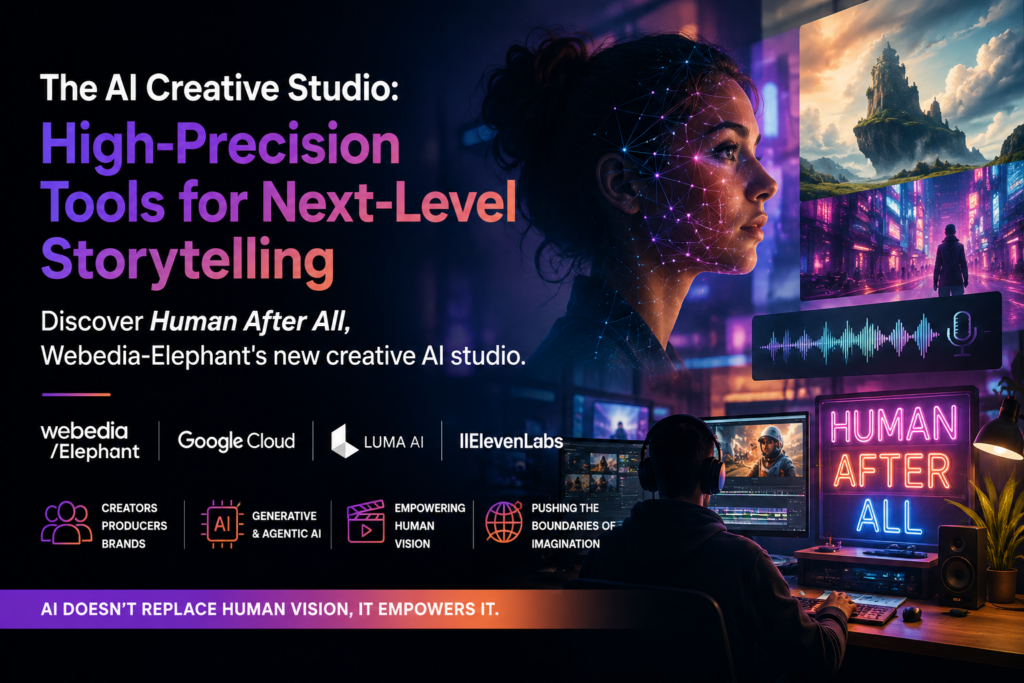
Based on this conviction, Webedia Elephant unveiled Human After All, a new AI-powered creative studio developed in partnership with Google Cloud, Luma AI, and ElevenLabs.
The announcement might seem like just another initiative in an industry where a new AI lab pops up every week. Yet it reveals a deeper transformation: content creation is entering a phase where mastery of the tools is becoming less important than the ability to orchestrate entire systems.
The Paradox of Accelerated Creation
Webedia now claims a monthly audience of 380 million people across its media outlets, social media platforms, and creator ecosystem.
But behind the numbers, one reality is becoming clear to the entire industry: the pace of technological change now outstrips that of the creative processes themselves.
Creative teams are facing an unprecedented situation. Templates change every week. Capabilities improve every month. Workflows become obsolete before they’ve even been fully adopted.
For Pauline Buter, Director of Creative and Development at Webedia, the challenge is no longer simply about learning how to use a technology.
The goal is to build a new form of creative trust.
On the one hand, the most tech-savvy creators are already experimenting with new models on a daily basis. On the other hand, a significant portion of the ecosystem remains hesitant, sometimes paralyzed by the pace of innovation.
The Creator Program announced by Webedia directly addresses this divide.
Rather than simply providing training on tools, the program aims to create an environment for experimentation that brings together creators, producers, brands, AI experts, and technology partners in a cohort deliberately limited to fifteen participants.
An approach that is more reminiscent of artist residencies than traditional technology accelerator programs.
The End of the Prompt, the Beginning of Agents
One of the most interesting insights from this roundtable, however, did not come from the creative sector, but from the infrastructure sector.
According to Mathieu Blanc of Google Cloud, the industry is entering a new phase.
After the era of chatbots comes the era of agents.
In other words, users will no longer simply ask an AI to generate an image or a piece of text. They will define an overall objective and let several specialized agents collaborate with one another to carry out a complete task.
Research, visual generation, dubbing, validation, optimization, and publication could soon be managed by autonomous systems working together.
This transition is far from insignificant.
For two years, generative AI was primarily viewed as a production tool. It is gradually becoming a creative infrastructure.
The difference is fundamental.
The challenge is no longer about producing content faster, but about developing new creative channels.
The Unexpected Return of Authenticity
The choice of the title *Human After All* is obviously no coincidence.
A deliberate reference to the Daft Punk album, it also reflects a growing concern within the industry.
As the quality of synthetic content improves, the perceived value of authenticity increases.
The demonstrations presented by Luma AI and ElevenLabs perfectly illustrate this tension.
On the one hand, these tools are now capable of transforming an actor filmed in a Parisian café into a cowboy moving through a completely computer-generated setting.
On the other hand, the speakers repeatedly emphasized the need to preserve the original human performance.
The same logic applies at ElevenLabs.
The goal is no longer simply to generate a believable artificial voice, but to preserve the vocal identity, emotions, and nuances unique to each creator during multilingual translations.
AI no longer seeks to replace humans.
She is trying to multiply it.
At least in theory.
The New Luxury: Instant Testing
Perhaps the most revealing aspect of the discussion emerged in the speakers’ closing remarks.
When asked what they were most excited about for the next twelve months, none of them mentioned the quality of the models.
They all talked about speed.
Speed for experimentation.
Iteration speed.
Speed in turning an intuition into reality.
For a creative professional, the gap between an idea and its realization has always come at a cost: time, budget, resources, and trade-offs.
AI drastically reduces this distance.
An idea can now be visualized, animated, voiced, and tested almost instantly.
This shortening of the creative cycle could be the most profound transformation of all.
Not because it produces better content.
But because it changes the way ideas emerge.
The real work remains unseen
However, the most strategic topic was neither generative video, nor agents, nor creative workflows.
He appeared almost unnoticed at the end of the conference.
Ethics.
Pauline Buter emphasized the need to develop legal and ethical frameworks in collaboration with artists rather than in opposition to them.
A comment that seems minor today but could become crucial tomorrow.
Because technology is now advancing faster than the rules governing its use.
The visual quality of synthetic content is no longer really an issue.
The issue then becomes one of creative ownership, consent, compensation, and traceability.
In other words, the most complex challenges are no longer technical.
They are cultural.
Human After All thus appears less like a production studio and more like a laboratory for negotiation between two worlds: that of human creativity and that of cognitive automation.
Recent history shows that technology almost always wins the performance race.
It remains to be seen whether she will also be able to preserve what makes a creation memorable: an intention, a sensibility, and a vision that cannot be measured in tokens or computing power.
Cette publication est également disponible en :

