
Travel is no longer just about getting from one place to another. In recent years, fashion houses have been reimagining the concept of mobility as an aesthetic language in its own right. At ETRO, this idea is by no means an opportunistic shift. Since the late 1960s, the Milanese house has built its creative vision around nomadic textiles, Eastern influences, and an unapologetic taste for cultural exchange. The announced collaboration with Globe-Trotter extends this continuity with an almost organic logic: that of luggage conceived not as a functional accessory, but as a narrative canvas.
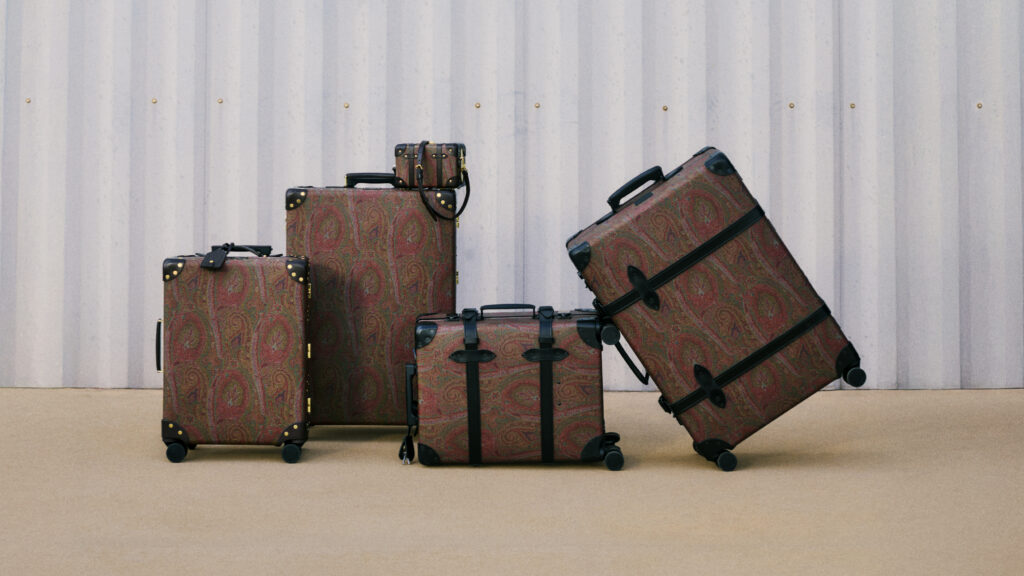
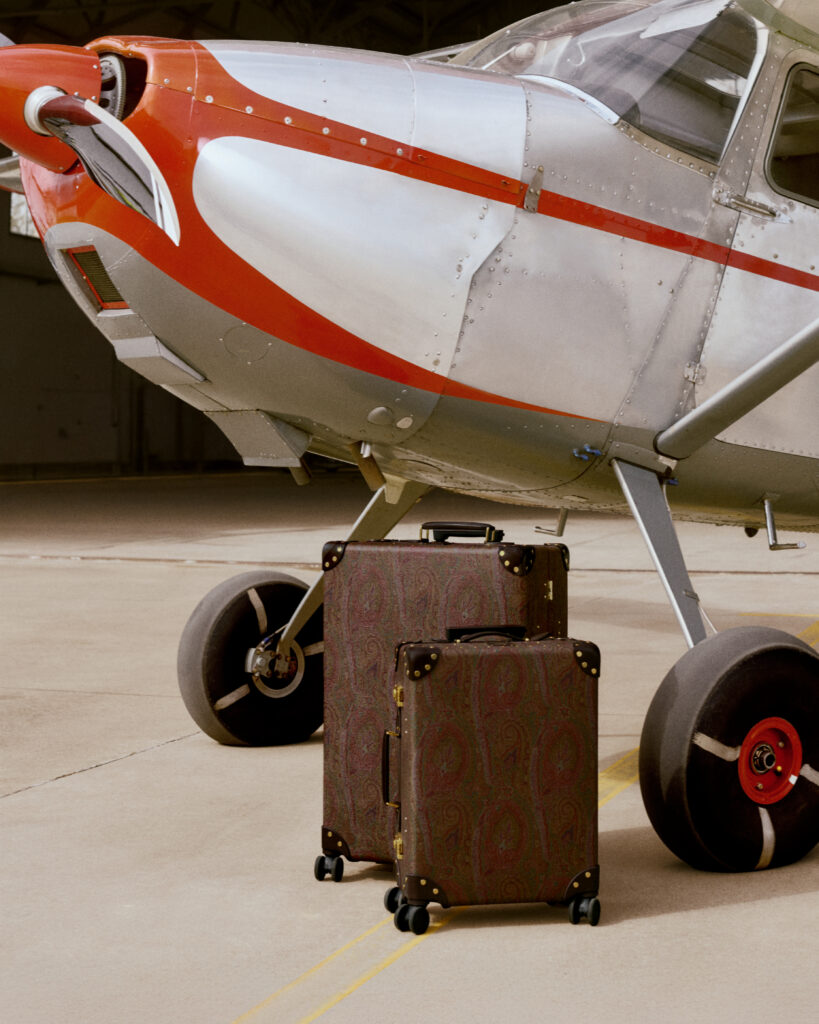
The partnership between the two companies is based less on co-branding than on a shared approach. On the one hand, Globe-Trotter continues to produce its trunks and suitcases in Hertfordshire using techniques inherited from the Victorian era, notably the use of vulcanized fiberboard, a material historically chosen for its lightness and impact resistance. On the other hand, ETRO brings its own textile vocabulary, centered here on the Arnica fabric—a jacquard woven with the Paisley pattern that has become one of the Italian house’s signature graphic motifs since the 1980s. The result never attempts to conceal the object’s structure: exposed metal corners, leather straps, visible hardware, and thick handles. The luggage retains its primary function—to withstand the test of time and travel through train stations—while incorporating ETRO’s decorative codes.
This dialogue between textiles and travel design also conveys a certain vision of contemporary luxury: less ostentatious, more closely tied to use and patina. Globe-Trotter has always championed an aesthetic of elegant wear and tear. The British brand’s suitcases aren’t meant to remain pristine; they gain character with each journey. ETRO embraces this philosophy here by focusing on memory rather than constant novelty. Each trolley becomes a surface destined to accumulate marks, scuffs, and memories—almost the opposite of a static museum piece.
The presence of the Paisley pattern, in fact, warrants a brief historical detour. Popularized in Europe in the 19th century through the Scottish mills in the town of Paisley, this design has its origins in Persian and Kashmiri motifs. ETRO made it one of the defining visual elements of Italian ready-to-wear in the 1980s, at a time when Milanese fashion was already exploring the concepts of travel, ornamentation, and cultural hybridization. By incorporating it into the hard shell of the Globe-Trotter suitcase, the brand shifts the motif from clothing to the traveling object itself. The container becomes an extension of the wardrobe.
The collection is available in Carry-On and Check-In versions, with two main designs: Arnica Gold, which combines ETRO canvas, brown leather, and brass hardware, and Arnica Black, a more graphic, almost monochromatic design featuring black leather and hardware. Some pieces feature exterior straps reminiscent of early 20th-century railway trunks. This detail avoids a vintage pastiche thanks to a design tailored for contemporary use.
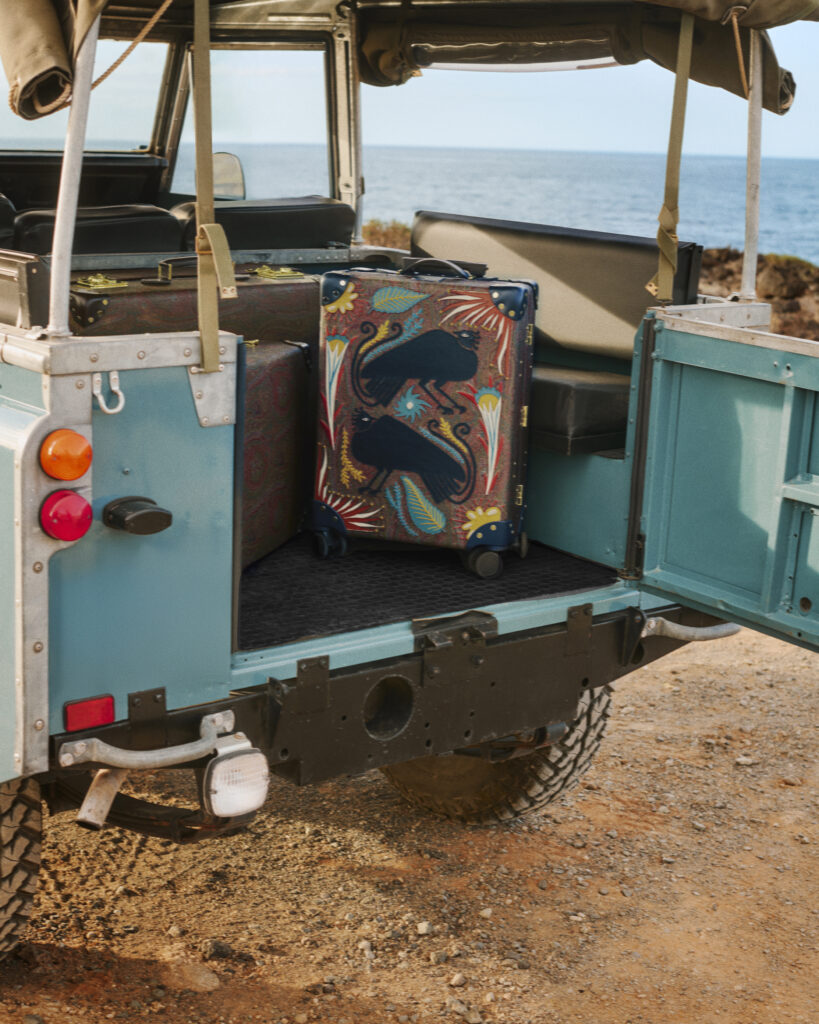
Perhaps the most distinctive element is the collection developed in collaboration with British illustrator and curator Tabby Booth. Her interpretation of the Paisley pattern introduces a dreamlike bestiary composed of mythological creatures, folkloric motifs, and stylized flora. This interpretation transforms the piece into a quasi-narrative surface, somewhere between a travel sketchbook illustration and an English decorative textile. Once again, ETRO returns to one of its historical strengths: the dialogue between textile craftsmanship and cultural imagination.
This collaboration also comes at a time of restructuring for ETRO. Since L Catterton acquired a stake in the company in 2021, followed by the arrival of investors led by Rams Global in late 2025, the Italian brand has been seeking to consolidate its status as a global “lifestyle house,” capable of extending its identity across fashion, fragrance, home decor, and now mobility. Luggage thus becomes a strategic focus: that of mobile, international luxury, designed for a clientele accustomed to airports as much as to second homes.
At Globe-Trotter, the challenge is different but complementary. For several years now, the British brand has been pursuing a strategy of targeted collaborations with cultural spheres capable of revitalizing its heritage without freezing it in aristocratic nostalgia. ETRO brings a more textile-focused, more Mediterranean, and almost more narrative dimension to a silhouette that is historically very English.
Ultimately, this collection is less about travel than about how people today construct their identities while on the move. Luggage is no longer merely a practical container. It becomes a portable archive, a cultural symbol, and a link between the places one passes through.




Cette publication est également disponible en :

