
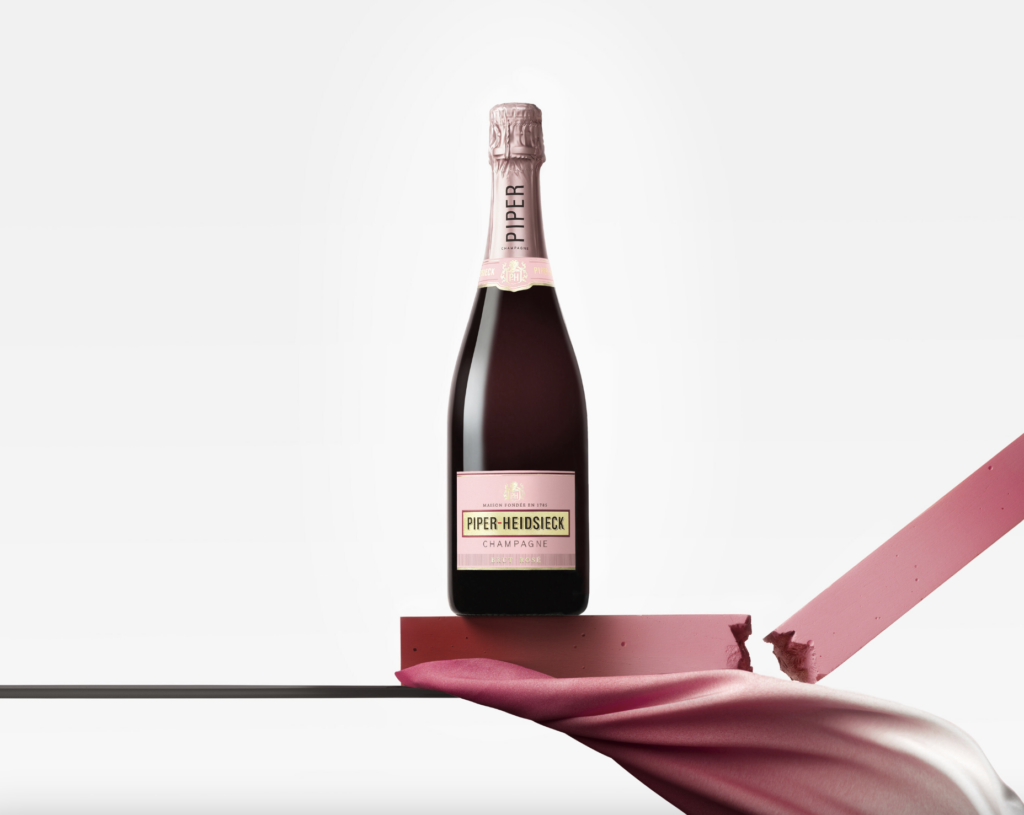
Rosé is not a chromatic variation. It’s a blending decision. At Piper-Heidsieck, this decision is part of a gradual rewriting of style, begun with the arrival of Chef de Caves Emilien Boutillat: reducing the impact of red wine to bring out something else – a more precise reading of the fruit.
The current Brut Rosé is the result of this move.
Historically, rosé blending has been based on the tension of integrating red Pinot Noir wines without unbalancing the structure of the white wine. Here, these red wines come largely from the village of Les Riceys, a singular territory in the Aube region renowned for the ripeness of its pinot noirs.
But balance doesn’t just happen at the outset. It’s built over time.
The cuvée includes a minimum of twenty-five percent reserve wines. This choice is not neutral: it stabilizes the aromatic profile from one year to the next, by introducing wines that have already evolved into the blend.
The wine is then aged on its lees for at least twenty-four months, with a further three months after disgorgement. Two distinct temporalities: the first builds texture, the second refines the wine’s legibility.
The dosage, set at eight grams per liter, positions the cuvée in a classic brut balance zone. Sufficiently present to support the fruit, sufficiently restrained to preserve the tension.
This technical framework makes it possible to interpret the aromatic profile without overplaying it. The markers – blood orange, wild strawberry, black cherry, blackberry – are not a simple fruit palette, but a stratification. Added to this are more discreet notes of fresh almond and orange blossom, shifting the wine towards a more floral reading.
What’s at stake here is a question of precision.
The recent evolution of the cuvée confirms this intention. The work undertaken by Emilien Boutillat explicitly aims to reduce the proportion of red wine in the blend in order to preserve the clarity of the fruit and the tension of the wine.
In other words: less imposed structure, more intrinsic expression.
This choice is part of a wider context. Champagne rosé is growing steadily – one bottle in ten by 2023 – and is now the second most popular category after brut.
Faced with this expansion, the temptation might be to reinforce the style. Piper-Heidsieck is doing the opposite: refining.
Brut Rosé thus becomes a balancing act between two logics. On the one hand, a classic architecture – blending, reserve, ageing. On the other, an almost contemporary search for aromatic clarity.
In glass, this translates into a more legible tension. A less demonstrative, but more mobile material.
Here, rosé ceases to be a variation. It becomes a method.
Cette publication est également disponible en :

