
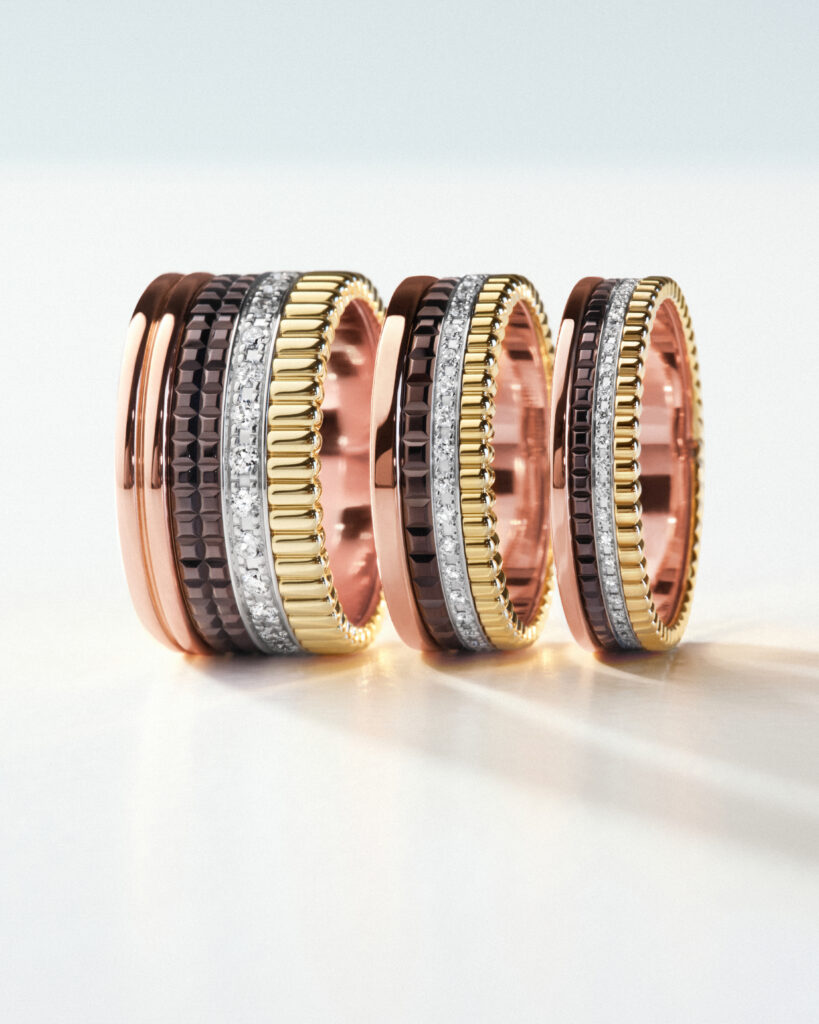
On the white table, the rings appear identical – until the eye adjusts its distance. The variation is not a new motif, but a question of proportion. At Maison Boucheron, the Quatre collection doesn’t change language: it changes scale.
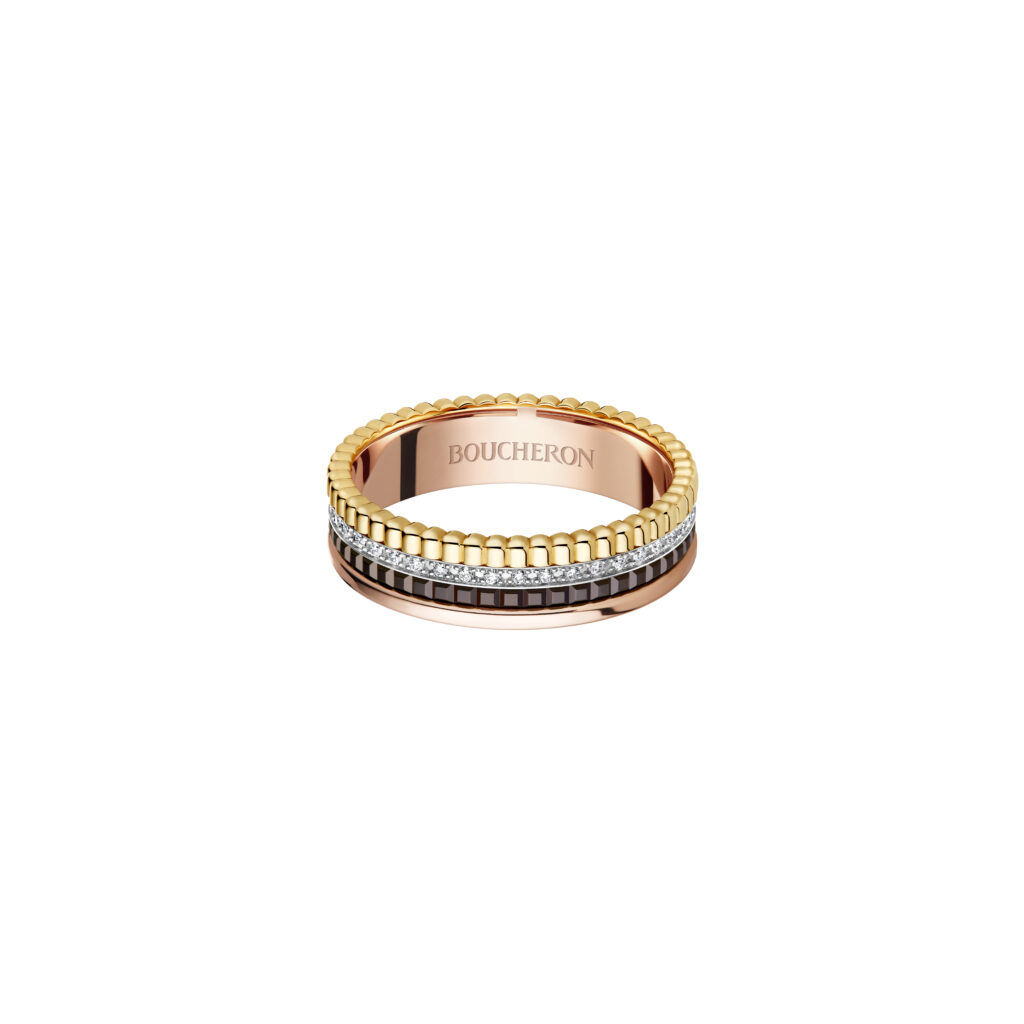
In 2026, the Maison introduced Quatre XS, a slimmer version than the Small, while retaining the original architecture. The challenge is not aesthetic in the decorative sense, but structural. Reducing a ring composed of four distinct rings – each worked separately and then assembled – means maintaining precision to a hundredth of a millimeter, or risk misalignment . Miniaturization becomes a rigorous exercise.
The Quatre collection is based on four identified formal codes, all drawn from the House’s archives. The Grosgrain, inspired by a ribbed silk fabric, refers to the textile heritage of Frédéric Boucheron’s father, a cloth merchant in the 1860s. The Clou de Paris, introduced in 1911, echoes the geometry of the cobblestones of Place Vendôme, where Boucheron first set up shop in 1893. The diamond line, introduced in 1892, is set in a mirror setting designed to amplify the reflection of light. Finally, the Double Godron, an architecturally inspired curved motif, appeared in the 1860s, combining two rings in a single shape.
These four elements are not juxtaposed; they are assembled in a precise sequence, then compressed into a reduced width. The document specifies that a final “click”, produced by a mechanical press, seals the assembly. This sound detail, almost invisible in the communication, nevertheless says the essential: the ring is not a monoblock volume, but a construction.
The reduction in size introduces another use. Slimmer, the XS ring facilitates accumulation – which the campaign highlights through games of layering and mix & match worn by Daisy Edgar-Jones, Han So-hee and Dilan Çiçek Deniz . The gesture changes: we no longer wear a single sign, but a combination.
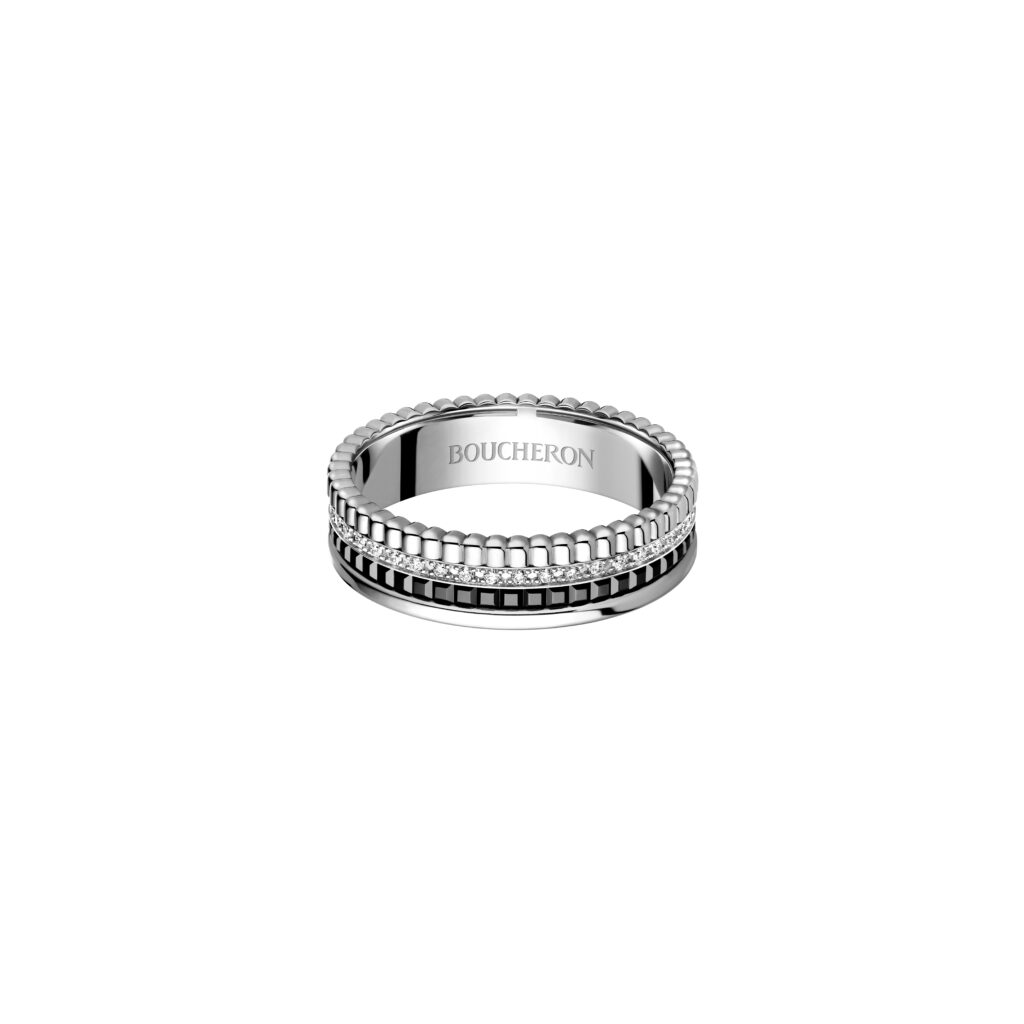
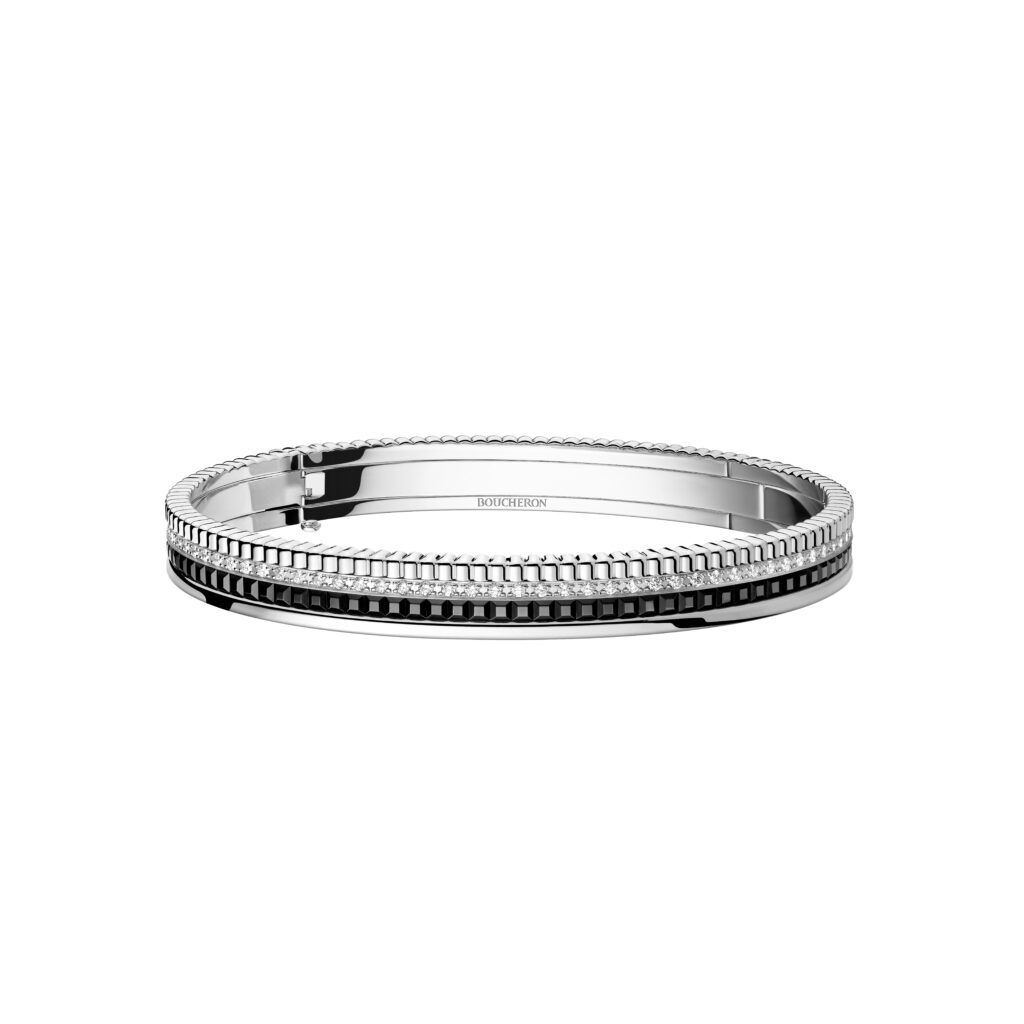
Around this central piece, the Maison has developed several extensions. The Quatre Radiant Edition, in diamond-paved white gold, uses different stone cuts – round, baguette, princess – applied respectively to the different codes. A tubular bracelet, introduced in 2025, continues this logic by transposing the circular structure into a continuous volume.
Since 2004, when Quatre Classique was launched, the collection has evolved through successive additions – White Edition, Black Edition, Radiant Edition, then XS in 2026 – without altering its fundamental architecture, as the chronology on page 10 of the dossier shows. A rare constancy: that of a formal system capable of absorbing variations without fragmenting.
Reducing, here, does not mean simplifying. It means maintaining a tension between four historical motifs, four techniques, four surfaces – in a more constrained space. A thinner ring, but an intact structure.







Cette publication est également disponible en :

