
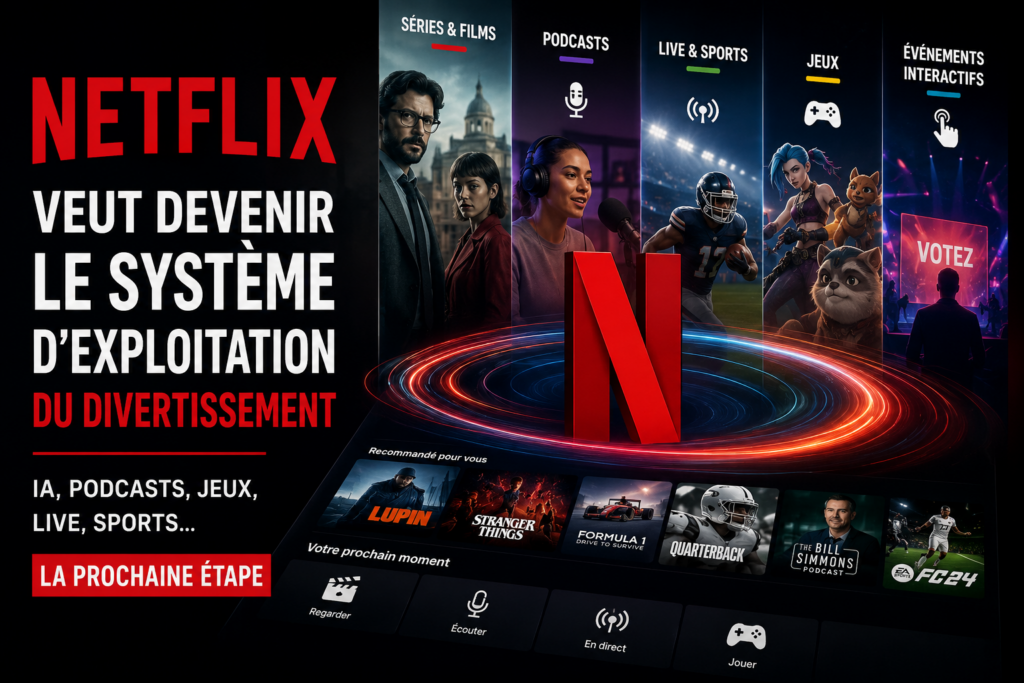
For two decades, Netflix has transformed content distribution. Its next challenge is even more ambitious: to become the single platform through which consumers enjoy all their entertainment experiences.
That was the message Elizabeth Stone conveyed during her conversation with Steven Levy at VivaTech.
Behind the announcements about AI, podcasts, and video games, a much deeper strategic shift is emerging.
The battle is no longer about streaming
For a long time, Netflix was a platform for movies and TV shows.
Today, the company thinks differently.
According to Elizabeth Stone, entertainment is no longer a single market but a set of behaviors:
- watch a TV show in the evening;
- listen to a podcast in the morning;
- watch a live sports event;
- play a video game on a mobile device or TV;
- take part in an interactive experience.
Netflix’s vision is to bring these uses together into a single, cohesive experience.
So the real competition is no longer just Disney+, Prime Video, or Max.
It’s the total amount of available attention.
This shift brings Netflix closer to an ecosystem platform model than to that of a simple content distributor.
Personalization remains the secret weapon
The challenge is clear.
The more content Netflix adds, the greater the risk of fragmentation.
How to balance:
- an NFL game,
- a Jay Shetty podcast,
- a series like Lupin,
- a sports documentary,
- a FIFA game?
The answer is the same as it was fifteen years ago: recommendations.
Elizabeth Stone points out that Netflix has been using machine learning for decades, long before the boom in generative AI.
But recent advances in AI now allow for a more nuanced understanding:
- content;
- user preferences;
- consumption contexts.
The challenge is no longer just about recommending the right show.
It’s about understanding whether the user wants to play, listen, watch, or participate.
In other words, Netflix is seeking to personalize not only the content but also the way users consume it.
Netflix’s future is looking more and more like YouTube’s
Even though Elizabeth Stone explicitly rejects the comparison, several signs point in that direction.
Netflix is now investing in:
- video podcasts;
- creator content;
- live streams;
- games;
- sports events.
Historically, these areas were more closely associated with YouTube.
The difference is that Netflix is trying to integrate them into a premium, curated, and highly personalized experience.
The goal isn’t to replicate YouTube but to offer a more controlled, more consistent, and higher-quality alternative.
The question then becomes: how much of daily usage can Netflix capture without diluting its identity?
AI is not a threat to creators, but a choice
When asked about AI-generated content, Elizabeth Stone takes a pragmatic stance.
Netflix does not set any ideological red lines.
Two scenarios coexist:
- filmmakers who reject any use of AI;
- others who want to use it to bring to life visions that would otherwise be impossible.
Netflix intends to provide the tools and leave the decision up to the creators.
This approach is interesting because it reflects a trend observed across all creative industries:
the question is no longer “should we use AI?” but “who retains creative control?”
Netflix is clearly positioning itself in favor of enhancing creative capabilities rather than replacing creators.
The real revolution may be French
The most strategic announcement, however, is neither AI nor gaming.
It is the full integration of TF1 into Netflix.
Starting in the summer of 2026, French subscribers will have access to:
- TF1’s linear channels;
- on-demand content;
- live programming.
For Netflix, this partnership serves as a global testing ground.
If the experiment works, it could be replicated in other countries.
This approach marks a significant shift.
For years, streaming platforms were seen as competitors to traditional TV networks.
Netflix is now proposing a different approach: becoming the aggregation layer that brings together all available entertainment.
Netflix’s True KPI
One passage from the interview perfectly sums up the company’s philosophy.
When asked how Netflix measures the success of a piece of content, Elizabeth Stone mentions neither box office numbers nor gross viewership.
The main criterion remains:
Does the member return to Netflix regularly and find something they like there?
For a platform with more than 300 million subscribers, this completely changes the investment strategy.
The role of content isn’t just to attract an audience.
It must reinforce the habit.
From this perspective, an NFL game, a documentary, a podcast, or a video game all serve exactly the same purpose: to increase engagement frequency.
The detail that matters
For a long time, Netflix was a content company.
Today, Netflix is becoming a navigation company.
Its competitive advantage no longer rests solely on what it produces or acquires, but on its ability to guide each user through a world of entertainment that has become infinitely vaster.
AI, podcasts, games, and live content are ultimately just building blocks.
Netflix’s true product is no longer the content.
It’s the ability to orchestrate attention.
And in an economy where attention is becoming the scarcest resource, this ambition is likely far more important than the next hit series.
Cette publication est également disponible en :

