
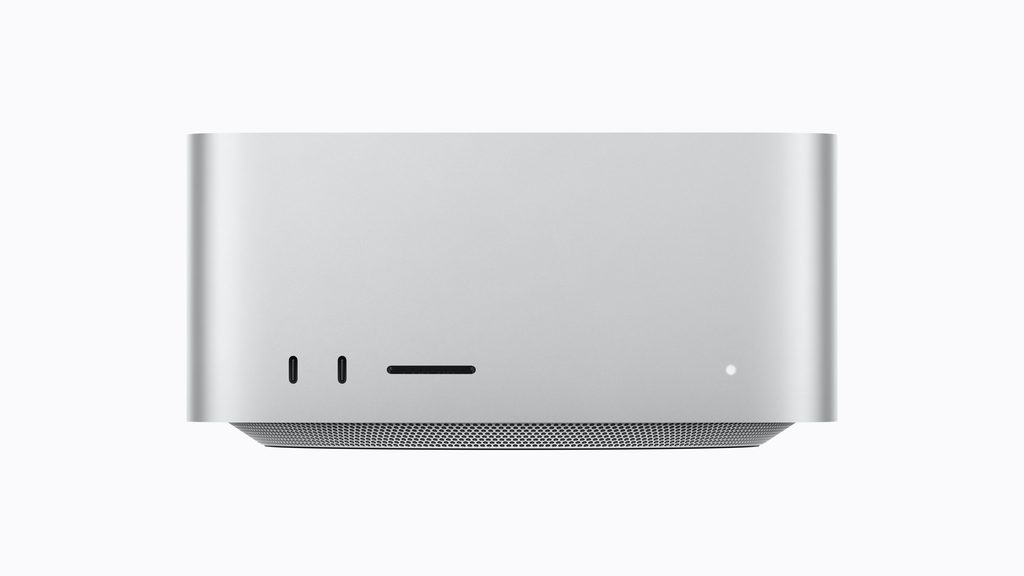
The new generation of Mac Studio isn’t just about speeding up creative work.
With up to 512 GB of unified memory and the ability to cluster multiple machines, Apple is turning the workstation into a small, on-premises AI infrastructure.
That’s where the cultural shift lies: bringing calculations back to the desktop that were previously associated with the cloud or the data center.
Announced on August 25, 2026, the new Mac Studio will be available starting September 22 with an M5 Max or M5 Ultra chip. The former can feature an 18-core CPU, a GPU with up to 40 cores, and 128 GB of unified memory. The latter boosts the CPU to up to thirty-six cores, the GPU to up to eighty cores, and unified memory to up to five hundred twelve GB, with a bandwidth of 1.2 TB/s.
This level of memory becomes critical when discussing large language models run locally. Apple highlights the ability to load very large models without systematically sending data to the cloud. For creative studios, research teams, developers, or organizations handling confidential datasets, this offering changes the nature of the device: the Mac Studio is no longer just a creative workstation, but a standalone computing platform.
The most compelling new feature is likely clustering. Through Thunderbolt 5 and RDMA technology, multiple Mac Studio systems can share computing resources. Apple claims that a cluster of four machines can achieve inference performance up to three times that of a single system. While this claim warrants independent verification, it reveals a clear ambition: to make the architecture modular without abandoning the desktop form factor.
The M5 Ultra reinforces this positioning with a GPU featuring up to eighty cores—each equipped with a Neural Accelerator—and a 32-core Neural Engine. Apple reports peak AI performance up to 4.3 times that of the M3 Ultra. The Media Engine can simultaneously play back up to thirty-three ProRes 422 8K streams at thirty frames per second—a figure that also reestablishes the device’s place in its traditional domain: the visual arts.
Connectivity keeps pace with this density. Thunderbolt 5 supports up to 120 Gbps, storage uses a PCIe Gen 6 architecture, and the new models include Wi-Fi 7 and Bluetooth 6. Apple also mentions support for Genlock via USB-C and up to eight displays, or four Studio Display XDRs at 5K and 120 Hz.
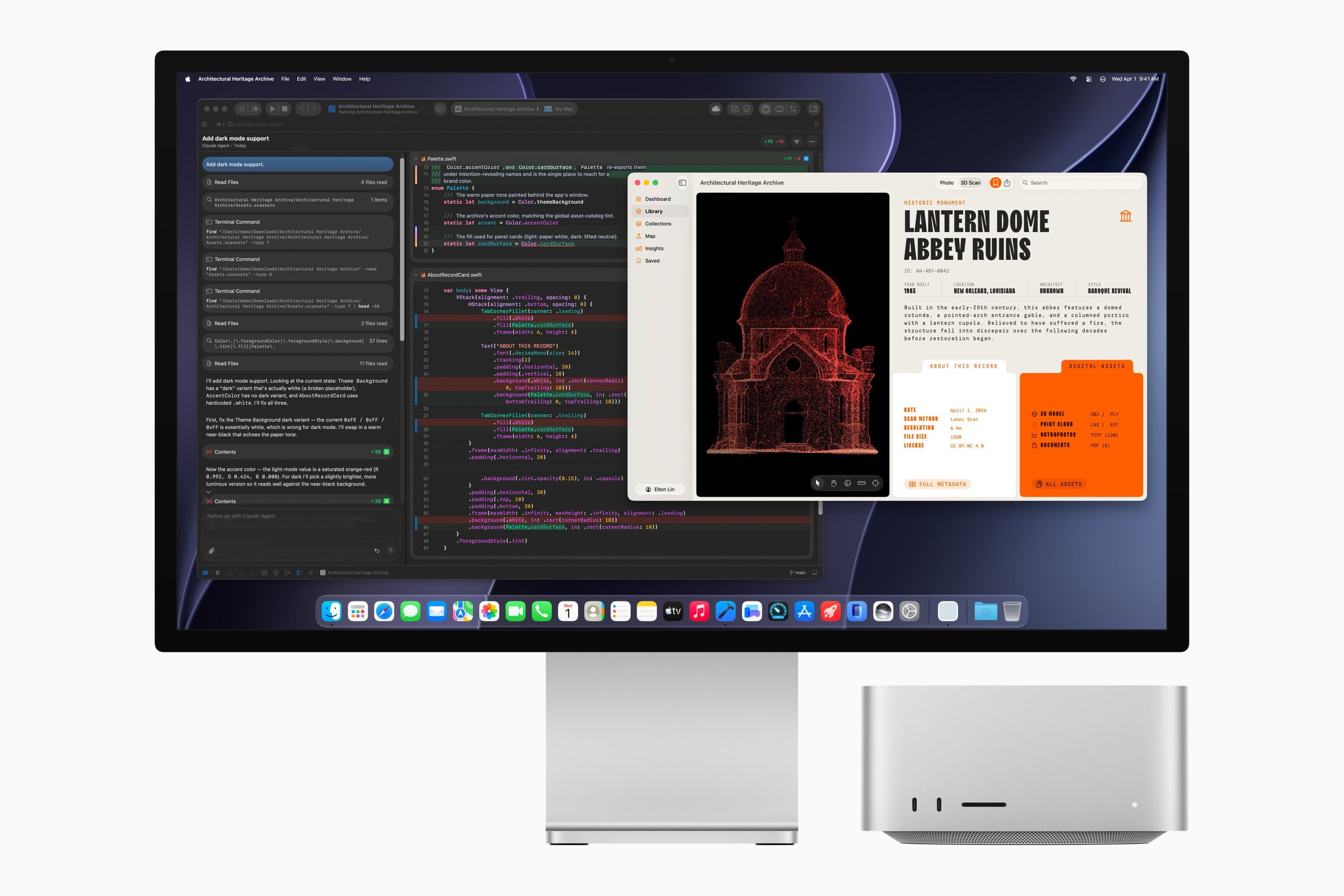
These features alone are not enough to define the machine. The real challenge is integration. Core AI, MLX, Xcode, and the unified memory architecture form an environment in which hardware and software are designed together. This continuity—more than raw performance—is one of the advantages that is most difficult to replicate.
That leaves the economic question. Apple does not provide details here on the cost of the highest-end configurations, nor on the cost-performance ratio of a cluster compared to a cloud solution or a dedicated GPU workstation. Yet that is what will determine adoption outside traditional creative circles.
With this generation, the Mac Studio is gradually moving beyond the realm of the editing or design studio. It is becoming a cutting-edge machine: still a personal computer in form, but already an AI infrastructure in its applications.
Cette publication est également disponible en :

