
Champagne has built its reputation on a paradoxical principle: erasing regional distinctions to create harmony. Blending—a meticulous art practiced by Maison Boizel since 1834—consists precisely of blending Chardonnay from Avize, Pinot Noir from Tours-sur-Marne, and grapes from seven hectares spread across the region’s finest crus into a single, recognizable profile from one year to the next. The idea was to transcend the vintage and break free from the terroir. For a century and a half, it worked.
The Monocrus collection signals that something has changed in the way the great Champagne Houses view their own heritage.
Why now? Because over the past decade, the high-end Champagne market has faced pressure from independent growers—small-scale producers who work in a single village, sometimes on just a few rows of vines, and who have championed a “terroir-first” approach that the major Houses could not embrace without betraying their own principles. Boizel isn’t compromising its principles. Instead, it’s doing something different: it’s opening up its network of contacts.
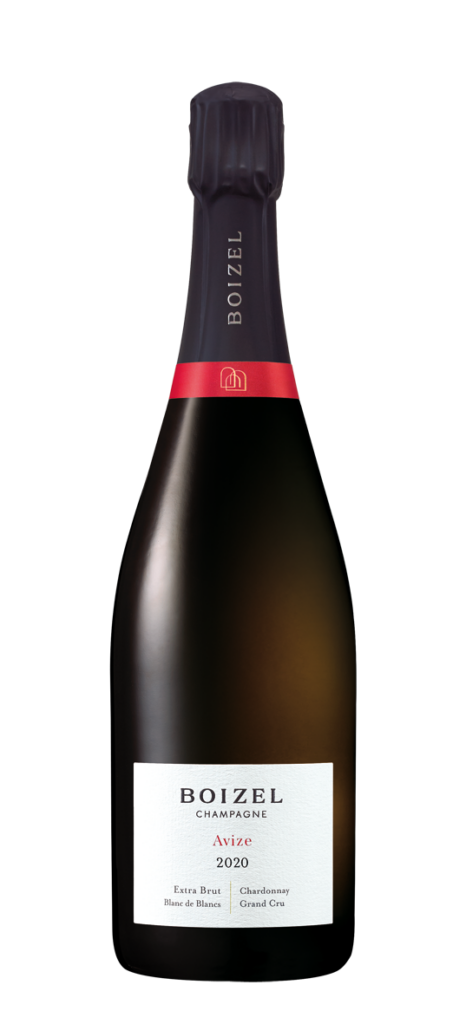
In Avize, a Grand Cru village in the heart of the Côte des Blancs, the family has called this place home for several generations. It still owns vineyards there today. This is not a strategic purchase of vineyards to justify a launch—it is a belated but well-documented declaration of origin. The Chardonnay from Avize grows on chalk of uniform purity, at altitudes between 120 and 240 meters, facing east, across 268 hectares entirely dedicated to this single grape variety. The winemaking process for this cuvée involves aging 70% in stainless steel tanks and 30% in oak barrels—a balance that preserves the terroir’s tension without seeking to add oaky character.
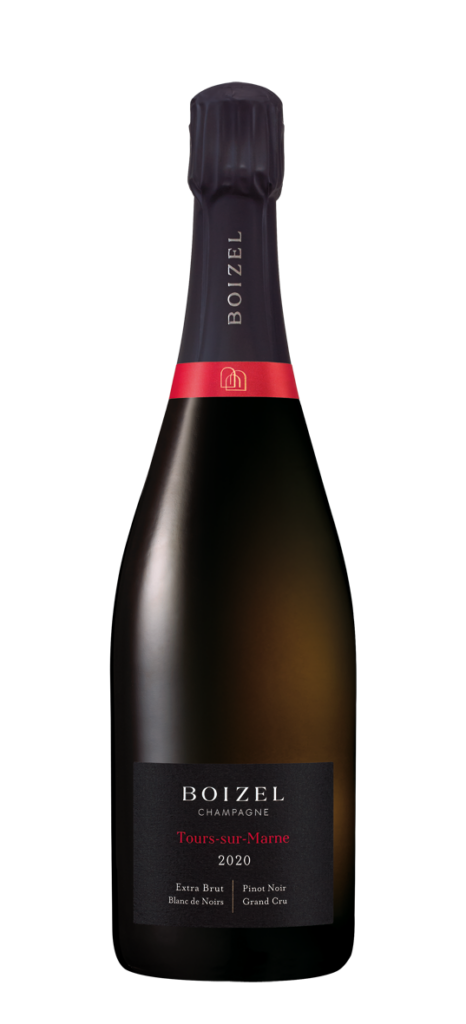
Technical Details Avize 2020 — Dosage: 3.5 g/l — Aging: five years on lees — Production: 4,000 bottles Tours-sur-Marne 2020 — 100% Pinot Noir, 100% stainless steel tanks — Terroir: 52 hectares, clay-limestone soil with a high chalk content, southeast exposure, elevation 90 to 180 meters — Production: 4,000 bottles
Tours-sur-Marne presents a different challenge. This 52-hectare Grand Cru—small by Champagne standards—is located at the junction of the Montagne de Reims and the Marne Valley, on the same hillside as Bouzy. Its Pinot Noir yields little. It shares with its neighbor a reputation for structure and aromatic intensity, built upon clay-limestone soil with a high chalk content. Whereas Avize is a terroir of linear tension, Tours-sur-Marne is a terroir of restrained density. Two contrasting styles, the same dosage of 3.5 g/l, five years of aging on lees under identical conditions—and two wines that Boizel’s technical dossier presents as deliberately dissimilar.
That is precisely where the collection’s cultural significance lies. It’s not simply a matter of adding two entries to a catalog. It’s about revealing, for the first time in a disassembled form, the geological map that has shaped every brut, every vintage, and every grand cuvée of the House for a century and a half. The Monocrus serve as a retrospective X-ray of the blends: by understanding Avize on its own, one understands what Avize contributed when it was blended into the cuvée.
Florent Roques-Boizel leads the estate as the sixth generation of his family to do so. The decision to launch these single-vineyard wines in 2025, and then to expand the lineup in 2026, does not appear to be a response to independent winegrowers. Rather, it feels like a revelation—that of a House which, after keeping its terroirs to itself for so long, has decided that the time has come to name them.
What blended Champagne has always been able to do is tell a story without revealing everything. A single-vineyard wine demands a different kind of candor.
Cette publication est également disponible en :

