
The Guimet Museum chooses to present ancient Korea not as a distant prelude, but as a fully formed civilization of art, power, and spirituality. The exhibition dedicated to the Kingdom of Silla thus offers more than just a collection of masterpieces: it is a way of bringing history into the present.
As part of the 140th anniversary of Franco-Korean diplomatic relations, this museum project also serves as an act of cultural translation.
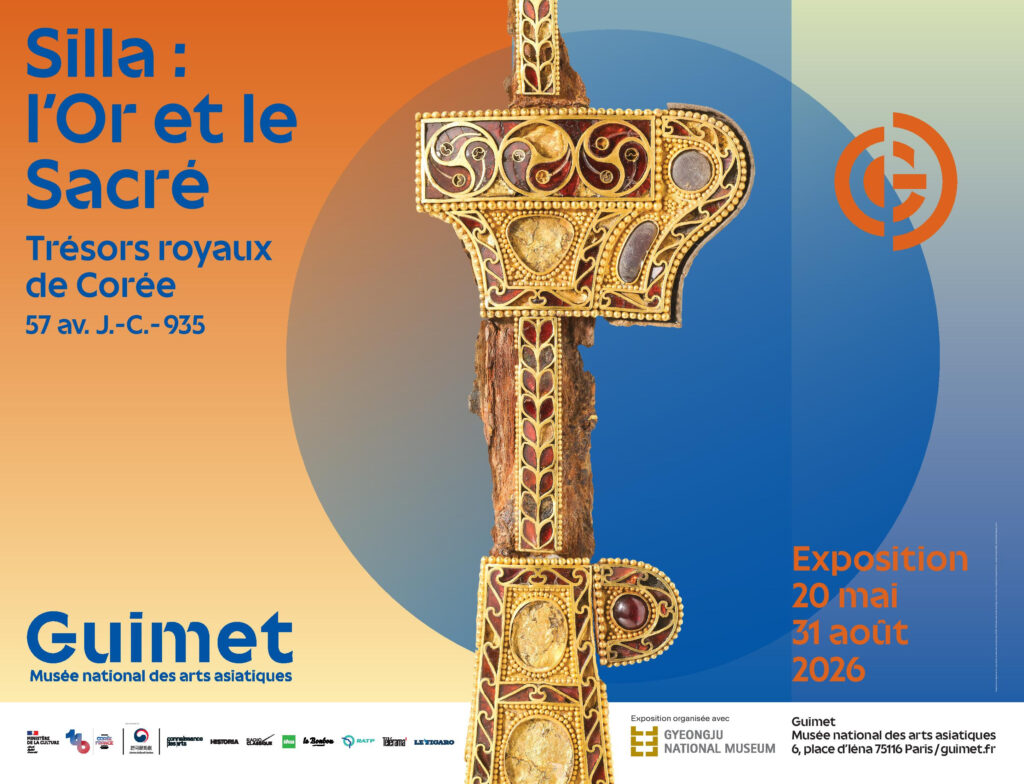
Presented for the first time in Europe, this exhibition dedicated to the Kingdom of Silla spans the period from 57 BCE to 935. Organized in collaboration with the Gyeongju National Museum and other South Korean and French institutions, it unfolds a narrative across five sections where archaeology, medieval chronicles, regional history, and symbols of power intersect. The Guimet Museum’s approach is pivotal: the aim is not merely to display rare artifacts, but to reconstruct a visual and spiritual system. Gold, jewelry, Buddhism, monumental tombs, and the landscape of Gyeongju all come together here to form a single language.
The strength of the exhibition lies in this shift in perspective. Silla is not presented as an abstract “golden age,” but as a civilization whose forms have survived through customs, narratives, and a conservation policy that remains active in contemporary Korea. The famous mountain tombs of Gyeongju, the temples, and the royal artifacts are therefore not merely matters of archaeology; they illustrate a continuity between territory, sovereignty, and the collective imagination. In this context, the presence of numerous national treasures on display for the first time outside South Korea takes on a genuine diplomatic significance.
The curatorial team includes Arnaud Bertrand, curator of the Korean and Ancient Chinese collections at the Guimet Museum; Yim Jaewan, senior curator at the Gyeongju National Museum; and Yun Seogyeong, assistant curator. This dual Franco-Korean expertise avoids the pitfall of viewing the works through an exotic or purely decorative lens. Instead, it allows the works to be situated within a history of the circulation of forms and beliefs. A fifth-century gold and jade crown or a Buddha dating from 692 are not presented here as isolated icons, but as clues to a broader symbolic order.
This historical interpretation is complemented by a contemporary installation by Seulgi Lee. Through February 2027, the artist is presenting two works on the museum’s façade and in its rotunda that continue the dialogue with Korea without illustrating it literally. *Dal*, on the facade, pays homage to the *moonsal* of traditional Korean architecture. *Dari*, in the observation deck, forms a network of 700 meters of suspended ribbons, weighted down by three bronze bells. This counterpoint avoids the effect of “heritage vitrification”: it reminds us that a civilization can also be understood through the forms it continues to inspire.
Here, the Guimet Museum is doing more than simply opening an exhibition. It is placing ancient Korea within the European intellectual landscape, at a time when cultural institutions are also called upon to play a delicate diplomatic role. The challenge now will be to see whether this in-depth exploration of Silla can permanently expand the space given to Korean visual histories within the grand narratives of Western museums.
Cette publication est également disponible en :

