
There are two ways to let time work its magic on a champagne. The first—the method Castelnau has been using for a hundred years—involves letting the wine rest on its lees—still, patient, developing complexity in the darkness of the Reims cellars. The second is its exact opposite: the solera method, inherited from Jerez, where the tank is never completely sealed. Each year, a portion of new wine is added, equal to the volume drawn off. Time does not stand still here—it flows.
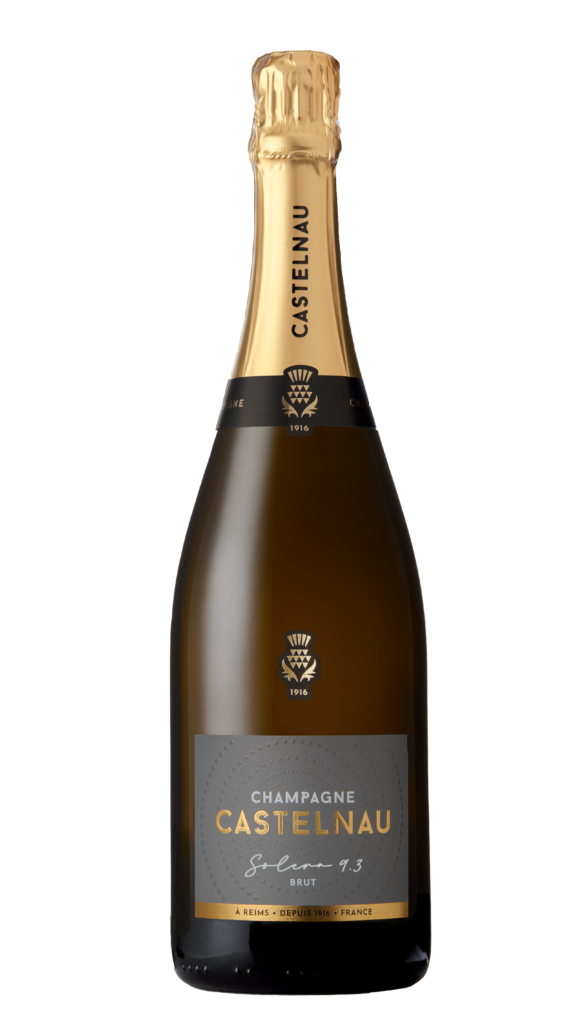
Solera 9.3 was born out of this deliberate contradiction. Launched with the 2009 vintage by Carine Bailleul, Cellar Master at Champagne Castelnau, and then rejuvenated starting with the 2017 bottling, it brings together several vintages, with 2018 being the most recent addition. Most of the wines that make up this blend have undergone eleven years of aging in tanks—not on the lees, as the House’s tradition requires, but through dynamic aging, in constant contact with successive generations.
Technical Detail: The solera system, also known as the perpetual reserve, operates on the principle of communicating vessels: the volume drawn off each year is exactly offset by an addition of young wine. The liquid in the tank is therefore never fixed to a single vintage—it is a moving average, a sum of vintages, the proportion of each of which mathematically decreases over time. The 2009 vintage, while still present in Solera 9.3, is now only present in trace amounts.
Carine Bailleul describes the result not as a cuvée but as a living archive: “Tasting it is like leafing through a family album featuring several generations. It’s like reconnecting with the elders—older vintages that evoke memories—alongside the younger generations—more recent, lively vintages. ” What she calls the “aromatic mille-feuille” stems less from the richness of the profile—notes of pineapple, cocoa, dried apricot, and white pepper—than from this layering of complexity, whose distinct layers remain perceptible on the palate.
What Solera 9.3 explores is a broader question that Castelnau poses to the entire appellation: To what extent can champagne be anything other than a snapshot in time? The traditional method locks in one vintage, sometimes two. The solera, on the other hand, rejects such limitations. It is less a cuvée than a process—an organism that sustains itself without ever repeating itself.
The fact that Castelnau is offering a box set this year that brings together all three iterations—9.1, 9.2, and 9.3—is part of a demonstrative approach. The three bottles are not successive vintages in the usual sense of the term; they represent different stages of the same process at different points in time. Perhaps this is a way of inviting the reader to see in the glass not a finished product, but a process still in the making.
Cette publication est également disponible en :

