
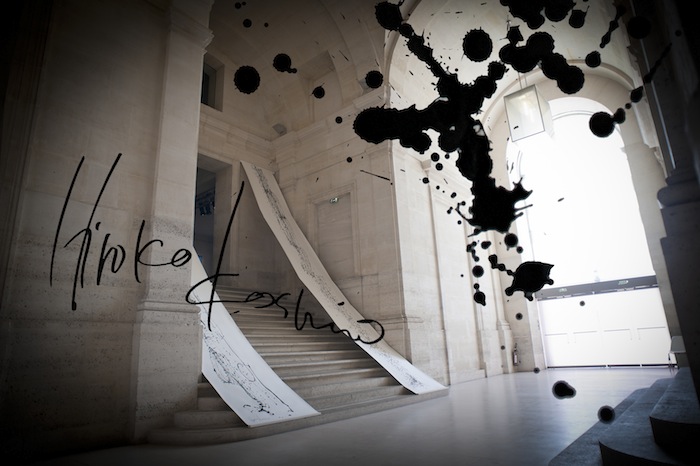
During the Haute-Couture presentations, from July 7 to 10, the Arts Décoratifs showcased the highly poetic work of Ms. Hiroko Koshino.
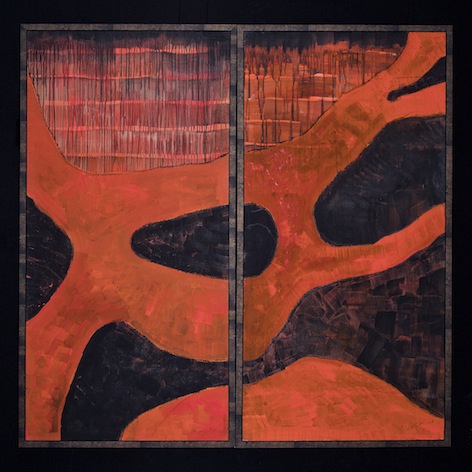
This artist – she undoubtedly deserves this appellation – has an incredible ability to enchant us. Sometimes a painter, sometimes a designer of clothing architecture, she knows how to create with a rare intensity.
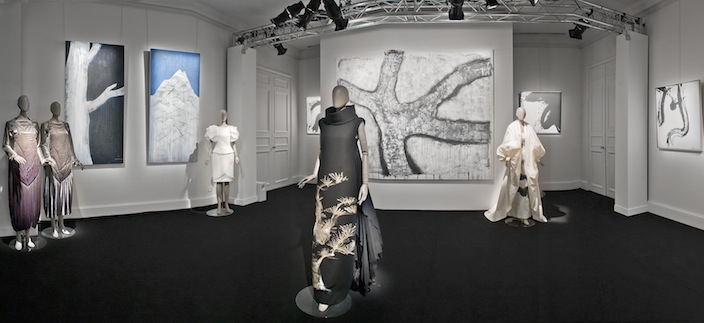
The exhibition parallels the two media, paintings and clothing, without revealing which inspired the other. But that’s not really the point. Ms. Hiroko Koshino’s discourse goes beyond that. She gives us a glimpse of her philosophy of existence, a Zen philosophy, an awakening to life and the world.
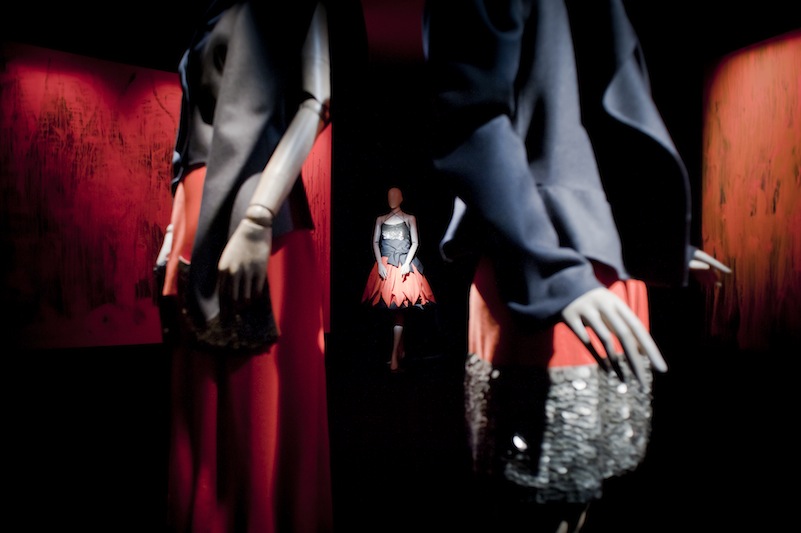
Interviewing him was an undeniable delight.
I How long have you felt drawn to art?
Since the age of three, traditional Japanese Kabuki and the beauty of color have heightened my sense of aesthetics.
The contemplation of artistic scenes has always been present in my life. What’s more, my family has always been involved with art, and even more so with traditional Japanese art. My father was a painter, my grandfather a tailor. He made kimonos.
II Did your personal interest in Kabuki inspire you to create for this art form and contribute to its development?
I’ve also designed costumes for Kabuki theater and ballets. However, while I really enjoy getting involved in this type of project, it requires a great deal of time, which I don’t have at the moment. I’m planning to work on this again at a later date.
III You have an exceptional artistic quality in both painting and clothing design. You must be very demanding when designing each piece of clothing. Given the connivance with sculpture, are these made from a volume pattern?
We certainly do. It goes much further than that. Expressing three-dimensionality is a priority for me. As soon as a piece is conceived, right from the drawing stage, I consider volume and three dimensions.
IV The need for a single piece must have crossed your mind, …
That much is obvious.
V Zen is becoming an ever-present source of inspiration in fashion. At the last prêt à porter show in Paris last March, many designers drew inspiration from it to create patterns and volumes in their own right. I’m thinking of designers such as Lie Sang Bong, as well as others.
For some, this use doesn’t seem to be dictated by an inner need, unlike you, but rather reflects trend books.
What do you think of this, in my eyes, abusive use of Zen?
I love the beauty of Zen philosophy. It’s about subtraction, the elimination of everything that isn’t necessary.
It should not be used for overly commercial marketing purposes.
VII In your approach, I perceive something quite different. When I catch a glimpse of the pieces presented at Arts Décoratifs, I get the feeling that you’ve managed to impart a direct spirituality to each creation.
However, in order to captivate the individual, the object has to ‘tickle’ the soul. This particular vibration is necessary to touch the public. The principle applies to both paintings and clothing. Both stem from the same spirituality. The nuance lies between two- and three-dimensionality.
VIII Do you have a particular approach to the choice of textiles?
I choose the textiles and then apply the designs.
I love to travel, and during a trip I can create, elaborate shapes and colors. I use textiles as a support. New textile technologies captivate me. I’m by no means limited to traditional fabric. I love experimenting.
I paint on the garment and it becomes a painting to buy. Painting on clothing is an obvious choice for me.
IX So, if you occasionally use an organic fabric, it’s not a priority for you. Do you prefer a creative approach to choosing textiles?
In fact, some new textiles can be used for surprising creations that we shouldn’t do without. They make it possible to envisage highly innovative creations.
X Paris seems like the ideal city for you. I know you think it’s the best place for creation, the link between art and fashion. What do you think of London, New York, ?
I appreciate the open-mindedness of Paris. In Paris, many people understand my
artistic approach. In Japan, much less so.
London and New York would undoubtedly be interesting cities for me and my creations. In fact, I’m planning an exhibition in London in the near future, … New York, why not ?
XI What do you think of the industrialization of fashion and the omnipresence of design offices? I’m thinking of certain houses in the luxury industry? Don’t you have the impression that this inhibits people’s elegance, their ability to elaborate and create their own style?
Fashion represents lifestyle, especially for women. As far as I’m concerned, I don’t want my lifestyle to be influenced by marketing.
XII At the same time, craftsmanship in Paris seems to be losing its place. It is no longer omnipresent. It’s not as respected or encouraged as it used to be. What’s your view?
Many societies live without the need for craftsmanship. They forget this primordial, essential aspect.
In Japan, this phenomenon also exists. Paris still seems privileged in this respect.
The designers themselves should commit to this craft, declaring it indispensable.
XIII Do you think the government should support them? Should craftsmanship and know-how be considered cultural heritage?
Each to his own role. I’m not against the idea. Politics should support, encourage, invest more at this level. They don’t have to understand, .
XIV Not understand or, .
Not understand or they do not want, ..
Cette publication est également disponible en :

