
There is a difference between asking artificial intelligence for an answer and assigning it a task. It is precisely in this distinction that agent-based AI begins to become interesting: no longer as a conversational interface, but as a working system.
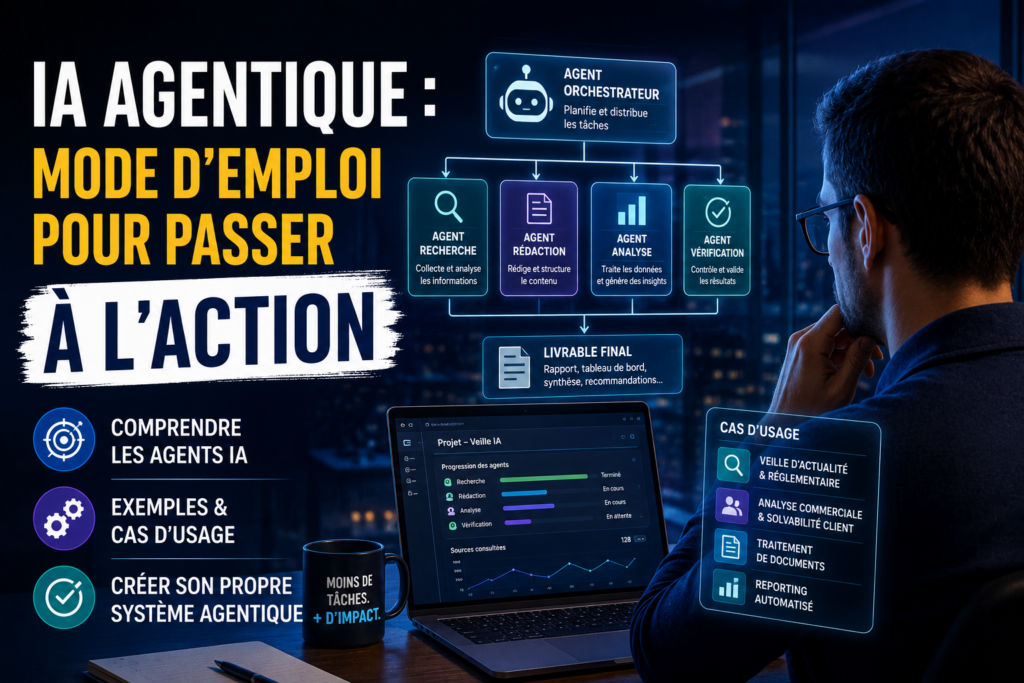
For a long time, the use of generative AI boiled down to a fairly simple scenario: a user enters a prompt, and the model produces text, a summary, a translation, or sometimes code. The interaction remains one-to-one: one question, one answer. Agent-based systems shift this paradigm. They introduce an orchestration model: a complex task is broken down, distributed, and executed by several specialized agents, then consolidated into a deliverable.
The promise, therefore, is not to “think for” the user. It is more concrete: to take on time-consuming, repetitive, research-based, administrative, or analytical tasks that require a significant amount of human time but often yield limited value.
From Assistant to Digital Worker
This distinction is essential. A language model remains probabilistic: it generates the most plausible sequence based on a given context. An agent-based system, on the other hand, adds an action loop. It can search, compare, extract, organize, verify, and try again. The value lies not only in the quality of the response, but in the ability to carry out a sequence of operations.
A sourced industry report, a weekly market watch, a prospect database, a creditworthiness analysis, a dashboard based on handwritten forms: these use cases have little in common from a business perspective, but they share the same underlying logic. They all require collecting information, structuring it, validating it, and then producing a usable result.
This is where business process automation becomes less flashy but much more serious.
The real issue: defining the problem
Perhaps the most useful lesson from this approach can be summed up in a single sentence: you can’t find the solution to a problem you haven’t defined. Many use cases are disappointing because the initial request is vague. Agent-based modeling does not eliminate this need for precision; it amplifies it.
A good system starts with a clear framework: the deliverable’s objective, authorized sources, time period covered, level of detail, expected format, and validation criteria. The more complex the task, the richer the context must be. Paradoxically, speaking into the tool can be more effective than writing a few lines: a lengthy dictation allows you to articulate your intent, constraints, nuances, and trade-offs.
A helpful agent isn’t the one who responds quickly. It’s the one who asks the right questions before getting started.
The first truly profitable cases
The most compelling use cases aren’t the most futuristic ones. They often involve existing functions: monitoring, business analysis, reporting, document processing, and data validation.
A monitoring specialist can monitor several sectors each week, filter sources, generate a report, and send it via email. A sales representative can analyze a prospect using public sources, identify weak signals, and assess the level of risk. An OCR system can convert hundreds of handwritten forms into an actionable dashboard.
In these cases, the benefit isn’t just time savings. It’s a new ability to handle volumes that the team wouldn’t have been able to manage, or would have processed too late.
The Details
One example presented during the demonstration involved 300 handwritten forms processed each month. The task, which previously took eight days to complete manually, was reduced to about thirty minutes after developing a system that combines OCR, Excel structuring, scoring, verbatim data, and data visualization. The key point is not automation alone, but the transformation of raw, hard-to-use data into a decision-making tool.
What companies need to address
Agent-based systems require stricter governance than conversational AI. The more an agent acts, the more it must be constrained. Authorized sources, data access, human validation, logging, login permissions, and privacy: autonomy without safeguards quickly becomes an operational risk.
For a fashion house, media outlet, or consulting firm, the question is therefore not “which tool should we choose?” but “which tasks are worth entrusting to an agent-based system?” The answer is rarely found in grand statements. It lies in the daily irritants: spreadsheets to consolidate, emails to sort, information to verify, reports to produce, and leads to qualify.
Agent-based AI does not yet replace an organization. Above all, it reveals where the organization is wasting time.
The next step won’t be to multiply the number of agents the way we pile up software subscriptions. It will involve putting together a small, specialized, controlled digital team aligned with the real business challenges. Not an autonomous army, but a discreet workshop.
Perhaps this is where the mature use of artificial intelligence begins: when it stops impressing and starts doing the job.
Cette publication est également disponible en :

