
Among the hundreds of AI demonstrations showcased at VivaTech 2026, one of the most significant might just fit on the tip of your nose.
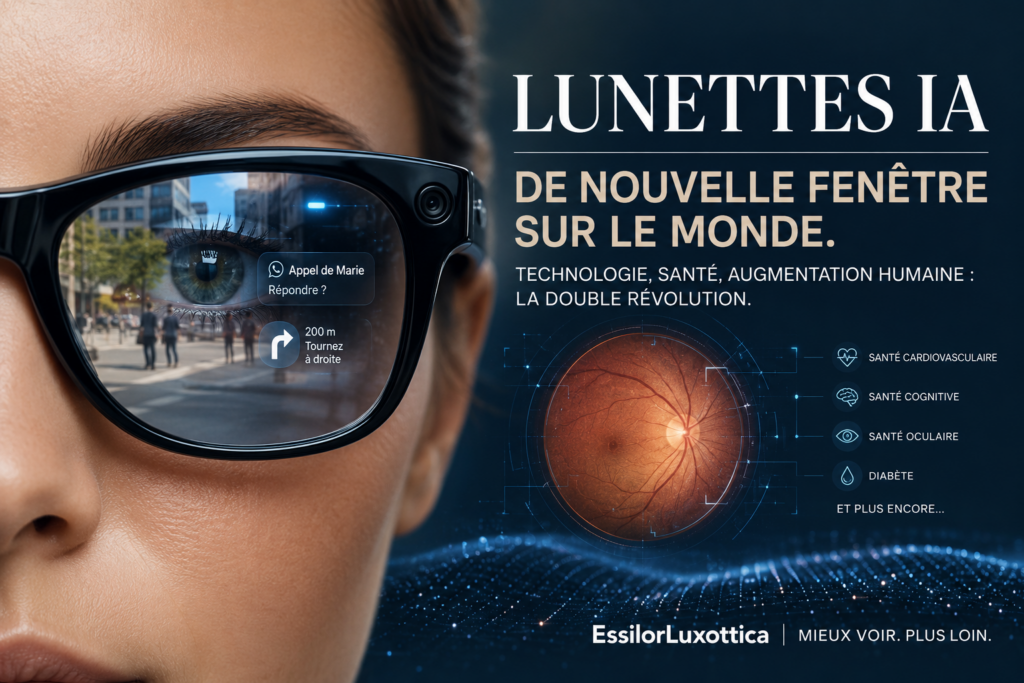
In ten minutes, EssilorLuxottica’s executives outlined a transformation that goes far beyond the optical industry: eyeglasses are becoming both a permanent digital interface and a tool for preventive medicine.
In other words, an object capable of looking both outward and inward.
The technological device that managed to disappear
The recent history of tech is littered with devices that no one really wanted to wear. Bulky headsets, watches with limited uses, and connected gadgets that were quickly forgotten in a drawer.
Smart glasses are taking a different path.
According to figures presented at the conference, more than seven million pairs of AI glasses developed in collaboration with Meta have already been distributed worldwide. This figure is less a testament to technological prowess than to the success of the product in practice.
The reason is simple: unlike most connected devices, glasses don’t require any change in behavior.
Take a photo without taking out your phone. Answer a call. Listen to music. Ask a voice assistant a question without a screen or keyboard.
Innovation isn’t about the function. It’s about the disappearance of the interface.
This is probably the first major lesson to be learned from this new generation of AI devices: technology wins when it stops drawing attention to itself.
EssilorLuxottica’s stated goal is, in fact, clear: to make AI ubiquitous yet invisible, always available but never intrusive.
A form of technological luxury based not on the accumulation of features, but on their elimination.
When Glasses Become a Cognitive Extension
The most interesting phenomenon, however, is not the one imagined by the engineers.
As is often the case with platform technologies, new uses emerge from the users themselves.
The examples cited during the conference are telling.
People with visual impairments are already using these glasses to identify clothing, match colors, or find their way around a supermarket.
Others use them as a kind of enhanced memory, capable of locating a car that was parked several hours earlier.
We are witnessing the gradual emergence of a new category of digital assistance.
After the smartphone, which outsourced our memory, and then the cloud, which outsourced our knowledge, AI glasses could outsource part of our perception.
The question is no longer just what we see.
It becomes: What can we understand from what our glasses see?
Details
The partnerships announced between EssilorLuxottica, Meta, and Applied Materials are now focused on developing lenses capable of directly integrating augmented reality display elements.
The goal is no longer simply to capture the environment, but to overlay it with contextual information in real time.
The historic promise of AR—long held back by the weight, design, or battery life of the devices—is gradually taking on a socially acceptable form: a pair of ordinary glasses.
The Retina: The Human Body’s New Dashboard
The second revolution mentioned on stage is potentially even more significant.
The eye is the only organ that allows for direct observation of nerve and blood vessel structures without invasive procedures.
This anatomical feature is gradually transforming ophthalmology into a strategic discipline for predictive medicine.
The latest generations of retinal imaging technology now achieve remarkable levels of accuracy.
The OCT (Optical Coherence Tomography) systems presented by the group make it possible to visualize certain structures with a resolution of two microns.
At this scale, the analysis is no longer limited to the organ level.
It extends down to the tissue, or even to the cell.
When combined with artificial intelligence, these images become a significant source of biomarkers.
Glaucoma, retinal degeneration, diabetes, cardiovascular disease, or neurodegenerative disorders: variations that are invisible to a clinician can be statistically detected by algorithms trained on millions of images.
The idea is particularly striking.
Examine a photograph of the retina today, then a second one six months later, in order to identify microscopic changes that signal a disease several years before the first symptoms appear.
The medicine is no longer working.
She’s planning ahead.
From Curative Medicine to Predictive Maintenance
The parallel drawn during the conference with the aerospace industry is revealing.
For quite some time now, airplanes have no longer been repaired only when they break down. Instead, they undergo predictive maintenance based on thousands of sensors.
The human body might follow a similar path.
The promise isn’t just clinical.
It’s also economical.
With healthcare systems under strain, the ability to triage patients earlier, identify priority cases, and detect conditions before they worsen represents a paradigm shift.
Artificial intelligence does not replace doctors.
It serves as an additional layer of early detection.
A filter capable of flagging what warrants human attention.
The Eye: The Future Gateway to AI
Behind the product announcements, a more fundamental question arises.
For twenty years, the smartphone has been the dominant interface between humans and the digital world.
This dominance is based on a contradiction: to access the digital world, you have to look away from the real world.
AI glasses turn this logic on its head.
They place the interface exactly where our attention is already focused.
Just a few centimeters from our eyes, our ears, and our voice.
This proximity gives them a considerable structural advantage.
They see what we see.
They hear what we hear.
Understand the context in which we operate.
For those in the AI field, it’s a technological dream.
For companies in the optical industry, this is a historic opportunity.
For users, this may mark the beginning of a new relationship with technology: less visible, more contextual, and more integrated into daily life.
So perhaps the real question is no longer whether glasses will become smart.
The question is: to what extent will we allow them to know us better than we know ourselves?
Cette publication est également disponible en :

