
At Minerva, the story of time is not told solely by the hands. It is also told by the way the hand interacts with the watch. A crown that is pulled out, a push-button that is pressed, a bezel held between two fingers: each interface speaks to the era in which it was created. With the Minerva The Unveiled Crownless and the new Minerva The Unveiled Secret Limited Editions 18 and 58, the Villeret Manufacture pursues the same idea: shifting the gaze, but also shifting the gesture.
The first removes the crown. The second reduces the diameter of the inverted chronograph. In both cases, Minerva is not pursuing complications for their own sake. It is exploring a rarer subject: the relationship between mechanical architecture, readability, and usability.
The Minerva The Unveiled Crownless is part of a specific historical lineage. In 1927, Minerva developed a military watch featuring a bezel-activated function, designed to allow pilots wearing thick gloves to adjust an internal timing ring intended for the stages of a flight plan. Nearly a century later, the Manufacture has revived this peripheral activation principle, but applied it to the watch’s fundamental functions: manual winding and time setting. The fluted bezel is no longer merely a visual signature; it has become a control mechanism.
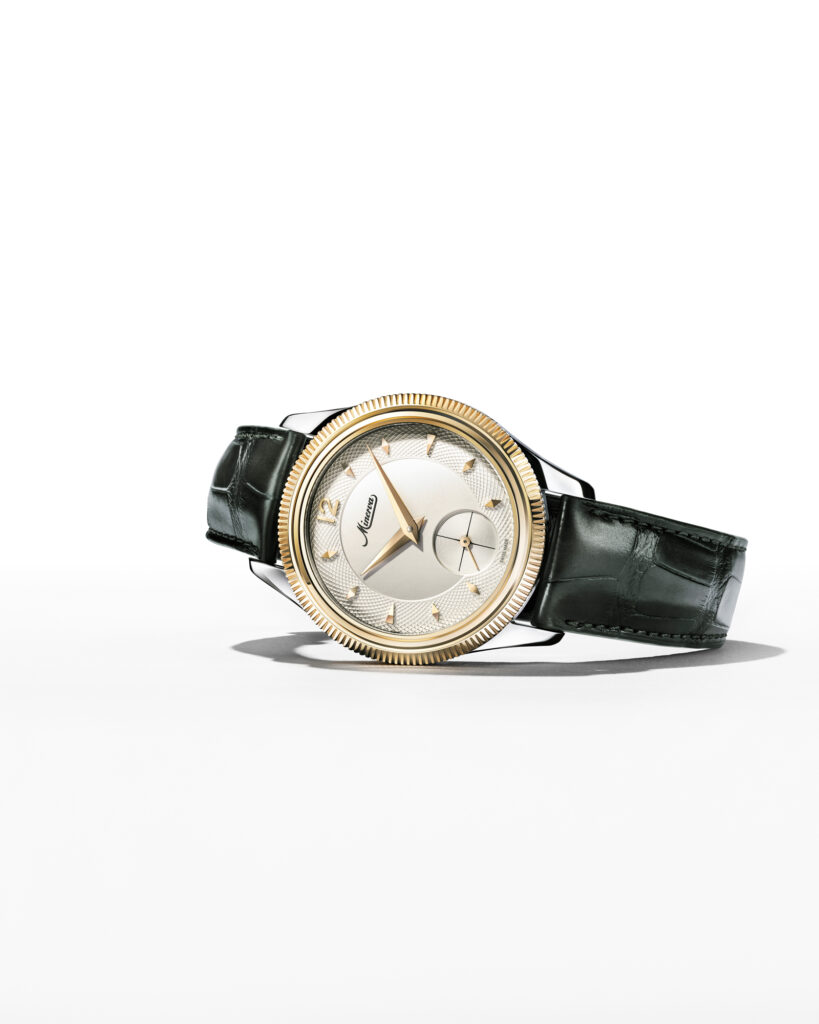
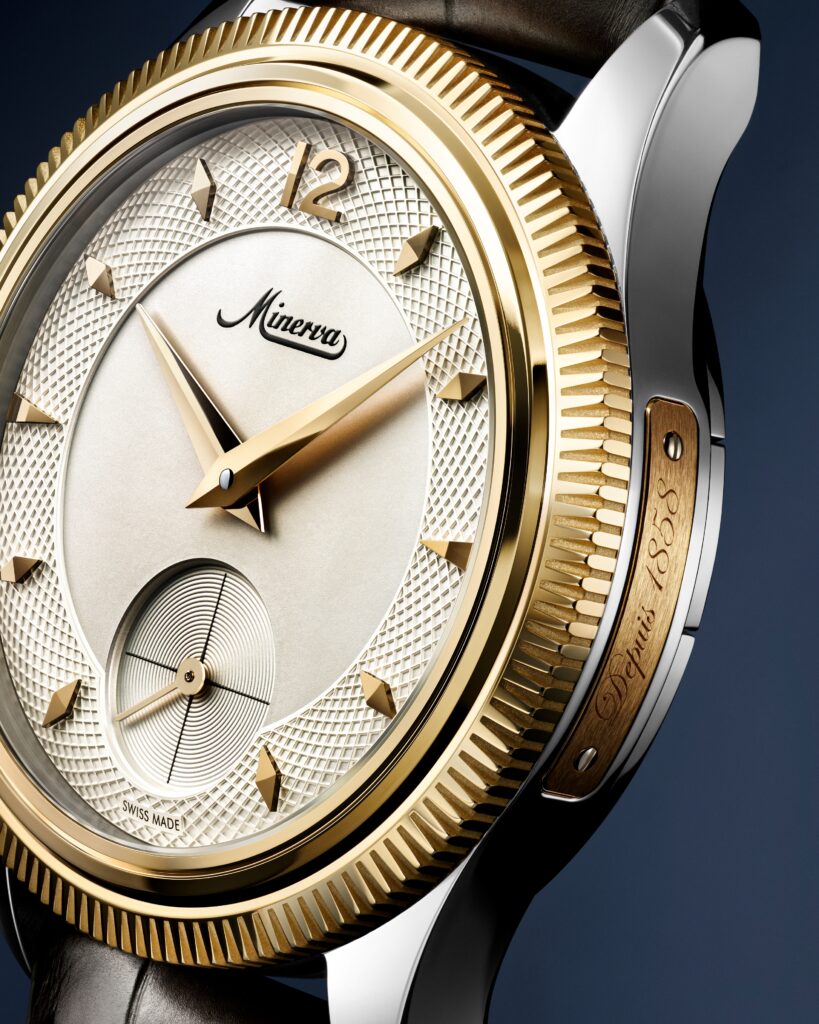

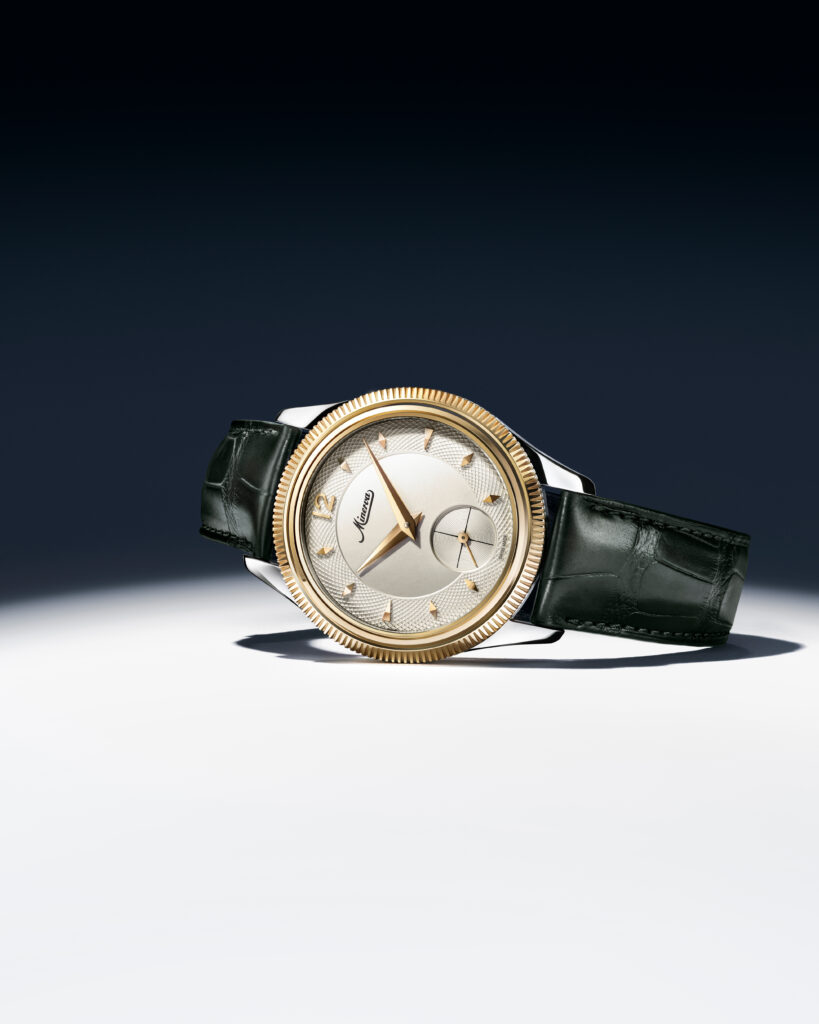
To create this three-hand watch without a crown, Minerva developed a brand-new caliber, the M15.08. The movement, manufactured in-house in Villeret, is a hand-wound time-only caliber with a small seconds sub-dial. It comprises 139 components, nineteen jewels, a power reserve of approximately eighty hours, and a traditional frequency of 18,000 vibrations per hour, or 2.5 Hz. The choice of this frequency—slower than that of many contemporary movements—places the timepiece within a more traditional temporal framework: that of a mechanical movement that one listens to almost as much as one reads it.
The mechanism is more subtle than it appears. At the 3 o’clock position on the case back, a lever integrated into the steel bezel allows the bezel function to be switched between winding and time setting. The lever remains discreet enough to preserve the case’s balance. The absence of a crown gives the watch an unusual symmetry, enhanced by its 41.5 mm diameter, stainless steel case, 18-karat rose gold bezel, and dark green alligator strap with a semi-matte finish.
The dial evokes the 1950s. An opaline center, a guilloché outer ring, faceted hour markers, a small seconds sub-dial at six o’clock, the Arabic numeral twelve, and the vintage Minerva logo come together to form a dial that does not seek to overshadow the technical innovation. Rather, it balances it. This is perhaps the most interesting aspect of this Crownless: while the watch could easily serve as a manifesto of engineering, it instead embraces the aesthetic of a dress watch—almost classic in style—where innovation is revealed through use.
The new Minerva The Unveiled Secret Limited Editions 18 and 58 explore a different concept: the inverted movement. Presented in a 39-mm case, this new size required a redesign of the openworked single-push-piece chronograph. Minerva has therefore developed a patented caliber, the M13.26, designed for this more compact architecture. The inverted movement positions the gear train toward the front of the watch, behind a skeletonized dial reduced to an outer ring and three open rings. The small seconds sub-dial is positioned at 9 o’clock, the 30-minute counter at 3 o’clock, and the hours and minutes in the center, alongside the chronograph hand.
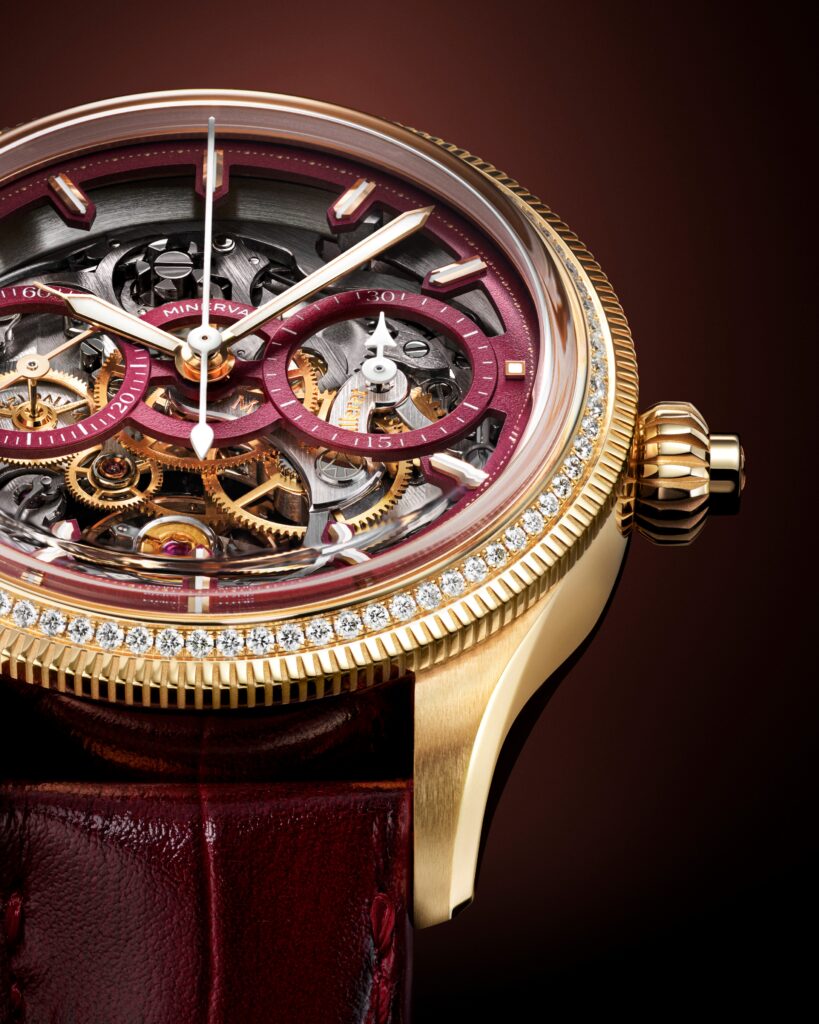
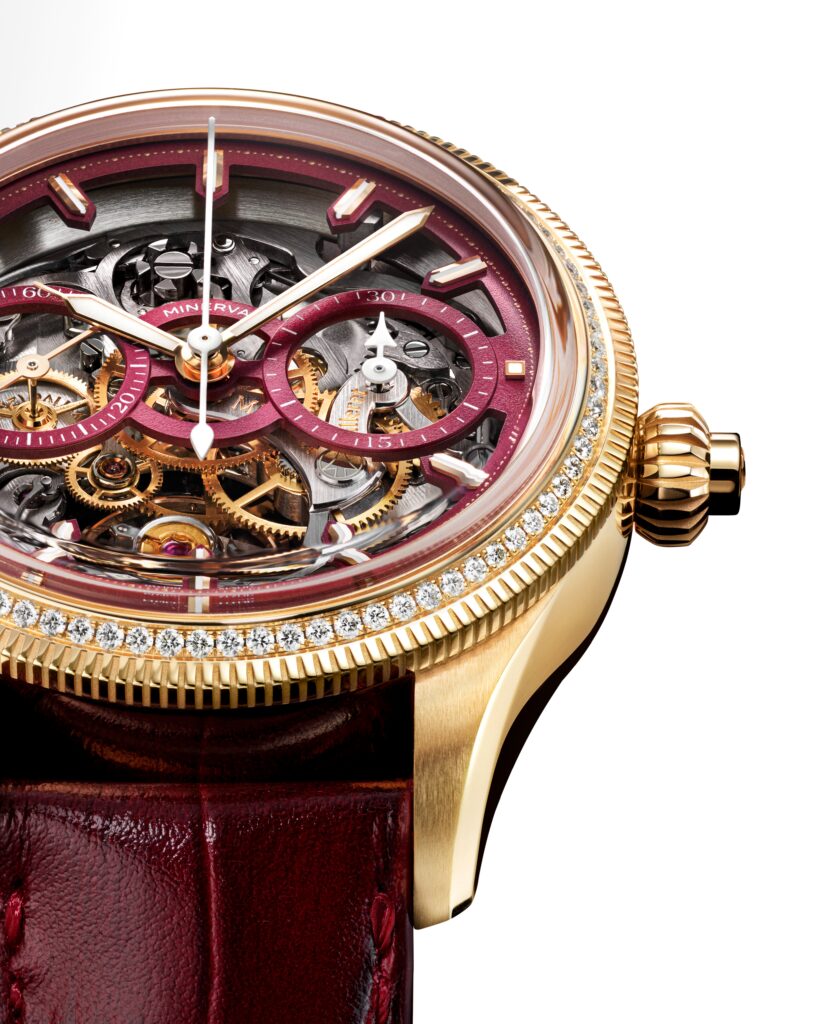
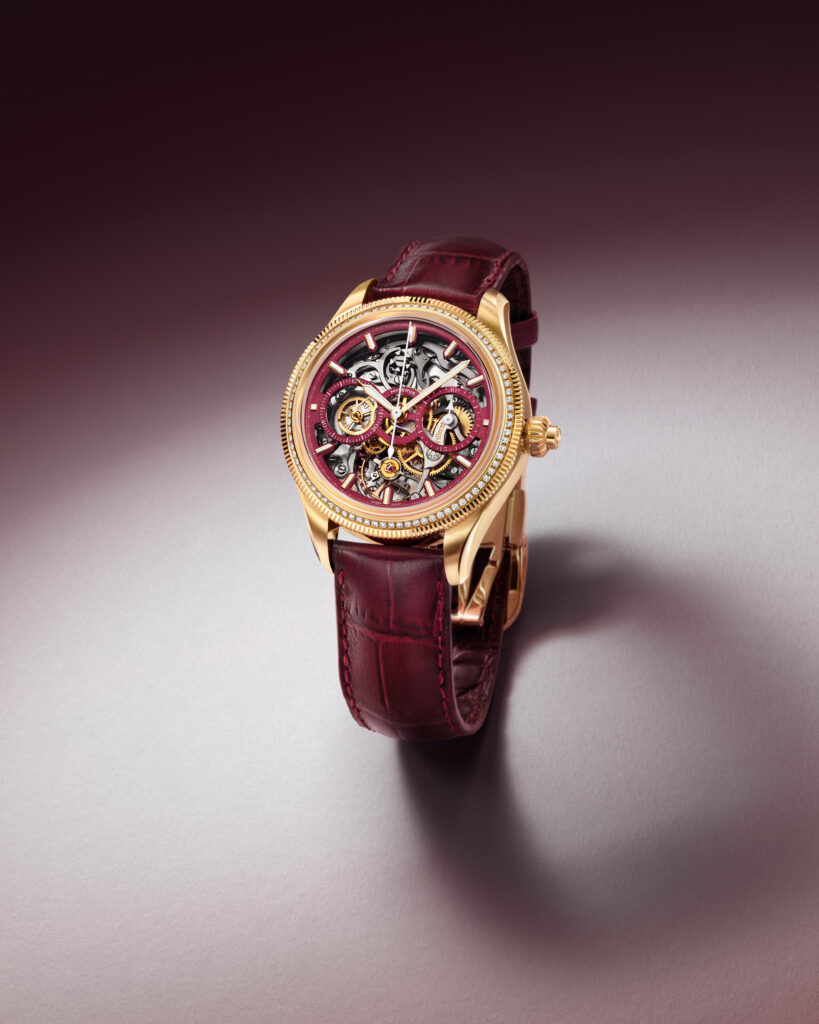
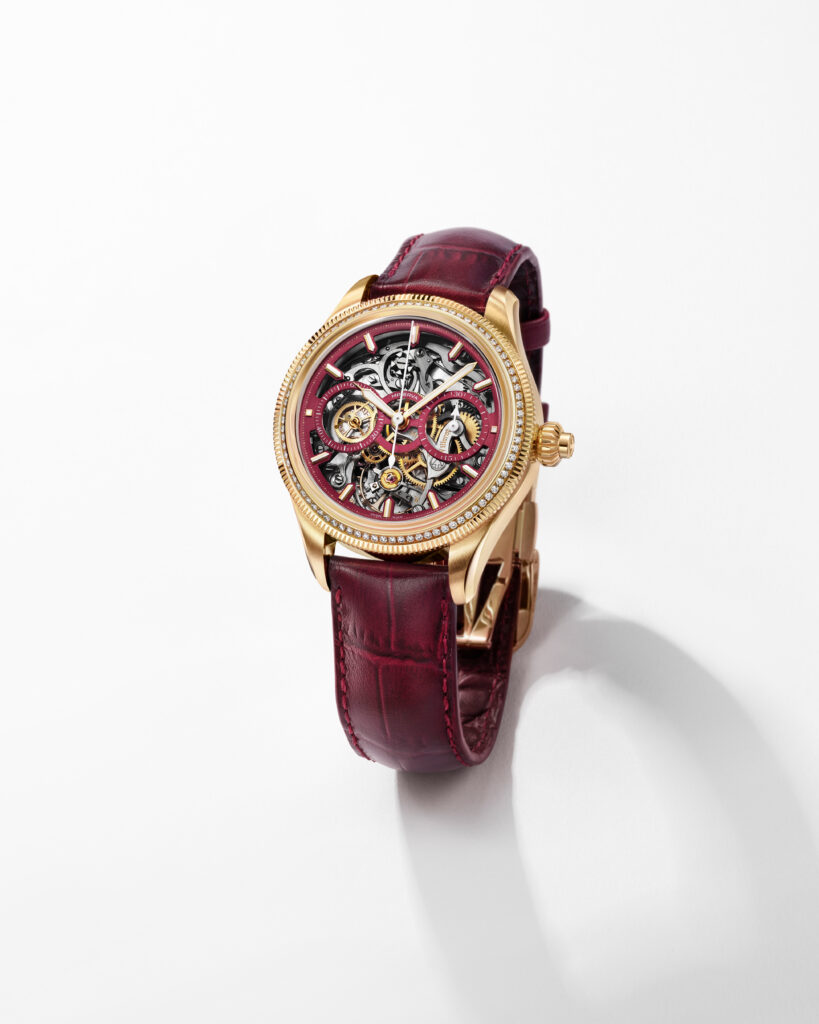
This reduction in size is not merely an aesthetic adjustment. An inverted chronograph must overcome a specific challenge: making the internal components visible while maintaining the natural direction of rotation of the hands. The first version of this design was unveiled in 2022 in a 43-mm case; the transition to 39 mm required a new, more compact movement, comprising 259 components and featuring twenty-five jewels. The M13.26 remains a hand-wound movement, featuring a column wheel, horizontal clutch, Phillips-curve balance spring, a power reserve of approximately sixty hours, and a frequency of 18,000 vibrations per hour.
Wine-red serves as the defining element of these two limited editions. It colors the skeletonized dial and the semi-matte alligator strap, without obscuring Minerva’s hallmarks: the arrow at 1 o’clock, the V-shaped chronograph bridge at 4 o’clock, and the visible balance wheel at 6 o’clock. The 18-karat rose gold edition is limited to eighteen pieces and features a bezel set with 84 brilliant-cut diamonds, totaling approximately 0.62 carats. The two-tone edition, limited to 58 pieces, combines a stainless steel case with a fluted bezel in 18-karat rose gold.
These choices convey two things. First, Minerva views small-batch production as a space for experimentation, not merely as a marker of rarity. Second, the Manufacture continues to treat the chronograph as a work of architecture to be admired. In contemporary watchmaking, skeletonization can quickly become merely decorative. Here, it serves a more precise purpose: to reveal the inner workings of a traditional movement, with its bridges, levers, balance wheel, and tension points.
The connection to Villeret remains central. The original Minerva Manufacture was founded in 1858 in this village in the Bernese Jura, where its historic workshops remain linked to Montblanc’s fine watchmaking. Several watchmaking sources highlight Minerva’s importance in the history of chronographs, notably with the development of its first chronograph movement in 1908, followed by a long-standing specialization in mechanical measuring instruments.
This legacy is not merely referenced—it is engraved. The casebacks of The Unveiled Secret watches feature a laser engraving of the Minerva Manufacture in Villeret, along with the RFV logo—Robert Frères Villeret—accompanied by the Minerva arrow. The Crownless also reflects this regional theme in its natural walnut case, featuring an engraved steel plate and the village coat of arms on the clasp. The detail might seem ceremonial; above all, it serves as a reminder that, at Minerva, a watch is still conceived as an object rooted in a specific place.
With the Crownless, the bezel becomes the starting point of the gesture. With The Unveiled Secret, the dial becomes a window onto the chronograph. These pieces do not tell the same story, but they share a common principle: not to view heritage as a static image. Minerva treats it as a living mechanism that can be turned over, scaled down, opened up, or controlled in new ways. Here, time is not merely displayed; it invites exploration from the side, through the bezel, and via the void left by the absence of a crown.
Cette publication est également disponible en :

