
There are fragrances that belong less to a season than to a style. Shalimar is one of them. Created in 1925 by Jacques Guerlain, it introduced a new way of composing amber into modern perfumery: bergamot at the top, a floral heart, and vanilla and tonka bean at the base, with that signature style unique to Maison Guerlain known as the Guerlinade. For its centennial, the House has chosen not to engage in a static commemoration. Instead, it returns to the essence of the matter—to one of the fundamental motifs of its palette: the rose.
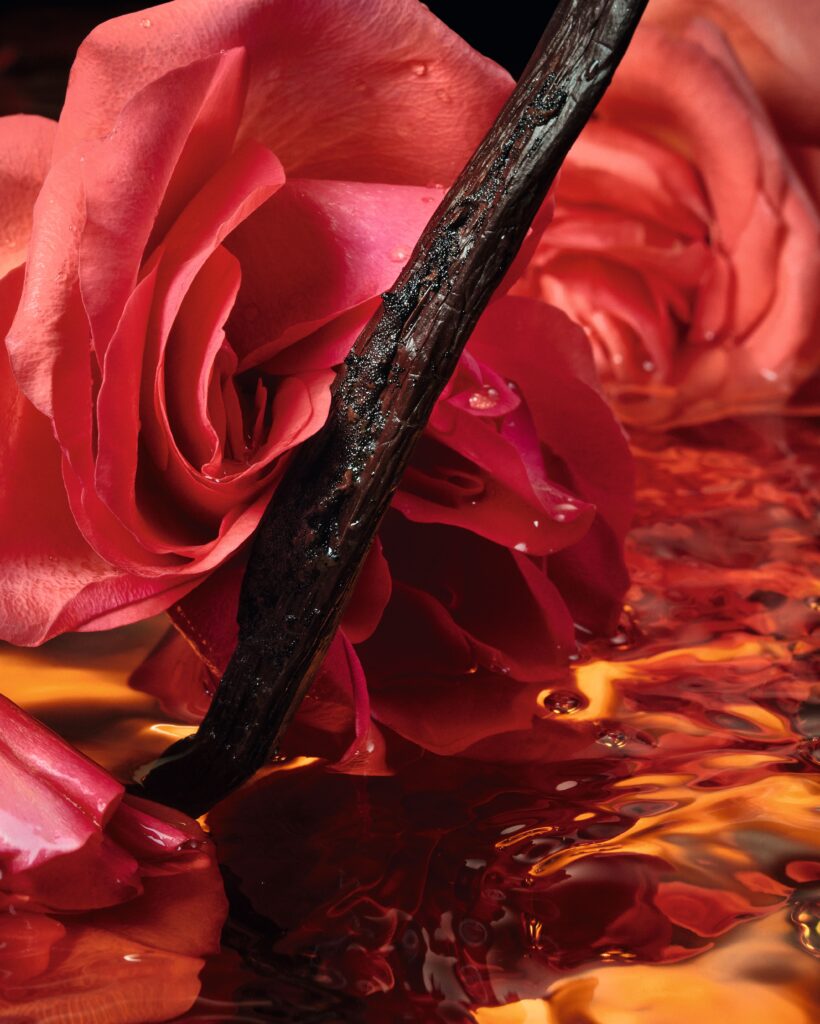
Shalimar Millésime Rose is part of this family of variations that do not seek to replace the original, but rather to shift its focus ever so slightly. Following vanilla, tonka bean, iris, and jasmine, Guerlain now turns its attention to the rose—not as a romantic backdrop, but as a multifaceted raw material. The press kit highlights three elements: Centifolia rose absolute from Grasse, Damascena rose essence, and rose water. The first brings honeyed accents, the second fruity and almond-like nuances, and the third a more aqueous freshness, almost resting on the skin like floral condensation.
This choice is not insignificant. In Shalimar, the rose is already part of the heart of the composition, alongside iris and jasmine. Making it the focal point brings to the fore a structure that is usually blended into the accord. Delphine Jelk, Creative Director of Guerlain Fragrances and Perfumer, articulates the intention clearly: “The rose, queen of flowers and of the Guerlinade, is my favorite flower. For Shalimar Millésime Rose, I wanted to reveal all its facets. ” Here, the quote serves less as a promise than as a method: to illuminate a flower that is already present, to bring it out of the amber-hued shadows without dissolving the original composition.
The risk with a floral variation of a fragrance so steeped in history would be to smooth out the composition, making it more immediately appealing. Guerlain seems to have taken the opposite approach: the rose isn’t simply layered over Shalimar; it’s absorbed by its opulence. The dossier mentions an accord that connoisseurs call “opanine,” composed notably of vanilla, opoponax, and patchouli. Incense, already present in Shalimar’s signature scent, is intensified in this variation. This is where the rose becomes truly compelling: not as an isolated fresh flower, but as a flower infused with resin, warmth, and an oriental depth.
Another key aspect of this edition is its botanical origin. Guerlain states that it has formed a long-term partnership with Le Mas des Sources, an estate located in the Grasse region that specializes in perfume plants. The family-run farm organically cultivates the Centifolia rose used in the composition of Shalimar and other fragrances from the House. In an industry where the traceability of raw materials is becoming as much a matter of creativity as it is of responsibility, this detail matters. It anchors the fragrance in a specific place, far from the usual abstraction of olfactory language.
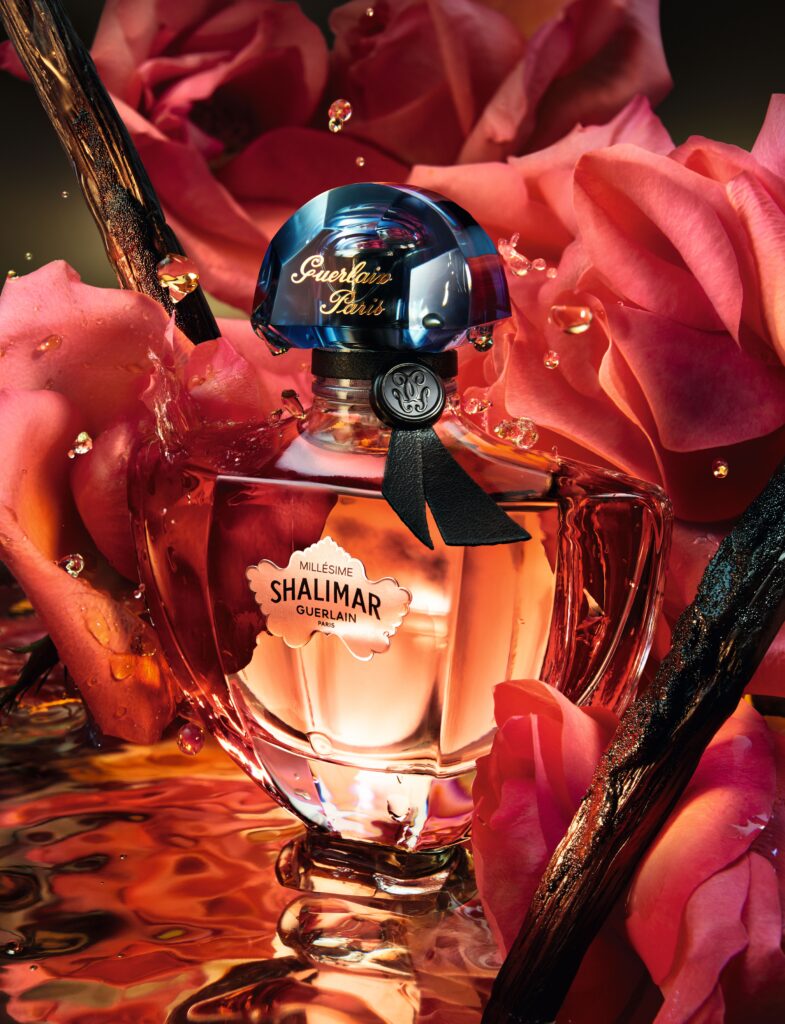
The bottle continues this heritage-inspired theme. Originally designed by Raymond Guerlain, the Shalimar bottle was unveiled in 1925 at the International Exhibition of Decorative Arts in Paris. Guerlain notes that its curves are inspired by the ponds in the Shalimar gardens and that its blue fan-shaped cap evokes the water gushing from those gardens. For Millésime Rose, the so-called “bat” label takes on a rosy hue with golden accents, while the neck retains the black leather tie distinctive of the Millésime collection.
The story of Shalimar remains linked to Mughal India, to Emperor Shah Jahan, to Mumtaz Mahal, to the Taj Mahal, and to the gardens of Lahore. But this oft-repeated story is no longer enough on its own. What keeps Shalimar relevant today is its ability to embrace successive interpretations without losing its essence. Guerlain officially notes that the fragrance was created in 1925 by Jacques Guerlain and is considered one of the first amber fragrances in the history of perfumery.
With Shalimar Millésime Rose, the House is not seeking to abruptly modernize a classic. Instead, it takes a more delicate approach: shifting the focus. In the original, the rose contributed to the sensuality of the heart note. Here, it becomes the prism through which amber is reinterpreted. A flower in the warmth, rather than a flower in the air. A variation that reminds us that great fragrances never go out of style when they allow themselves to be viewed in a new light.
Cette publication est également disponible en :

