
JAEGER-LECOULTRE SUPPORTS THE EXHIBITION “THE SUPERMARKET OF IMAGESPRESENTED BY THE JEU DE PAUME IN PARIS
A privileged partner of the Jeu de Paume since 2006, Jaeger-LeCoultre invites visitors to discover the exhibition Le Supermarché des images, a powerful reflection on the economy of images – or iconomy – from February 11, 2020 in Paris. As a creative center dedicated to images and contemporary photography, the Jeu de Paume is committed to a cross-disciplinary approach to the study of visual culture. Thanks in particular to the support of the Grande Maison, a talented collective has been able to confront its vision with the hyper-production of images characteristic of our society, and to question the issues of circulation and management that ensue. An exhibition in tune with the times.
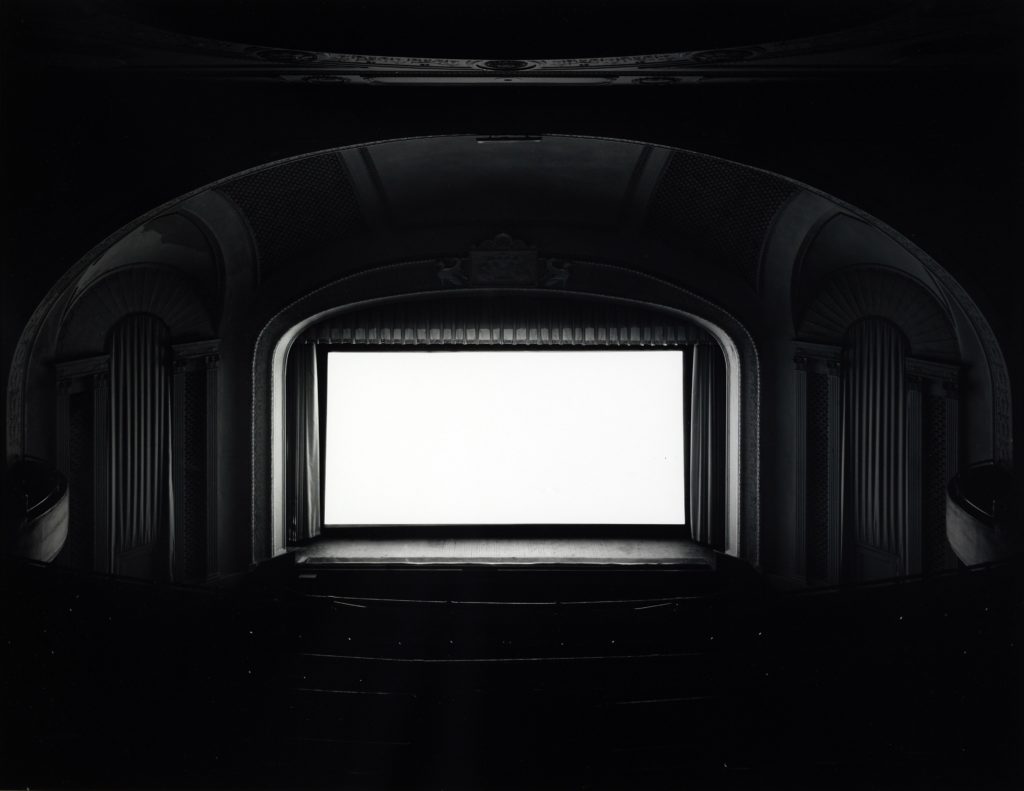
Hiroshi Sugimoto, Theaters
A collective of talents at work
As part of its partnership with Jaeger-LeCoultre, Jaeger-LeCoultre wishes to support an artistic impetus and participate in setting in motion the creation of all forms of creation.
Le Supermarché des images confronts visitors with questions about images, their circulation and exchange in our modern world, the human (or non-human) labor involved in their creation, and the fluctuation in their values during their globalized circulation. Such an ambitious subject could not have been tackled by a single eye. At the Jeu de Paume, the strength of the collective was needed to bring out the nuances and rough edges.
Jaeger-LeCoultre, which since its foundation has cultivated working, creating and innovating together, welcomes this approach. It reflects the state of mind that gives the Manufacture its distinctive dynamic. In photography as in watchmaking, genius loci has found its home
A shared vision
The meeting between Jaeger-LeCoultre and the Jeu de Paume in 2006 was the meeting of two worlds that saw how everything essential brought them together. Since 1833, the Manufacture has brought together watchmakers, engineers, designers and craftsmen under one roof. In this place of interaction and transmission, in this space of trust, a feeling of belonging is woven that gives substance to the distinctive style of the Manufacture, the absolute balance between elegance and technical prowess. Hosting exhibitions, tours and conferences, symposia, training courses and performances, the Jeu de Paume is also a place of convergence. Here, photography never ceases to reinvent itself as an innovative, sometimes disruptive force, because it’s healthy to push back the boundaries. This is how the future looks.
The inspiration that flows through these two locations, one in Paris, the other in the Vallée de Joux, is equally tinged with respect. A photograph cannot capture an image and lock it into a fixed frame. Similarly, according to Jaeger-LeCoultre, the purpose of a watch is not to imprison time, but to embody it in its most precise and meaningful expression. The link between the Jeu de Paume and the Grande Maison is one made to last.
Hiroshi Sugimoto, Theaters
The Theaters series, initiated in 1976, is inspired by Sugimoto’s interest in Zen and phenomenology. “Does the world as it appears to me really exist? From the outset, [it] appeared to me as an illusory object, which only takes on a whiff of reality when photographed.” With the idea of capturing an image that would exist only for the camera, condensing tens of thousands of visible images, he entered a New York cinema (formerly a theater) and took a shot with an exposure time equal to the duration of the film. The sum of the 24 images per second that have passed during the projection is a sparkling white rectangle, barely illuminating the surrounding room. As in Zen, emptiness is the culmination of consciousness. Is it by chance that Sugimoto began this series the year after the first filmless shooting, which would lead to the digital era and the dematerialization of the image? Continuing for forty years, the series extends in 2015 to the Abandoned Cinemas, whose screens now illuminate with their whiteness only the decrepitude of abandoned cinemas. Beyond its meditative dimension and its evocation of the time of photography, Theaters can be read as a metaphor for the disappearance of the image as a physical experience, harking back to a time when the image was not a datum transiting in a virtual flux, but the projection of an inner vision, the objectification of a spiritual exchange between the viewing subject and the object looked at.
Cette publication est également disponible en :

