
Last day: suspicions confirmed. This season, pink flamingos, corals, feathers and computers are haunting designers. Classic elegance becomes their obsession. A remedy consisting of taffeta, satin drapes and silk coats. In the front rows of this show, seated in Louis XVI armchairs, a mix of aristocrats and stars witness the advent of a new order. Nothing is predictable or controllable anymore: whether it’s digital, investors, buyers, or the uncertain profits reaped by influencers we no longer know what to do with. To stand out from the crowd, haute-couture reiterates its glory days, its Callas, Audrey Hepburns and Grace Kellys. Is the new society based on the myths of the old? Not so simple: the historic houses ( Dior, Chanel, Armani Privé…) are the conservators of institutional elegance. At the front, we find “eccentric creatives” such as Galliano for Maison Margiela or Viktor &Rolf, who support the discourse that haute-couture is an art. And the staging of Guoi Pei and Margiela cleverly demonstrates this. For the final day, all this order is condensed into a film. A manifesto that begins with Maison Margiela and concludes with Valentino’s swan song. Is haute-couture dying in one last grand gesture? This sweet mythical fiction serves to lay the foundations for a new couture system. This week wasn’t just a nostalgic return to the 20s and 50s: it was a return to the moment when social classes deepened, gender and sex stereotypes were born and the nuclear family model solidified. A return to the past that tells us how conservative our present is. Is it on these retrograde foundations that haute-couture is renewing itself?
-

- Viktor&Rolf
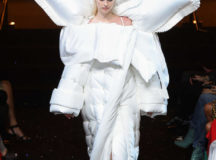
-
- Valentino
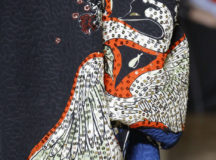
-
- Maison Margiela
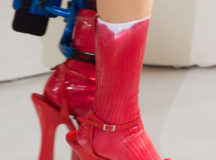
-
- Valentino
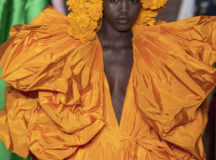
The question: Is Haute Couture playing the utopian card of rediscovered elegance, only to mutate into a dystopian scenario for “popular” fashion?
Haute-couture: increasingly inaccessible?
MAISON MARGIELA: Technique as extension
In every good dystopia, you have to define your relationship with technology. Ahead of the Maison Margiela Atelier show, John Galliano seems to be clarifying Maison Marigiela‘s vision, as he evokes his vision of couture on the podcast : “It’s volumes that drive fashion forward”. The result: surreal silhouettes that superimpose noble fabrics and urban fabrics. All in a staging in which technique plays a primordial role. Entitled “In Memory of”, the Margiela show is not opposed to new techniques, but shows how they can both record the history of fashion, and serve its future. Social networks, telephones and tablets are the wardrobe extensions of a new society. Rather than killing off couture, new techniques and their uses enrich haute-couture and enable it to reinvent itself. But beware the catastrophist discourse is also encouraged by this fashion show, where the mannequins no longer have anything human about them. Too much modernity or a profitable cataclysm for fashion’s detractors?
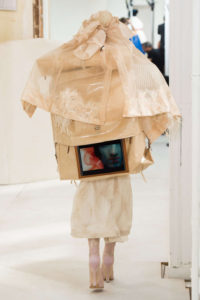
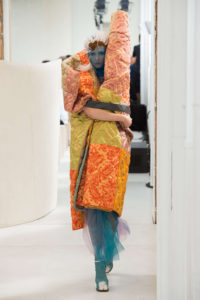
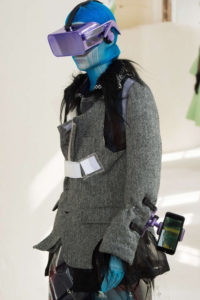
FENDI COUTURE: The smell of silver
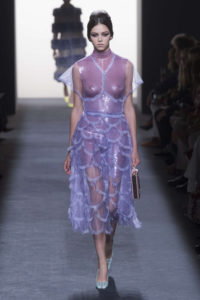
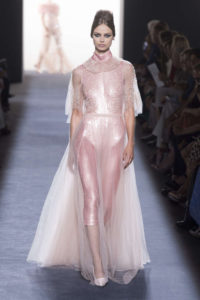
The first political tactic of the Fendi fashion show: mark the break by changing the name. It’s no longer Fendi Furbut Fendi Couture. While some of the coats appear to be made of mink, this is a clever trompe l’oeil, orchestrated by Karl Largerld and Silvia Fendi. “80% of these garments are not even fur”. Here we touch on another side of this renewal plan: Fendi is breaking away from the fur tradition of its national Italy to reach out to a new transnational elite whose attachment to the skin of dead beasts is much less obvious. By breaking with national tradition, Fendi enters the global stock market. In the Palais Brogniart, formerly the French Place de la Bourse, the Fendi order takes on the allure of sixties socialite housewives in love with Robert Delaunay. A worldly refrain: the third act of the renewal plan. While certain codes too closely associated with a dusty elite need to be eradicated, others are becoming the basis of the “Fendi exception” discourse .
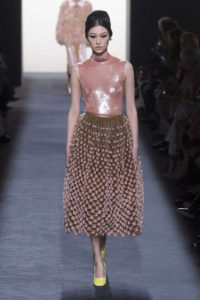
GUO PEI: the human stone of haute-couture performance
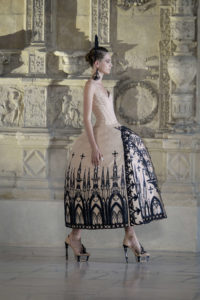
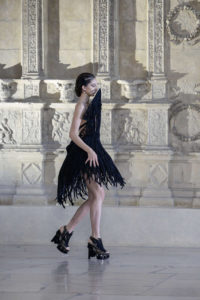
At Guo Pei, women’s bodies become the cathedrals of couture savoir-faire. A performance show where the weight of the pieces forces the models to walk slowly, forcing spectators to watch. To dissect the work of all the couture journeymen who build in the shadows. Guo Pei is not paying homage to a religion, but to the work promulgated by the idea of the sacred. A tribute to those who have tried to illustrate this world with golden numbers, while thinking of new balances in power relations. The outfits are rigid, black irradiated with a few gold points: the utopias of yesteryear have faded away to make way for a world with new rites.And what’s wrong with that? By looking at couture through the prism of French architecture, Chinese designer Guo Pei pays tribute to the idea of a world heritage that transcends religious differences. She restores the opportunity to study haute-couture as a place where the myths of civilizations take shape.
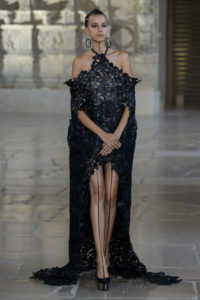
The opulence of appearances – a dystopian opulence? By relegating sportswear, casual wear and denim to the ready-to-wear sector, haute couture is shedding all appearances that might confuse it with couture. It is art, it is refined, it is eccentric, wearable and importable. A work of art that makes itself deceptively accessible, the better to elude us. Something complex
By combining new techniques with the wardrobe of the European society that gave birth to it, Haute Couture was renewed in a new way to appeal to a world of buyers whose sensitivity to Europe had mutated.
Cette publication est également disponible en :

