
Just a year ago, generative artificial intelligence was measured by the quality of its responses. Today, it is judged by its ability to take action. With Codex, work agents, and the new ChatGPT environments, OpenAI is no longer just describing an assistant: it is designing an execution layer capable of understanding context, manipulating tools, producing software, and soon orchestrating entire tasks.
The Shift from Text to Action
The shift isn’t in the conversation itself. It lies in the extension of the conversation to the computer itself. An agent isn’t just a chatbot in fancy clothes; it’s a system entrusted with a goal, an environment, limited permissions, and a timeframe for action. It no longer merely makes suggestions. It sorts, tests, assembles, verifies, prepares, and corrects.
Software development has served as a natural laboratory. Code has a rare quality: it can be verified. It either compiles or it doesn’t. It either passes tests or fails them. It is this ability to verify that has made Codex a prime learning environment. But the key insight lies elsewhere: what makes an agent useful to the code—broad context, precision, persistence, and the ability to use tools—does not belong to the code itself. These qualities also apply to finance, marketing, operations, market intelligence, meeting preparation, and document analysis.
The agent thus marks AI’s entry into a more delicate realm: that of ordinary work. Not spectacular demonstrations, but the invisible tasks that fill our days.
The real issue becomes taste
In a GitHub repository, the agent can be evaluated. In a strategic presentation, a speech, a committee memo, or a corporate interface, the question becomes more complex: what constitutes a good result? The answer lies not only in accuracy. It depends on tone, hierarchy, silence, and a sense of proportion.
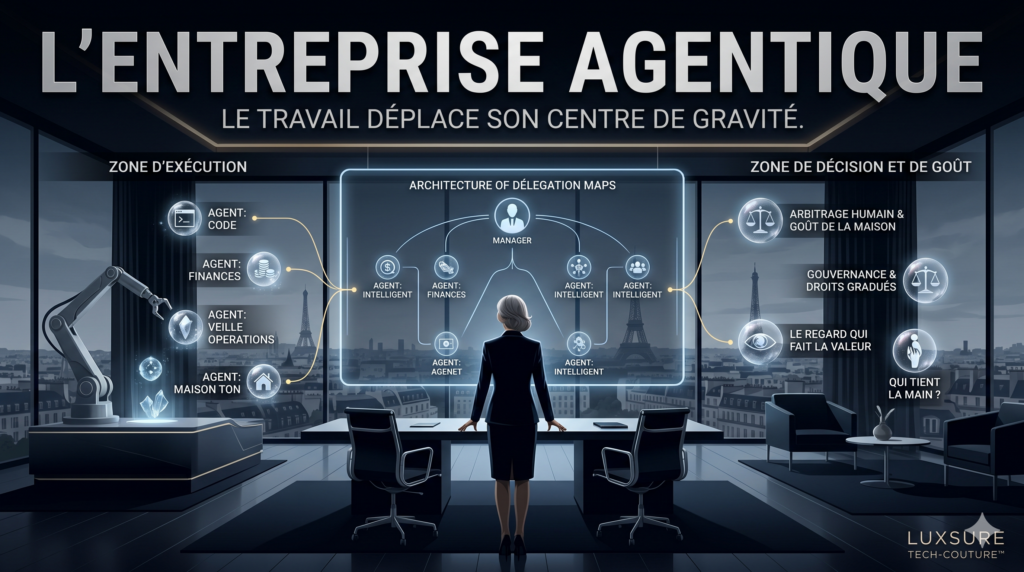
That is where the human element does not disappear. It simply shifts roles. The human no longer necessarily produces every variation; instead, he or she mediates, guides, selects, and sets the standards. The agent becomes a helping hand. But the hand has no taste without the gaze.
For the Houses, this distinction is crucial. A general-purpose agent can speed up a task. It can also trivialize a voice. The risk isn’t that AI will perform poorly; the risk is that it will perform correctly, but in a language that isn’t the company’s own. The agent-based enterprise will therefore not be merely a matter of tools. It will be a matter of internal grammar.
The Details
Codex is no longer just a code-generation interface. OpenAI presents it as an agent capable of writing, reviewing, and delivering code, accessible via an app, CLI, IDE extension, or the web. Workspace agents, on the other hand, introduce a more organizational logic: creation of shared agents, access to tools, administrative controls, usage visibility, and safeguards by workspace.
Specialized agents rather than a universal butler
The prevailing notion calls for a single, omniscient agent capable of doing everything. In practice, however, a more cautious approach seems to prevail. A specialized agent, operating within a narrow context and with a clear objective, remains more predictable. One agent per project. Another for monitoring. Another for a team. Another to prepare meetings. Sophistication does not come from a central brain, but from a delegation-based architecture.
This lesson can be directly applied to the luxury sector. A luxury brand should not go looking for “its AI” the way one chooses software. It should map out its processes: producing a press release, reviewing a product sheet, extracting key takeaways from a fashion show, preparing an executive committee memo, assessing a customer request, or turning an archive into editorial content. Each process has its own agent, its own dataset, its own rules, and its own restrictions.
The most significant promise isn’t total automation. It’s the reliable repetition of requirements.
Governance is becoming the new design
The more an agent acts, the more the design evolves. It’s no longer just about designing an elegant interface, but about deciding what the agent can see, do, modify, publish, or delete. The user experience becomes an experience built on trust.
Companies that adopt agents without governance will create a new form of shadow AI: no longer isolated prompts, but microsystems capable of operating behind the scenes. Companies that are overly cautious, on the other hand, will allow their employees to use tools on their own that are faster than the official ones provided by the organization.
Between the two, there is a more mature approach: registered agents, tiered permissions, observability, human validation, action logs, and training through real-world use. Agent-based systems are not a productivity revolution. They are an operational discipline.
The Company as an Augmented Workshop
Perhaps the most striking phrase is this: everyone becomes a manager. Not a manager of human teams, but a manager of specialized systems. Work then comes to resemble workshop management: setting an intention, assigning tasks, checking the work, and reworking a part when the mechanical hand has smoothed the material too much.
From this perspective, the agent does not replace expertise. It reveals the absence of expertise where activity and value were once conflated. Anything that was mere repetition without judgment can be automated. Anything that requires insight, context, culture, and responsibility takes on greater value.
The agent-driven company, therefore, is not one where humans work less. It is one where they can no longer hide the lack of perspective behind production volume.
By 2030, it may seem natural to ask an agent to create a dashboard, prepare a meeting, generate an interface, or write code—all without the user realizing that the agent is programming. The real question, for agencies as well as for companies, will be an older one: Who’s in control? And according to what criteria?
Cette publication est également disponible en :

