
Artificial intelligence promises to simplify tasks, speed up decision-making, and make the world run more smoothly. But behind every model, every query, and every data center, an older reality reasserts itself: electricity. At VivaTech, Pablo Koziner pointed out that the next frontier of AI may not be software, but industry.
For twenty years, energy was treated as something in the background. It had to be available, stable, and as invisible as possible. Digital industries tapped into it just as one plugs in a lamp. Growth seemed to be measurable in lines of code, computing power, and fundraising. Then artificial intelligence brought electrons back into the conversation.
The paradox is almost elegant: the most abstract technology of our time depends on a cumbersome, slow, and geographically bound infrastructure. The most advanced model requires turbines, transformers, cables, permits, grids, and construction timelines. AI speaks the language of immediacy; energy responds with the timeframes of concrete, copper, and public policy.
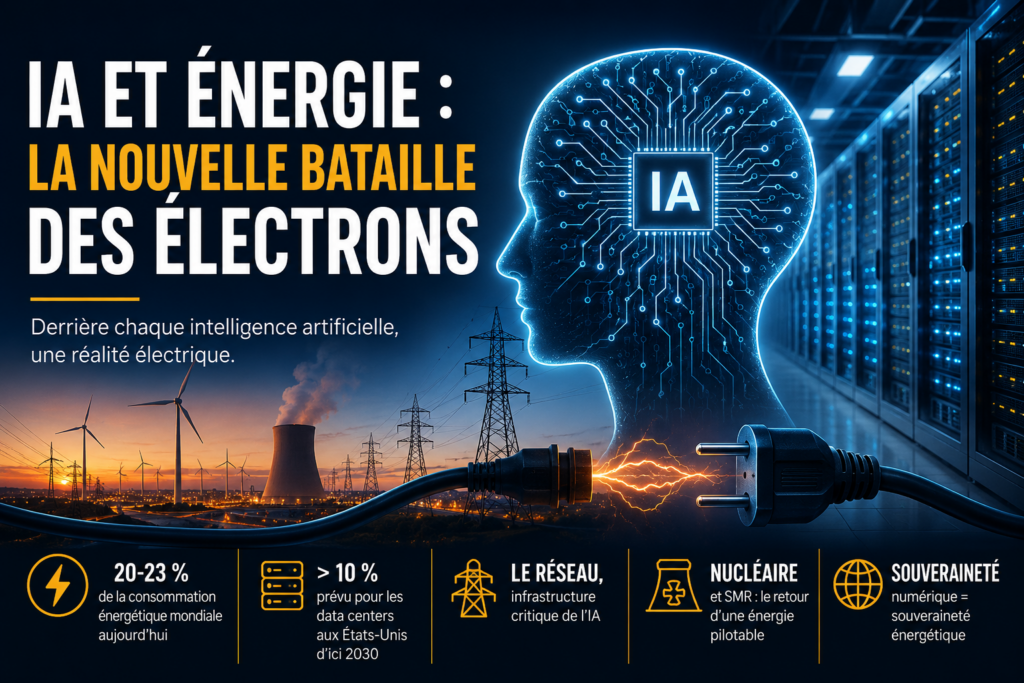
According to Pablo Koziner, electricity currently accounts for about 20 to 23 percent of global energy consumption. The projected trajectory points to a much larger share by 2050, driven by the electrification of various applications: vehicles, heating, industry, and data centers. This figure is not merely technical; it reflects the shift from a world where energy was burned to one where it must flow.
The Network: That Invisible Thread
It would be tempting to reduce the issue to production: more solar, more wind, more nuclear, more gas. Koziner, however, shifts the focus. The key issue is not merely to generate more electricity, but to transmit it, stabilize it, and deliver it to where demand is concentrated.
The grid thus becomes the critical infrastructure for AI—not merely a support system, but the very prerequisite for its existence. A robust power grid makes it possible to integrate more renewable energy, manage fluctuations, and avoid bottlenecks. A fragile grid turns every digital ambition into an unfulfilled promise.
There is a lesson in this idea that the Houses know all too well. Excellence does not lie solely in the visible object. It rests on what cannot be seen: the lining, the tension of a thread, the balance of a structure, the precision of a preparatory gesture. AI, too, will have its own lining. It will be electric.
The End of Energy as a Commodity
One of the major shifts highlighted at VivaTech relates to the behavior of large electricity consumers. Hyperscalers are no longer content to simply purchase energy. They are getting involved in its design, location, and security. They are entering into discussions that were once the domain of energy companies, infrastructure developers, or grid operators.
This is a significant change. AI does not consume power like a traditional factory. Its power requirements can fluctuate within milliseconds. The load rises, falls, and shifts. It requires systems capable of absorbing rapid fluctuations without compromising overall stability. The discussion is therefore no longer just about supplying a machine or piece of equipment, but about the entire architecture: from production all the way to the rack.
In this new paradigm, energy is no longer a cost center. It becomes a strategic asset. Those with reliable, abundant, and competitively priced access to electricity can drive innovation, host operations, and scale up. Those without it will depend on others.
Details
Pablo Koziner estimates that data centers accounted for about 2 to 3 percent of U.S. electricity consumption in 2025. By the end of the decade, that share could exceed 10%. This shift from peripheral use to structural consumption explains why he refers to an “electricity supercycle”: not a temporary spike in prices, but a long-term reconfiguration of needs in the areas of transmission, generation, and storage.
Digital sovereignty, energy sovereignty
The European debate on artificial intelligence has long focused on models, talent, regulation, and data. These topics remain essential. But they are incomplete if we overlook the energy infrastructure.
Sovereign AI cannot be achieved solely through a legal framework or funding from national actors. It requires infrastructure capable of supporting training, inference, storage, and data security. It also requires electricity costs that are competitive on the international stage.
This is where the issue takes on a political dimension. While the United States, certain regions of Asia, and the Middle East have more abundant or less expensive energy, Europe cannot simply rely on rhetoric about sovereignty. It will have to solve the underlying industrial equation.
So the question is no longer just: Where are our models? It has become: Where are our megawatts?
The Return of Controllable Energy
In this scenario, nuclear power regains a central role. Koziner mentions small modular reactors, notably a project currently under construction in Canada with a capacity of 300 MW, described as capable of powering 300,000 households and occupying an area the size of a football field. The benefits are clear: carbon-free, continuous, and controllable power generation.
But the luxury of the long term once again dictates the rules here. The value of a technology does not lie solely in its promise. It lies in its ability to be built, financed, approved, and replicated. Modular nuclear power will only be a game-changer if it manages to move beyond the prototype stage and scale up, at an acceptable cost.
The same caution applies to sovereign data centers, infrastructure disconnected from the global cloud, facilities in the Middle East, and more speculative projects involving data centers in orbit. Our era loves grand visions. Infrastructure, however, demands proof.
What AI Forces Us to Look At
Pablo Koziner’s contribution has the merit of shifting the narrative. It reminds us that the digital age does not exist in a vacuum separate from the physical world. It depends on materials, supply chains, geographic constraints, public policy, and industrial decisions. AI does not eliminate reality. It makes it more demanding.
For the fashion houses, this lesson goes beyond technology. Every use of AI—image generation, personalization, customer service, data analysis, and editorial automation—relies on an infrastructure whose economic, energy, and strategic costs will become increasingly apparent.
In the future, digital elegance will not be measured solely by the quality of an interface or the sophistication of a design. It will also be measured by the simplicity of its architecture, the relevance of its applications, and an organization’s ability to distinguish between power and volume.
AI has long been portrayed as a disembodied intelligence. VivaTech reminds us that it has a physical structure: data centers, networks, power plants, cables, engineers, and regions. The next scarce resource may not be the algorithm. It will be the electron available in the right place, at the right time, and at the right price.
Cette publication est également disponible en :

