
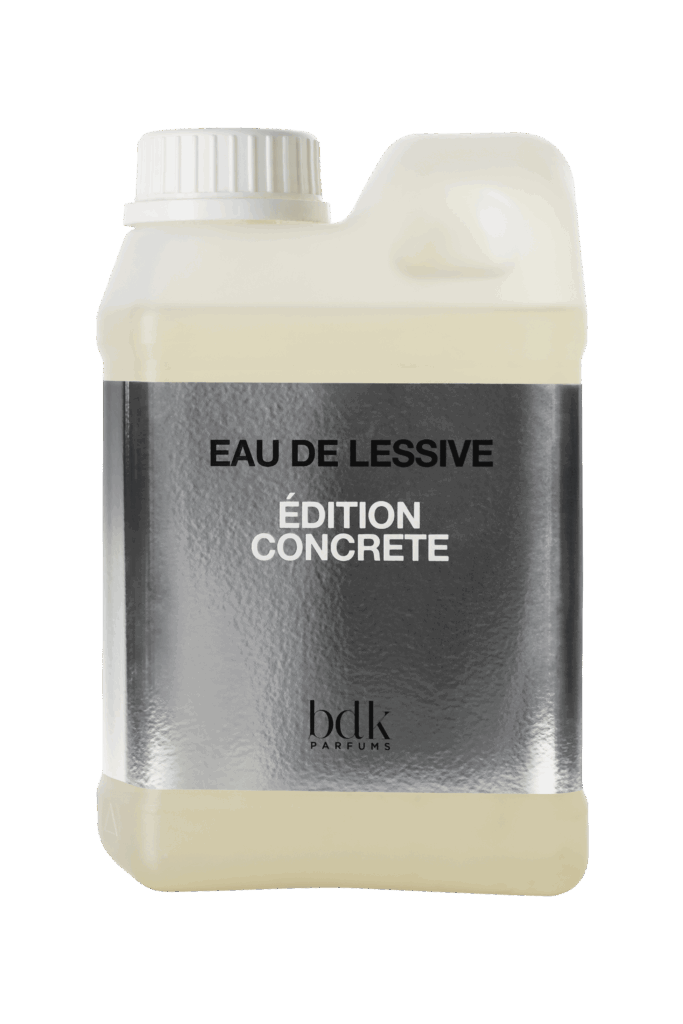
For its tenth anniversary, BDK Parfums is unveiling not a solemn new eau de toilette, but a third edition of its Eau de Lessive — this time inspired by the raw concrete of Paris. A gesture that says more about the times than about the house itself.
Smelling of everyday life rather than a special occasion
Exclusive fine perfumery has long been built around the idea of the exceptional: a fragrance for an evening, a rare raw material, a story in a presentation box. By choosing to call one of its flagship products “Eau de Lessive”, BDK Parfums takes the opposite approach — naming the most domestic, repetitive and unprestigious of tasks outright, and turning it into an object of desire at €40 a bottle.
The proposition is more than provocative: it reveals a deeper tendency in contemporary luxury, which seeks its legitimacy no longer in the rarity of the occasion, but in the sophistication of the commonplace.
Concrete, the material of urban energy
For this Édition Concrète, perfumer Anne-Sophie Behaghel (Flair Paris) pairs a mineral note of raw concrete with orange blossom — an accord she had not yet explored in the range’s previous variations. The press release evokes the energy of Parisian architecture and concrete’s ability to “help architecture evolve”; it does not say that this material, long considered cold and impersonal, becomes a vehicle for an unexpected, almost domestic softness once married to citrus and orange blossom.
Top notes of orange, bergamot and mandarin, a heart of petitgrain and aldehydes, a base of sandalwood and white musks: the olfactory construction follows an almost architectural logic, from the most volatile to the most structural.
Ten years of embracing individuality
This third Eau de Lessive marks a decade of existence for a house that has made the atypical a signature rather than an accident. In a niche fragrance market increasingly saturated with heroic narratives — journeys, alchemy, family secrets — BDK has spent ten years choosing to tell the story of an everyday object we never look at, yet smell every day.
One amusing, slightly dizzying question remains: if the smell of laundry becomes a luxury product, what will be left tomorrow to describe what is still ordinary?
Cette publication est également disponible en :


