
For years, artificial intelligence in software development has been presented as an assistant—a co-pilot capable of suggesting a line of code, correcting an error, or speeding up a repetitive task. At VivaTech 2026, the nature of the debate has shifted. The question is no longer how AI helps developers, but how it is gradually becoming an integral part of the workforce itself.
The shift from “co-pilot” to “agent” likely marks one of the most significant turning points in the digital economy since the advent of the cloud.
The End of the Developer as a Bottleneck
According to Thomas Dohmke, former CEO of GitHub and now founder of Entire, software production is entering a phase of unprecedented acceleration.
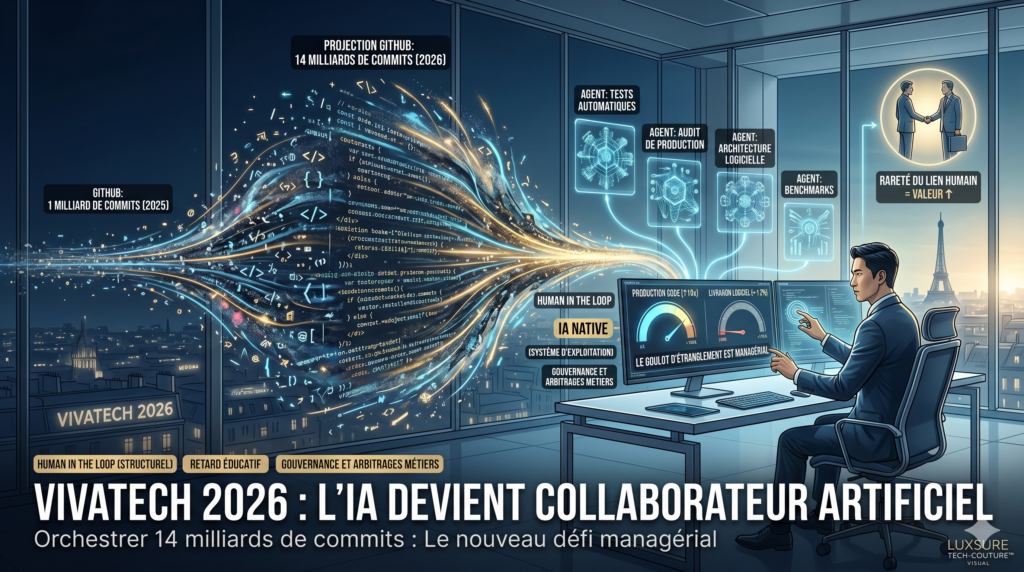
The metric he highlights is staggering: GitHub is projected to rise from approximately one billion commits in 2025 to a projected fourteen billion in 2026. Behind this figure lies a simple reality: developers no longer work alone.
Today, an engineer can simultaneously delegate multiple tasks to different AI agents, asking them to build a benchmark, verify an architectural design, run tests, or even audit their own output. Humans are becoming more like orchestrators than executors.
This shift does not necessarily mean less development. Above all, it means more software being produced.
The parallel with previous industrial revolutions is striking: when production capacity increases, demand often follows suit.
The Illusion of Productivity Gains
However, an important distinction emerges between individual productivity and organizational productivity.
Matt Fitzpatrick, CEO of Invisible Technologies, points out that several studies show significant individual gains—between 15 and 18 percent according to some estimates—but much more modest gains at the organizational level, often limited to 1 or 2 percent.
This phenomenon is well known.
Producing more code is not synonymous with producing more value.
The Financial Times recently highlighted a paradox: code volumes are skyrocketing, while actual software releases are growing much more slowly.
In other words, AI solves part of the production problem but does not eliminate governance constraints, business trade-offs, or organizational complexity.
The real challenge, therefore, is no longer technical.
It has become a managerial one.
AI Still Unable to Operate on Its Own
One of the most widely accepted ideas in this debate concerns the ongoing need for human involvement.
Unlike traditional automation, generative models remain probabilistic. They can produce excellent results while occasionally making major errors.
In highly regulated sectors such as banking, insurance, or healthcare, this residual uncertainty remains difficult to accept.
The well-known “human-in-the-loop” approach is therefore not a temporary measure.
Today, it is a structural component of AI adoption.
The picture that is emerging is not that of a fully automated company but rather that of hybrid teams where humans and AI agents collaborate continuously.
The Paradox of the Human Connection
One of the most interesting moments in the discussion concerned a topic that seems far removed from technology: human relationships.
As tools become more powerful, several speakers believe that the value of human interaction could, paradoxically, increase.
The reasoning is simple.
As automatically generated content floods digital channels, authentic interactions are becoming rarer—and therefore more valuable.
Sales are a perfect example of this phenomenon.
The widespread automation of sales emails has had an unexpected effect: recipients no longer respond. AI-generated messages are now filtered, ignored, or deleted.
As a result, in-person meetings, personal recommendations, and trusting relationships are regaining strategic importance.
In a world saturated with synthetic content, human attention is becoming a scarce resource.
And as is often the case in the luxury sector, scarcity creates value.
Will recent college graduates be the big winners?
Contrary to the alarmist scenarios frequently reported, the speakers expressed relative optimism regarding the younger generations.
Thomas Dohmke even mentioned a 14-year-old contributor already working on advanced machine learning projects.
The idea is that AI significantly lowers the barriers to entry.
Where technical expertise once required years of training, a young user can now quickly access capabilities that were once reserved for specialists.
A new generation is emerging: not “digital natives,” but “AI natives.”
These users view ChatGPT, Claude, or Codex not as tools but as a natural work environment.
For them, AI isn’t an innovation.
It’s the operating system.
The Real Lag: Education
On one point, the two speakers are in complete agreement: education systems are advancing much more slowly than technology.
Programming education often remains a niche subject, even though software now underpins the entire economy.
Beyond coding, the broader issue of foundational skills is at stake.
Digital literacy, statistics, data analysis, critical thinking, and an understanding of automated systems: these are all areas that are becoming central in an environment where AI is ubiquitous.
The paradox is striking.
Companies are trying to accelerate their transformation, while the institutions responsible for training future workers often continue to operate according to models designed before the Internet.
Work isn’t disappearing—it’s being reshaped
The discussion ultimately revealed a reality that is more nuanced than the doomsday or utopian scenarios usually associated with AI.
The issue is likely not the disappearance of work.
It is the redistribution of value between what can be automated and what remains profoundly human.
Information gathering, standardized production, and certain administrative tasks seem particularly vulnerable.
Conversely, judgment, strategic creativity, human relationships, trust, and coordination are becoming increasingly rare assets.
So perhaps the real change isn’t technological.
For the first time, companies must learn to manage not only human employees but also artificial employees.
And like any new workforce, these agents require supervision, governance, culture, and objectives.
The revolution is not about code.
It is a revolution in management.
Cette publication est également disponible en :

