
In contemporary watchmaking, there are few timepieces in which the very act of accessing them constitutes a design statement. The M.A.D.2 REDemption is one of them.
Presented in 2026 by M.A.D.Editions—the affordable line launched in 2020 under the MB&F umbrella—this edition is not available through a random drawing or through any distribution network. It is reserved for individuals who have entered at least four M.A.D.Editions raffles without ever being selected. These persistent buyers are contacted directly. No waiting list. No additional lottery. A one-time offer—take it or leave it.
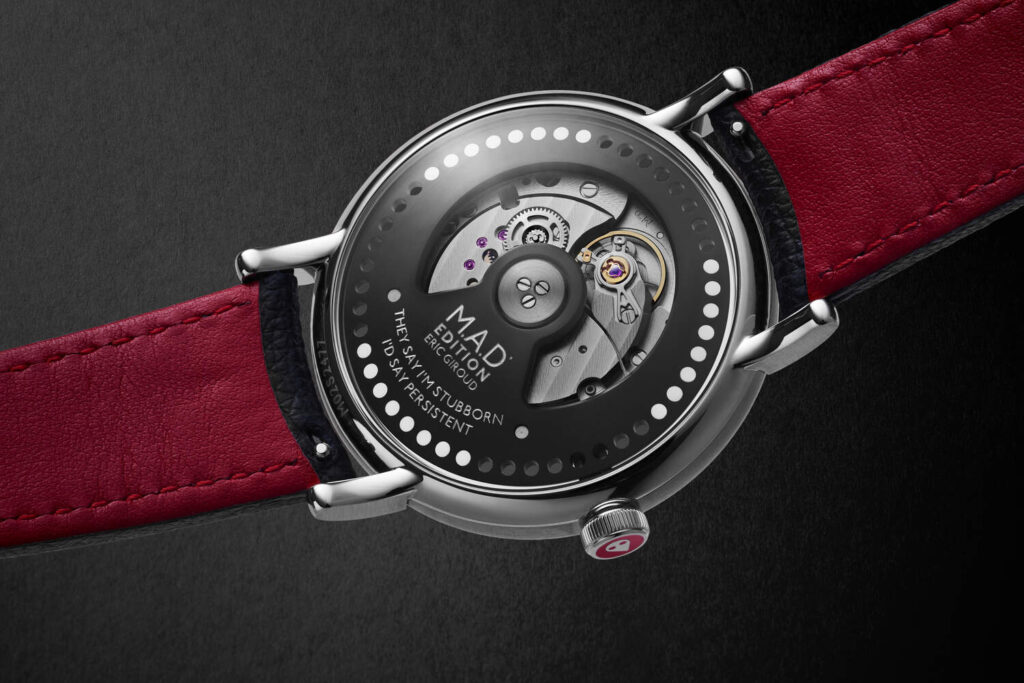
The engraving on the back of the rotor puts it bluntly: “They say I’m stubborn, I’d say persistent.” The rotor in question is not merely decorative—it is the watch’s automatic winding mechanism, visible from both the front and back of the case, whose design is inspired by the stroboscopic strip of the Technics SL-1200. Every movement of the wrist causes it to turn. The text rotates with it.
Technical details 316L stainless steel case, 42 mm in diameter, 12.3 mm thick. La Joux-Perret G101 caliber: 4 Hz, 24 jewels, 64-hour power reserve, automatic winding. Bidirectional jumping hours and trailing minutes module developed in-house by MB&F. Double-sided anti-reflective sapphire crystal, water-resistant to 3 ATM.
The REDemption’s dial plate is bright red—the jumping hour and trailing minute discs are black, creating a perfect color contrast with the M.A.D.2 R&B, which was unveiled at the same time. The latter features a black dial with red discs and is distributed via the usual random draw protocol supervised by a notary; registration is open for one week.
Both editions are part of a series whose visual language has remained consistent since 2025: a smooth, pebble-shaped case; raised sub-dials reminiscent of a mixing console’s turntables; and grooves reminiscent of a vinyl record. The M.A.D.2 received the Prix de la Petite Aiguille at the Grand Prix d’Horlogerie de Genève in 2025—in the 3,000 to 10,000 CHF category.
What sets REDemption apart in the history of M.A.D.Editions is that its logic runs counter to that of the secondary market. Whereas watch speculation typically prioritizes quick acquisition and resale, this edition rewards the absence of repeated results. It transforms serial failure into a right to purchase. In an industry where scarcity is most often managed through price or exclusive relationships, this approach is rare enough to be noteworthy.
The question she ultimately raises is this: if access to a piece can become an ethical protocol, what will become of the concept of limited editions in the years to come?














Cette publication est également disponible en :

