
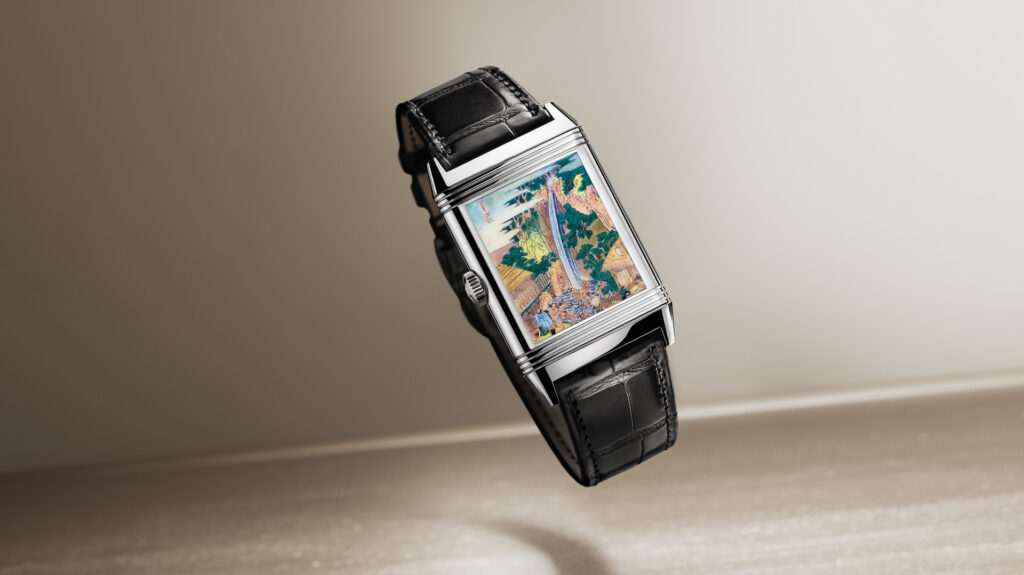
There is something in a Hokusai waterfall that defies miniaturization. The water does not merely fall: it carves out space, overwhelms human figures, and transforms the landscape into an almost animistic force. It is precisely this challenge that Jaeger-LeCoultre has chosen to tackle with four new Reverso Tribute Enamel Hokusai Waterfalls Series watches, each limited to ten pieces and decorated in the Manufacture’s Atelier des Métiers Rares™.
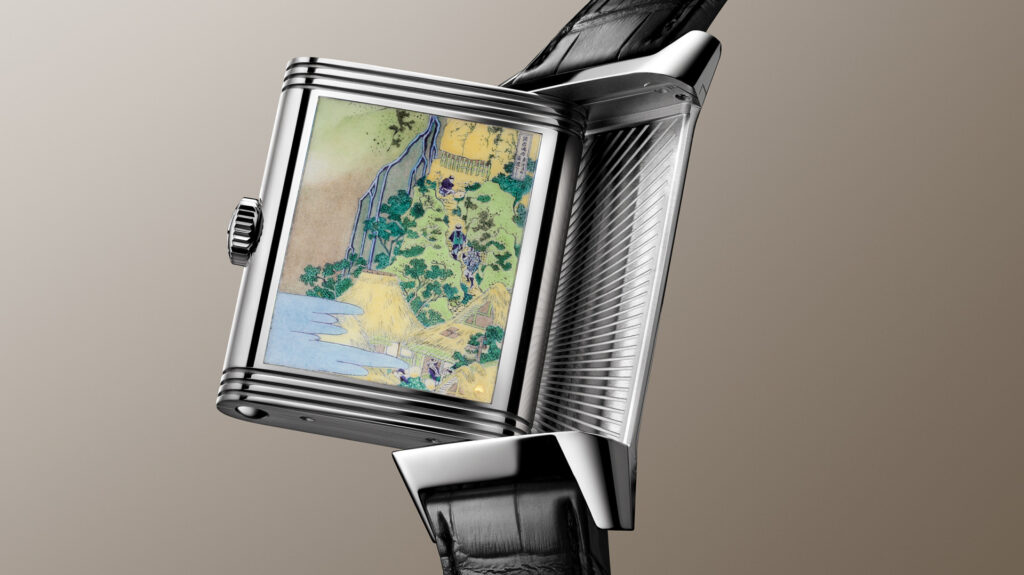
The series concludes a cycle launched by Jaeger-LeCoultre in 2018 centered on Katsushika Hokusai, following *The Great Wave off Kanagawa* and several interpretations from the *A Tour of the Waterfalls of the Provinces* series. The four final prints selected— *Rōben Waterfall at Ōyama in Sagami Province*, *Kiyotaki Kannon Waterfall at Sakanoshita on the Tōkaidō*, “Yōrō Waterfall in Mino Province,” and “The Falls at Aoigaoka in the Eastern Capital” —belong to a series of eight views dedicated to waterfalls, created around 1832 according to the collections of the Metropolitan Museum of Art.
This choice is significant. This series by Hokusai marks one of the first instances in ukiyo-e where a waterfall is treated as the central subject, with a new emphasis on movement, verticality, and scale. Human figures often serve as a counterpoint: pilgrims, bathers, and passersby, always rendered in their proper proportions against the landscape. The Manufacture’s exhibition catalog also highlights the importance of Prussian blue, a synthetic pigment that arrived in Japan in the early 19th century, of which Hokusai was one of the most influential users.
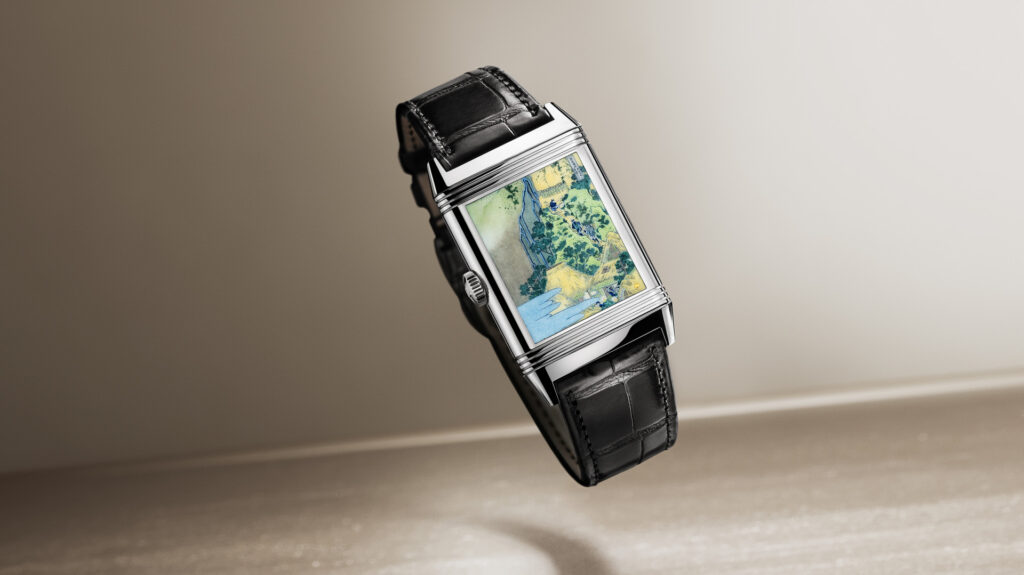
On the Reverso’s flip case, the process takes on a whole new dimension. Each grand feu enamel miniature requires at least fourteen layers of enamel, each fired at 800 °C, for approximately 80 hours of work. The original motif is reduced to an area of about two square centimeters. The challenge is therefore not merely decorative: it involves translating a woodcut—with its flat areas, gradients, and bokashi effect—into a vitrified material that tolerates neither excess nor approximation.
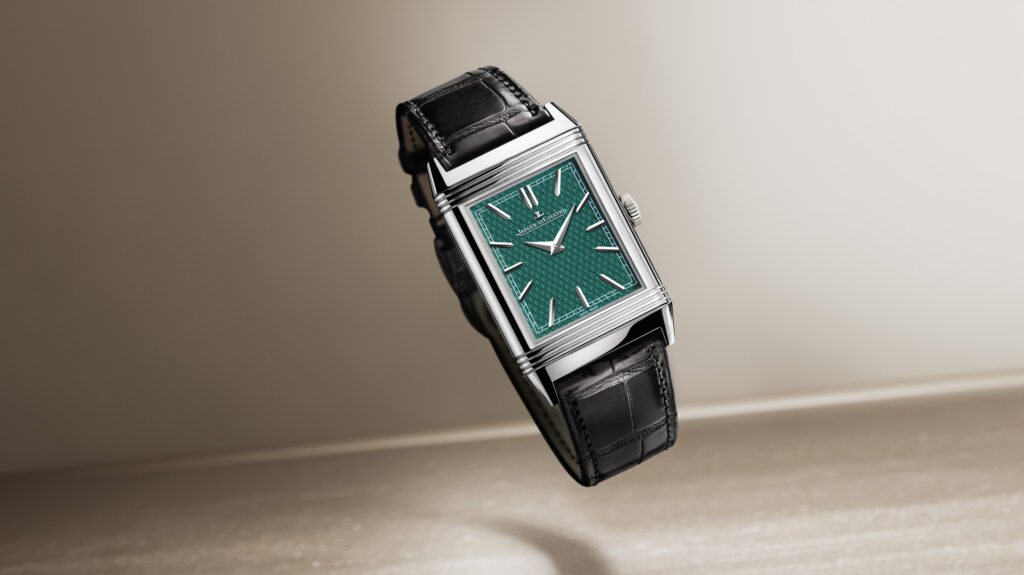
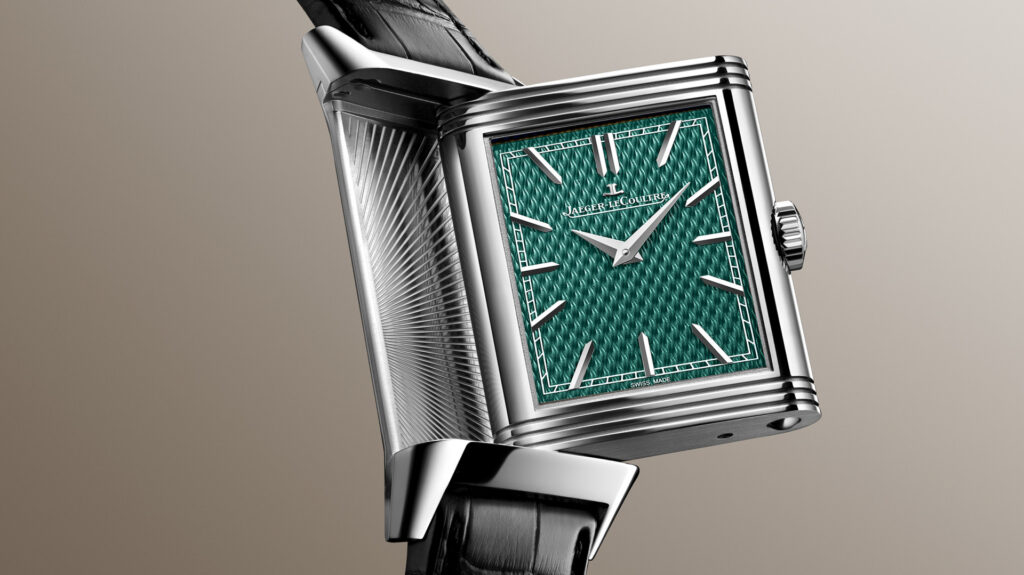
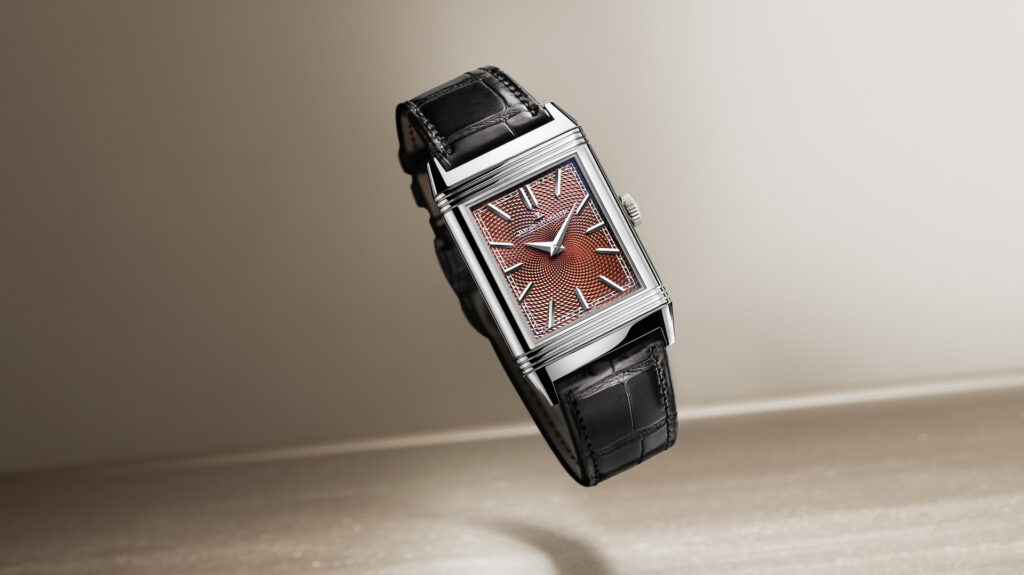
The dial is understated. The dials combine hand-engraved guilloché with translucent enamel: a barley grain pattern beneath light brown enamel for Rōben Waterfall, a wavy pattern beneath nearly emerald-green enamel for Kiyotaki Kannon, a bamboo pattern beneath olive-green enamel for Yōrō Waterfall, and a chevron pattern beneath cyan enamel for The Falls at Aoigaoka. The numbers behind the craftsmanship reveal the scale of the piece: 147 passes of the guilloché tool for the barley grain pattern, 198 for the wavy pattern, 144 for the bamboo pattern, and 360 for the chevron pattern.
This tension between the visible front and the hidden reverse side lies at the heart of the Reverso. Originally designed as a watch with a reversible case, it features here not so much a complication as a secret. The dial displays the hours and minutes; the reverse side reveals an image. The mechanics remain deliberately understated: the hand-wound Caliber 822, a rectangular movement designed, manufactured, and assembled in-house, measuring 2.94 mm in height, with a 42-hour power reserve and a frequency of 3 Hz. Jaeger-LeCoultre presents this caliber as a movement designed to perfectly complement the shape of the Reverso case.
The case, crafted from 18-karat white gold, measures 45.6 x 27.4 mm and is 9.73 mm thick. Each watch can be worn on a black alligator leather strap with a white gold folding clasp, or on a white gold “Or Deco” Milanese bracelet. The four models—Q39334T7, Q39334T8, Q39334T6, and Q39331T9—are each limited to ten pieces.
What this series says about Jaeger-LeCoultre goes beyond a mere tribute. It reveals a path that is all the more rare in contemporary watchmaking: using art not as surface decoration, but as a technical constraint. Hokusai challenges the Manufacture to master scale, color, legibility, and firing time. Nineteenth-century Japan enters the Vallée de Joux here—not as an exotic element, but through the discipline of craftsmanship. The waterfall becomes a test of precision.

Cette publication est également disponible en :

