
In Cravant-les-Côteaux, the wine doesn’t seek to make a splash. It flows down the hillside, passing through soils where clay, sand, silica, and limestone weave a slow-unfolding tapestry, then arrives in the glass with that Loire Valley restraint that says so much without raising its voice. Teyras de Grandval belongs to this family of estates that are still young in name but are already rooted in a territory older than themselves.
Founded in 2023 following Anatole de La Brosse’s acquisition of the Jaulin Plaisantin estate—he has also been the owner-winemaker of Domaine des Closiers since 2019—Teyras de Grandval is located in one of the historic villages of the Chinon appellation. The estate covers seventeen hectares of vineyards, mainly located on the slopes of Cravant-les-Côteaux: approximately sixteen hectares of Cabernet Franc, one hectare of Chenin, with a south to southeast exposure, and limestone-rich soils on the hillsides.
This geological detail matters more than any promise of a tasting experience. The “millarge”—locally associated with these limestone and clay-limestone soils—sets the stage for the story here: a Cabernet Franc that is more than just fruit, a Chenin that is more than just freshness. In an appellation where red wines largely dominate the imagination, the white wines serve as a reminder that Chinon is not just a land of Cabernet Franc. The INAO defines the Chinon AOP as an appellation for still red, rosé, or dry white wines, located in Touraine, west of Tours, on the south bank of the Loire River.
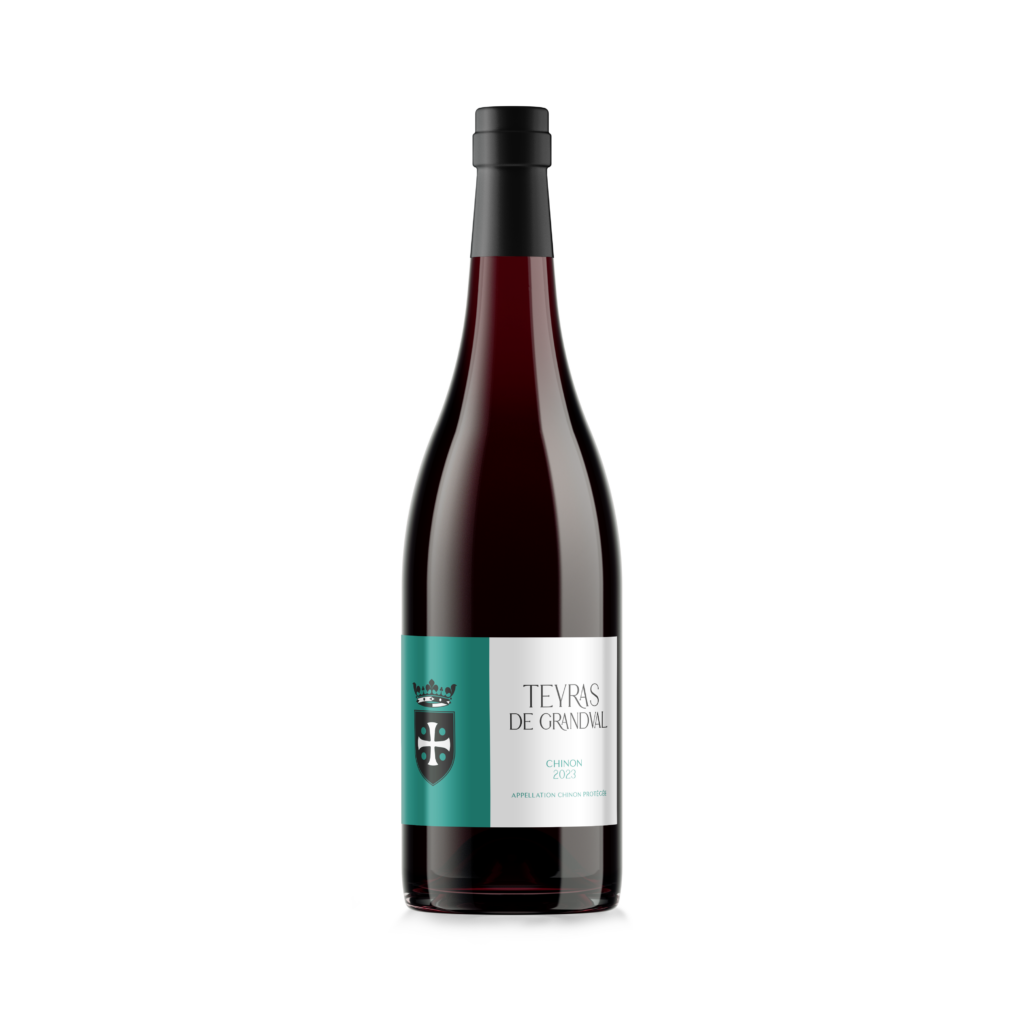
The first vintage, Chinon 2023, is a blend of Cabernet Franc grapes from plots located on the hillsides of Cravant-les-Côteaux. The grapes are hand-harvested, undergo four rounds of sorting, are fully destemmed, and then placed in vats for cold pre-fermentation maceration. The total maceration period lasts about one month. Aging continues for eight months, with 75% in stainless steel tanks and 25% in barrels, using only small amounts of SO₂ as the sole additive to ensure the wine’s stability.
This decision to use a combination of tank and barrel aging reveals a fairly clear intention: not to mask the Cabernet Franc behind oak, but to give it a solid foundation. The tank preserves the wine’s fruit-forward character, while the barrel adds nuance—less a fragrance than a touch of complexity. The press release describes a ruby color, red and black fruit, a supple texture, freshness underpinned by a mineral backbone, and a spicy finish. The editorial merit of this cuvée lies less in its stated richness than in its apparent refusal to overdo it.
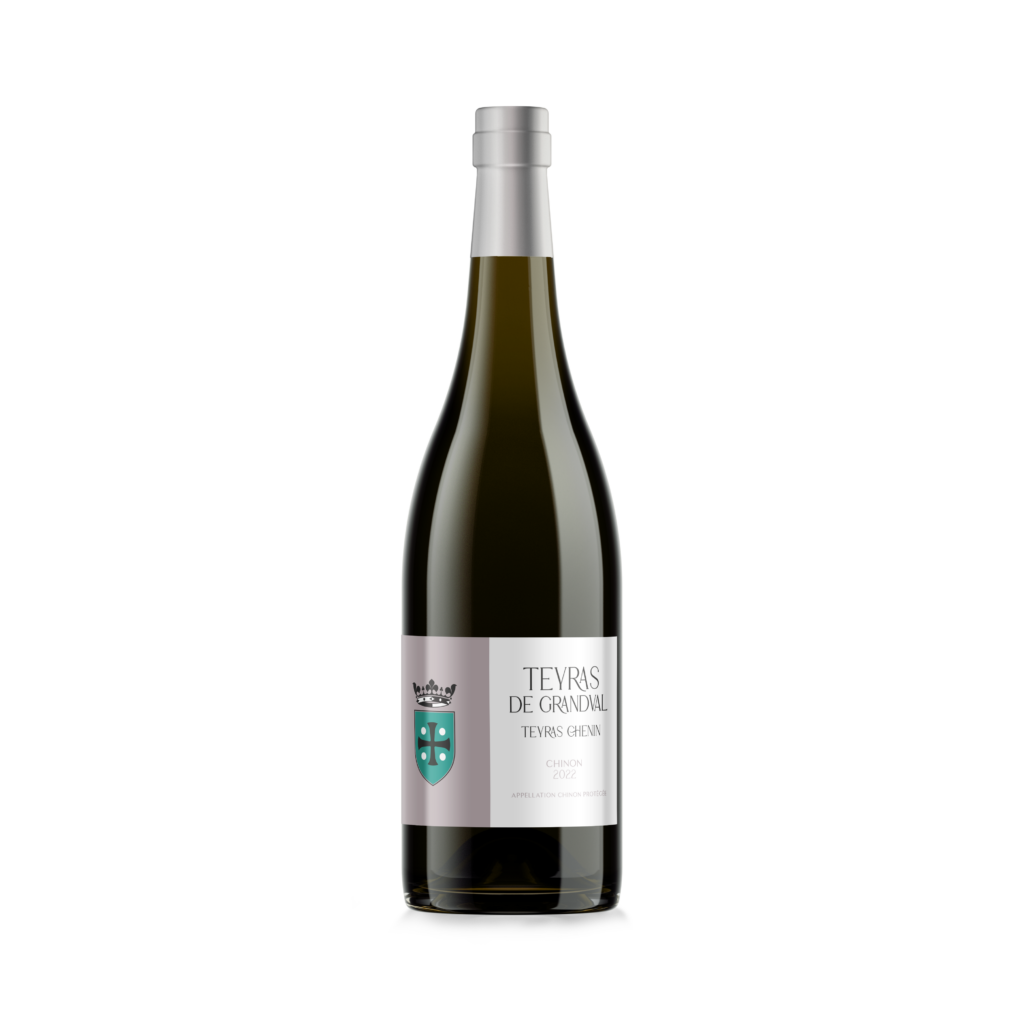
The 2023 Teyras Chenin, on the other hand, really catches the eye. It comes from Chenin plots located on these same hillsides in Cravant-les-Côteaux. The grapes are also hand-harvested, sorted four times before pressing, and then aged for twelve months in barrels—100% barrel-aged. No additives are used during the process, aside from small amounts of SO2. The wine has an alcohol content of 12.5% ABV, compared to 12% ABV for the 2023 Chinon.
The white wine is perhaps the most revealing of the pair. In a season when wines from the Loire Valley are often praised for their immediate freshness, Teyras de Grandval has chosen a Chenin that is aged entirely in oak for twelve months. The risk is that it might become too heavy; the challenge is ensuring it holds up. The profile describes a pale color with golden highlights, a nose of flowers and white fruits with toasty notes, followed by a palate that balances a lively attack with controlled roundness. Here again, the most interesting aspect is not the adjective, but the tension between the aging and the total acidity, listed at 3.96 g H₂SO₄/L.
Chinon has a literary heritage, reminiscent of Rabelais, that is almost boisterous in the way it is associated with conviviality. Teyras de Grandval seems to be taking the opposite approach: crafting a more fragmented, more understated, almost architectural interpretation of the appellation. The quote from Anatole de La Brosse, included in the dossier, sets the goal: to make Teyras de Grandval “one of the flagship estates of the Chinon appellation,” while respecting the differences in terroir and the appellation’s distinctive character.
It will obviously take time to assess this trajectory. A winery that was officially established in 2023 does not become a benchmark simply by declaring itself as such. But it can become one through its approach: a reasonable vineyard area, a clear understanding of the hillside, hand-harvesting, repeated sorting, minimal winemaking intervention, and two grape varieties treated not as distinct offerings within the lineup, but as two expressions of the same terroir.
Ultimately, the subject isn’t just Teyras de Grandval. It’s what Chinon still has to say when we stop reducing it to a pleasant, straightforward table wine. Here, Cabernet Franc and Chenin don’t try to show off. They get back to the basics: a hillside, an aspect, a village, limestone. The rest is up to time.
Cette publication est également disponible en :

