
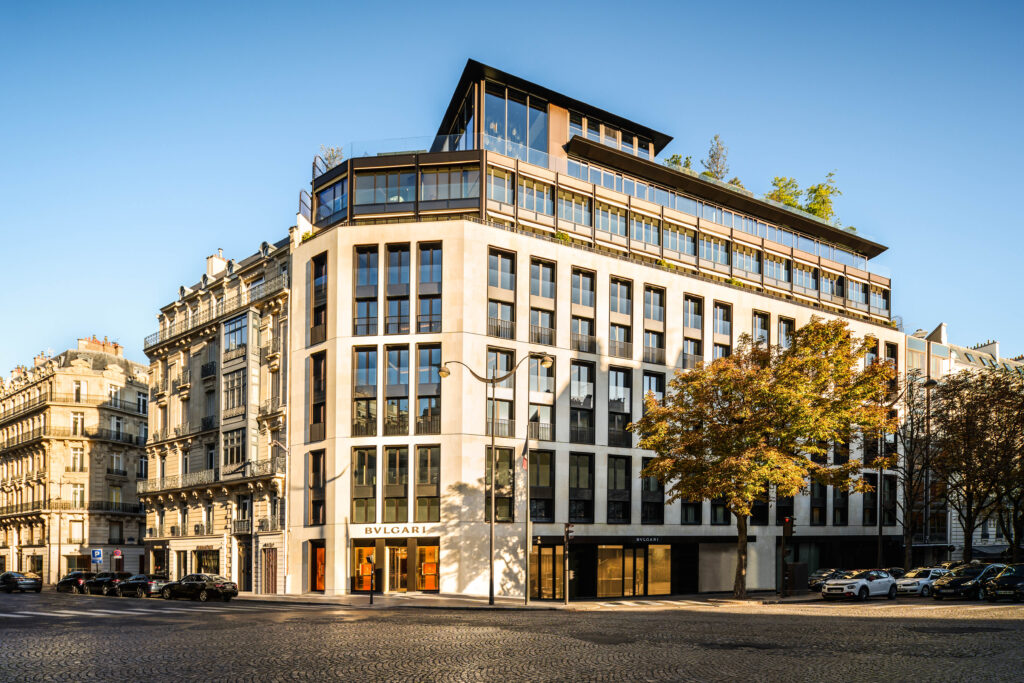
Five years after opening on Avenue George V, the Bvlgari Hotel Paris was awarded Palace status on June 2, 2026. The date itself is less important than what it signifies: a hotel designed as a silent testament to what it means to transform a jewelry house into a living space.
The initial challenge was far from straightforward. Bvlgari is a Roman brand, founded in 1884, and a jeweler at its core—its relationship with Paris is that of a House entering a market where the codes of luxury hospitality are already saturated with French references. The architectural choice responds to this tension with a refusal to compromise: Antonio Citterio and Patricia Viel, in collaboration with the French firm Valode & Pistre, have created an interior with a dark palette, rich woods, and precious marbles, in a style that borrows nothing from the Haussmannian tradition. The hotel does not seek to blend into the Golden Triangle—it stands as a distinct entity within it.
The 76 rooms and suites follow this same design philosophy. The textiles feature garnet, amethyst, and golden topaz—the palette of a jewel box, not a hotel room. The bathrooms, some of which are equipped with private hammams, combine frosted glass with glass engraved with the Serpenti motif. This serpent, which has been a hallmark of Bvlgari jewelry for decades, is engraved here in a steam room: the House does not merely decorate its hotel; it extends its formal language within it.
The choice of chef is perhaps the most revealing. For its first restaurant in France, Bvlgari selected Niko Romito—a self-taught chef from Abruzzo, a three-Michelin-starred chef who trained outside the traditional culinary schools and away from the major Parisian kitchens. His concept at Il Ristorante is defined as an anthology of classic Italian cuisine with a refined twist, focused on the vitality of the ingredients rather than on visible technical sophistication. This is precisely the opposite of what a prestigious Parisian hotel typically expects from its restaurant: Romito isn’t there to charm Paris, but to bring Rome to Avenue George V.
The Bvlgari Spa spans 1,300 square meters, with a design that draws inspiration from Roman baths—viewing bathing and body care as an ancient cultural practice rather than a mere hotel service. The reference to the House’s Roman heritage is no mere detail: it establishes a continuity between the jewelry house founded in 1884 and the 2021 wellness program, positioning the bath as a historical tradition rather than a mere facility.
The Magnificent Path app, a digital journey connecting the hotel to Bvlgari’s Parisian boutiques with narration by an art historian, rounds out the experience. It reveals something significant about the strategy of the hotel collection as a whole: the hotel is not an extension of the boutique; it is a platform for immersion in a worldview. There are currently nine locations—Milan, London, Bali, Beijing, Dubai, Shanghai, Tokyo, Rome, and Paris—with five more expected between 2026 and 2030.
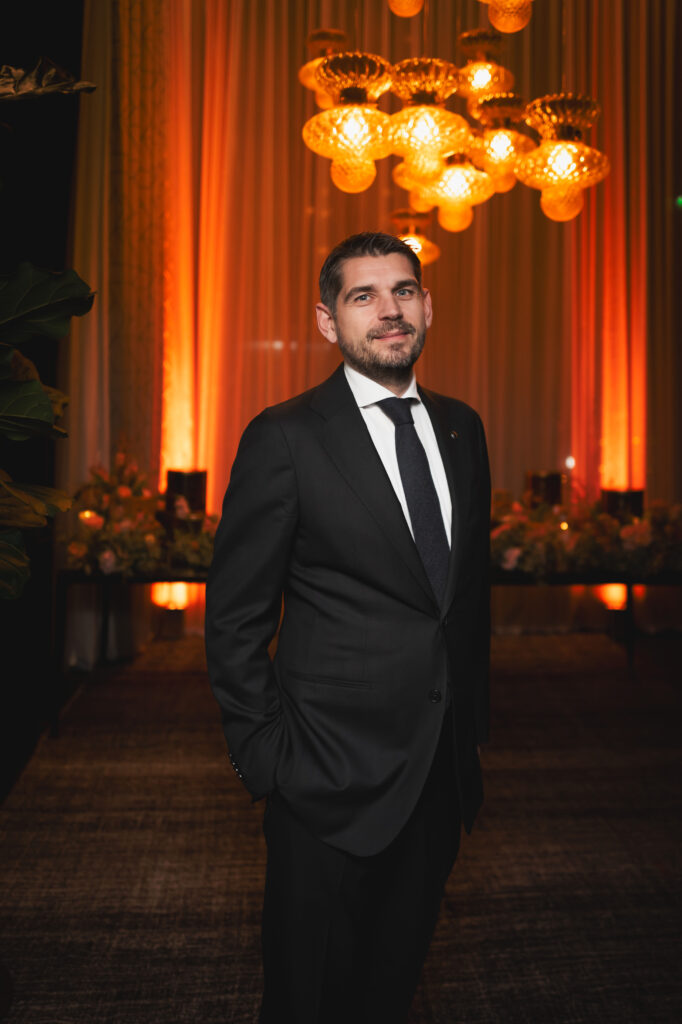
Rodolphe Callewaert, General Manager of the Bvlgari Hotel Paris, sees the Palace designation as a natural progression of the journey that began in 2021: “Joining the ranks of Parisian Palace hotels is a continuation of the Bvlgari Hotel Paris’s development since its opening.” The statement is cautious. What the distinction confirms above all is that a jeweler’s hotel can endure over time without adapting its language to the city that hosts it—provided that language is precise enough to require no translation.
Details — The Palace Designation Created in 2010 by the Ministry of Tourism, the Palace designation recognizes French hotels that exceed the five-star rating in terms of service quality, unique offerings, and cultural roots. It is granted for a renewable five-year period. In Paris, about twenty establishments hold this distinction. The Bvlgari Hotel Paris, which opened in 2021, received it at the end of its first full year of operation.
The question that remains is one of longevity. Citterio and Viel have created a hotel that does not age in the same way as a classic Parisian interior—its references are Roman, its materials are mineral, and its color palette does not follow the cycles of interior design trends. If the Bvlgari Hotels & Resorts collection continues to expand with the same consistent aesthetic—five additional locations by 2030—Paris will soon be a central hub in a network that will have its own distinct identity.
Cette publication est également disponible en :

