
Designed by internationally renowned Swiss architects Herzog & de Meuron, the extension to Tate Modern will be the largest cultural building to open in the UK in almost twenty years.
The new Tate Modern will also unveil a completely renewed presentation of its collections, featuring side-by-side iconic works from the museum and more recent acquisitions made since the museum’s creation in 2000. With a 60% increase in exhibition space, the world’s most visited museum of modern art will showcase works by over 250 artists from some 50 countries. In particular, it will highlight how art has evolved from the ateliers and salons, cradles of modernism, to live, interactive and socially engaged practices taking place in every corner of the globe.
According to Nicholas Serota, director of Tate :
“The new Tate Modern will be an instrument that will enable us to offer rich and varied experiences to all visitors, and also offer artists multiple opportunities to present and express their work.”
For Chris Dercon, Director of Tate Modern:
“Art is one of the most vivid and engaging forms of expression for all beings, and when we enter a museum today, we don’t want to find something alien to our existence, we want to find closeness. The new Tate Modern will be as much a place to present art as a platform for human encounter.”
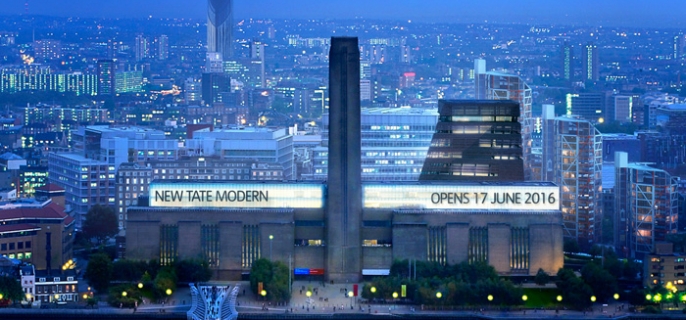
The immense Turbine Hall will be the heart of the new Tate Modern. It will be located between the 6-storey Boiler House and the new Switch House , whose 10-storey building will rise above the Tanks area. Construction of the new Switch House building is now complete, with work now concentrating on the interior design. This will offer a remarkable variety of spaces for visitors and for art, from the raw industrial spaces of the former Tanks to a panoramic roof terrace overlooking the London skyline. The project also includes new urban landscaping to the south and west of the building, completing the radical transformation of an originally industrial site into a welcoming, open public space.
The new Tate Modern aims to offer the most diverse and international perspective on modern art yet achieved. Encompassing all the new Switch House spaces, as well as a completely renewed display of the collection in the current Boiler House spaces, the presentations will explore the links between artists from cities all over the world, from São Paulo to Tokyo, in relation to the traditional creative centers of Berlin, Paris, London and New York. Performance art, film, photography and installations will be integrated into the new presentation of the collections. In each of the museum’s wings, and in the center of the new building, digital spaces will make use of the most advanced technologies.
Emblematic works by the greatest masters of the 20th century – Pablo Picasso, Joseph Beuys, Mark Rothko, etc. – will be presented alongside those by artists whom Tate Modern has helped to bring to the attention of a wide public, including Saloua Raouda Choucair (b. 1916, Lebanon), Meschac Gaba (b. 1961, Benin) and Cildo Meireles (b. 1948, Brazil). Numerous new acquisitions will also be presented for the first time in 2016, from an installation composed of human hair and car bumpers by Sheela Gowda (b. 1957, India), to a room filled with giant burlap bags by Magdalena Abakanowicz (b. 1930, Poland), to an immersive multi-screen film by Apichatpong Weerasethakul (b. 1970, Thailand).
Students from schools across the UK will be invited to a preview on Thursday June 16, the day before the new Tate Modern opens to the public. Young people will also be invited to celebrate the opening over the weekend of June 17, 18 and 19, to discover the new building and encounter modern and contemporary art.
The project was made possible by one of the largest cultural sponsorship campaigns ever organized in Great Britain, and thanks to the generosity of the British government, the Greater London Authority and numerous private individuals and foundations. In 2006, the estimated total cost was £215 million at 2012 prices. Since the size of the project has now increased significantly, with the addition of renovation work on the existing building, the total cost at 2016 prices is estimated at £260 million.
Cette publication est également disponible en :

