
What zoe gustavia anna whalen’s Birthing Circle collection has to say about fabrication as argument, and fashion as language space.
There’s a tendency in New York independent fashion to confuse intention with result. An approach is announced, collection notes are published, references are cited – and the garment ends up functioning as an illustration of a text rather than as an autonomous object. The Fall/Winter 2026 collection by zoe gustavia anna whalen, presented on February 15 in New York under the title Birthing Circle, takes the opposite risk: it makes the manufacturing method the main argument, and lets the text take account of it rather than supplement it.
Protocol as grammar
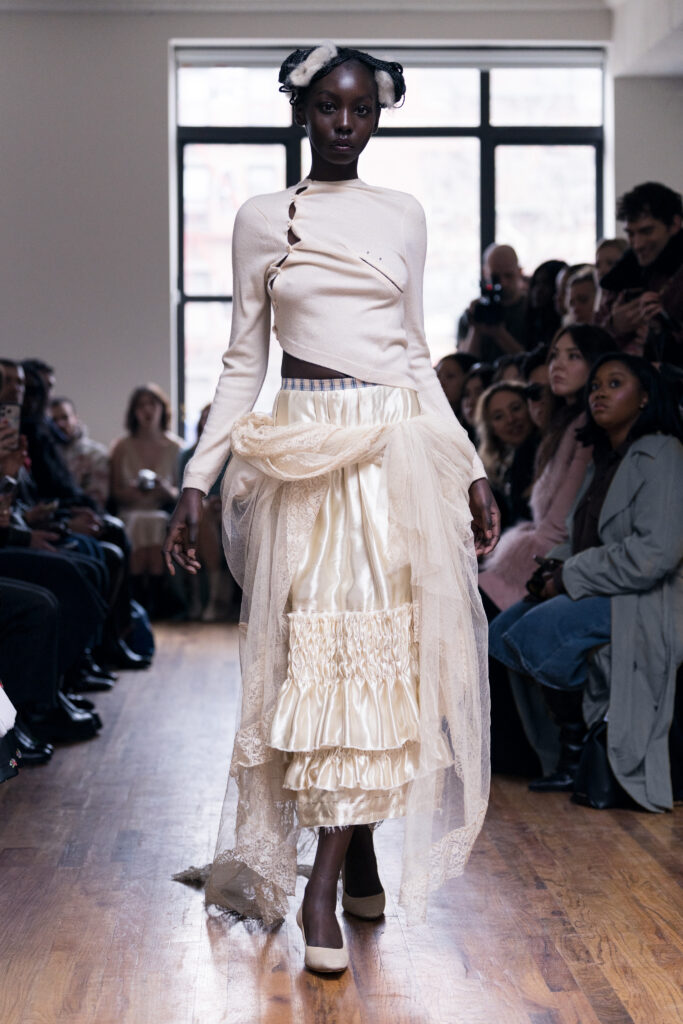
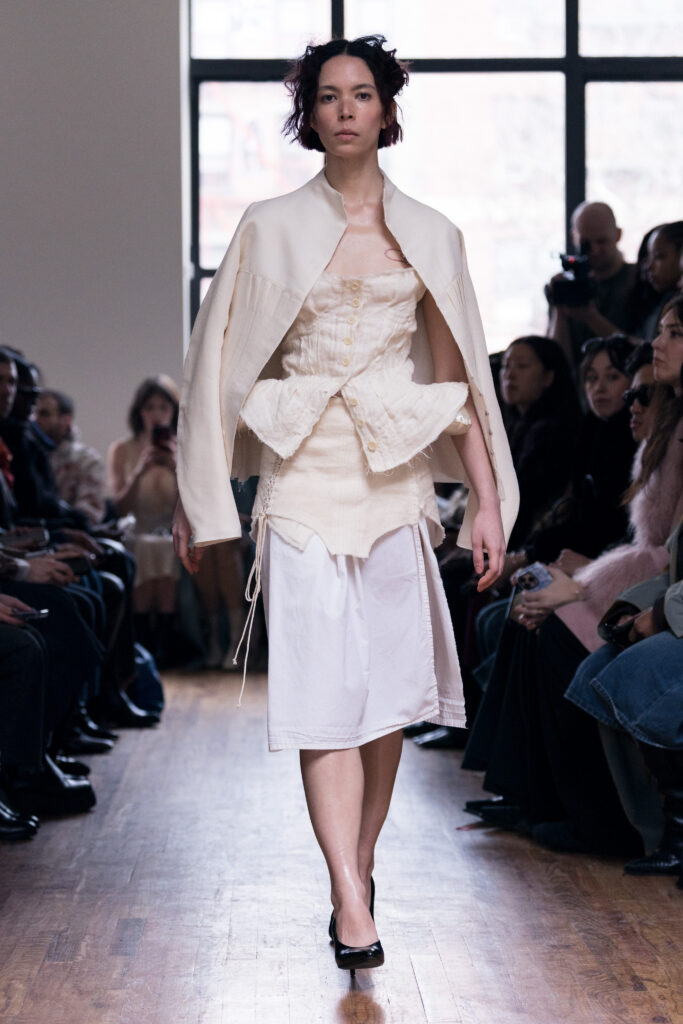
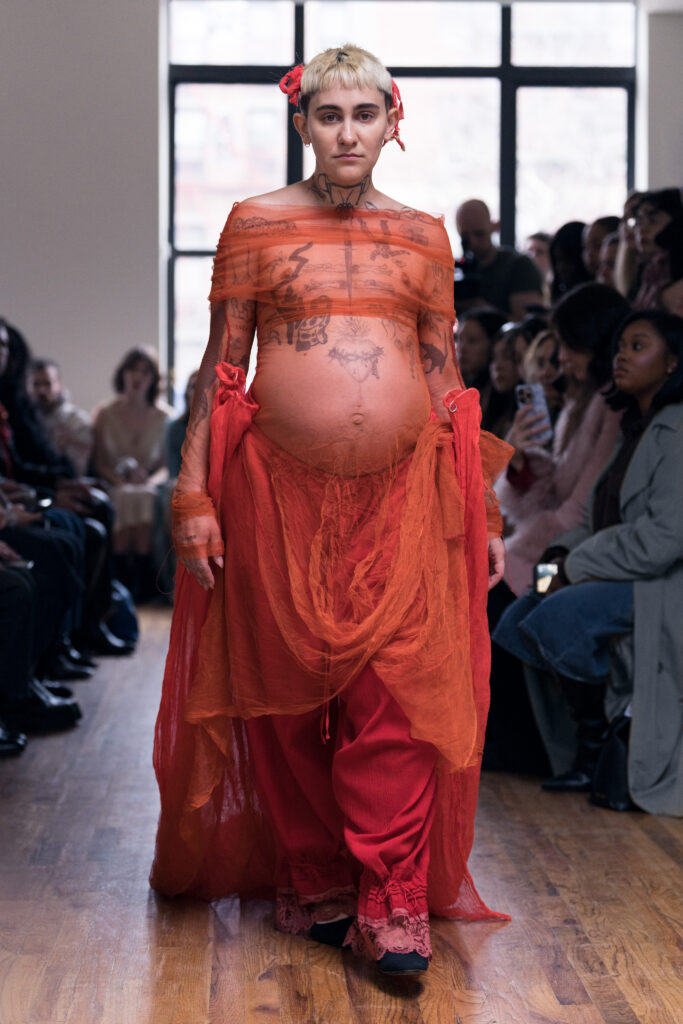
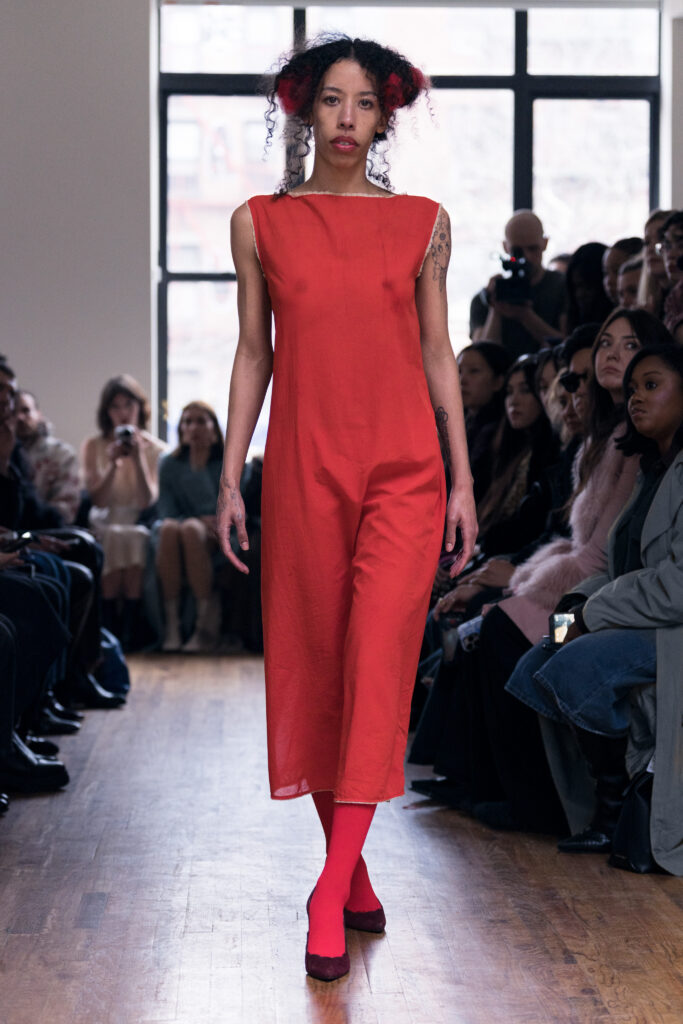
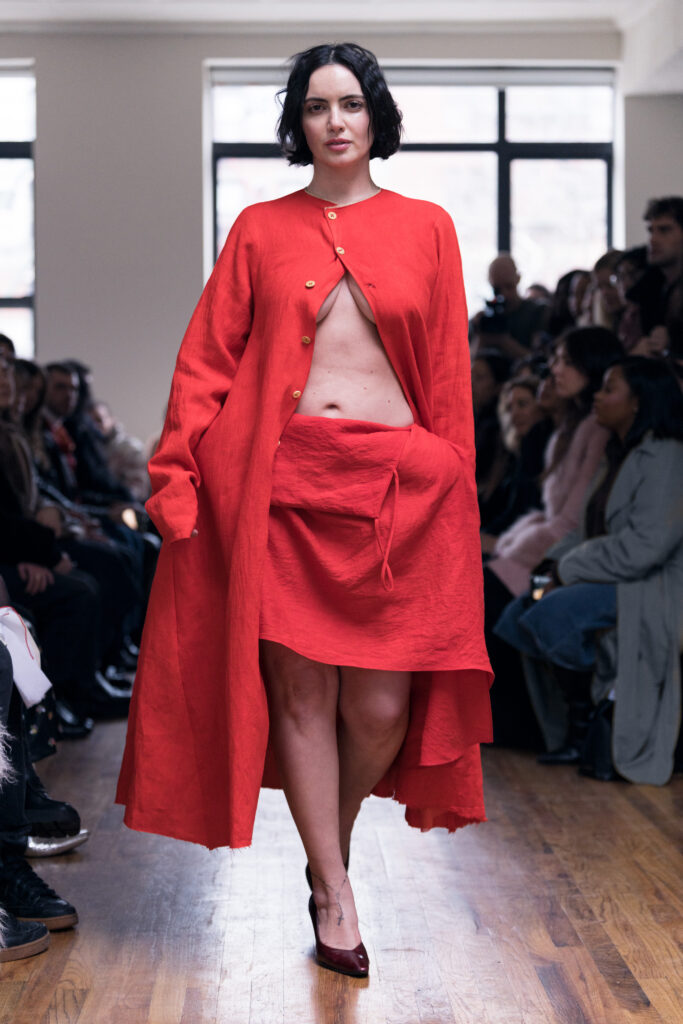
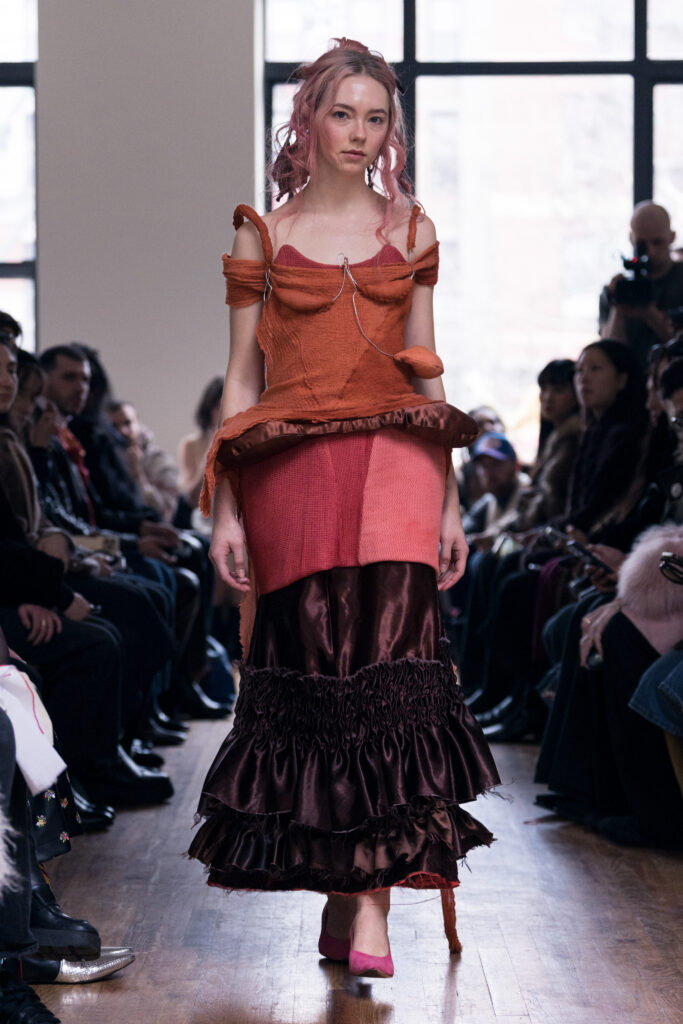
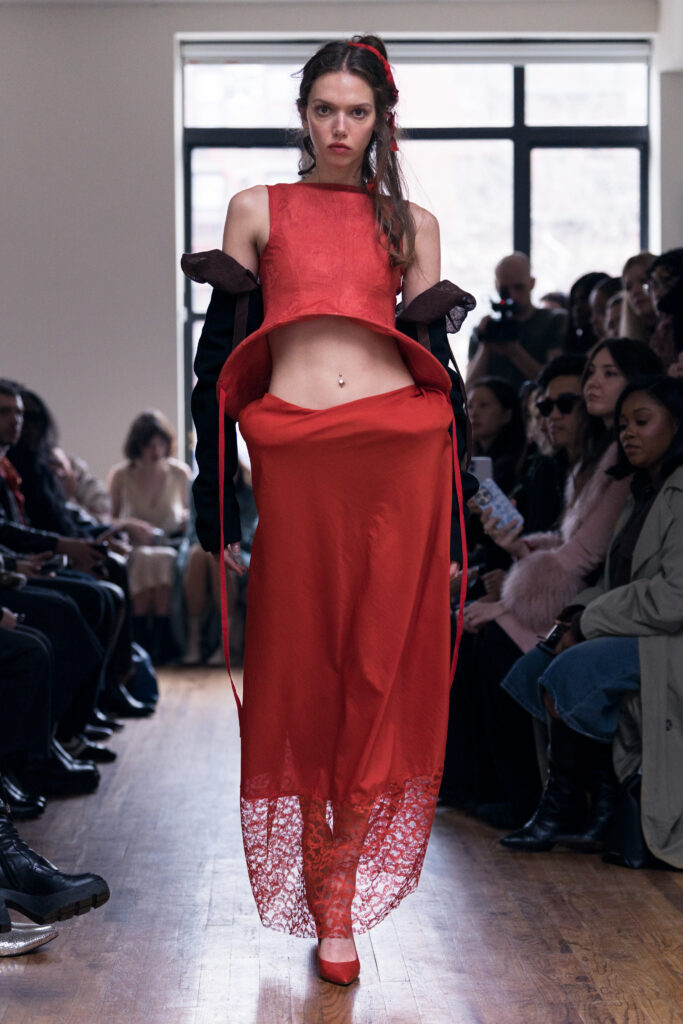
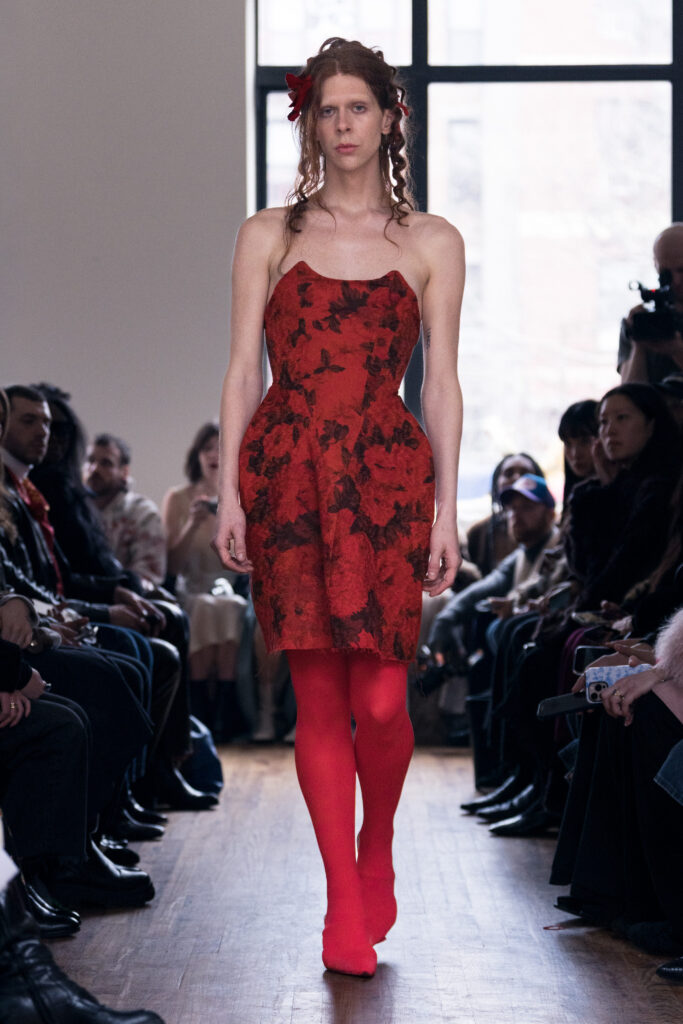
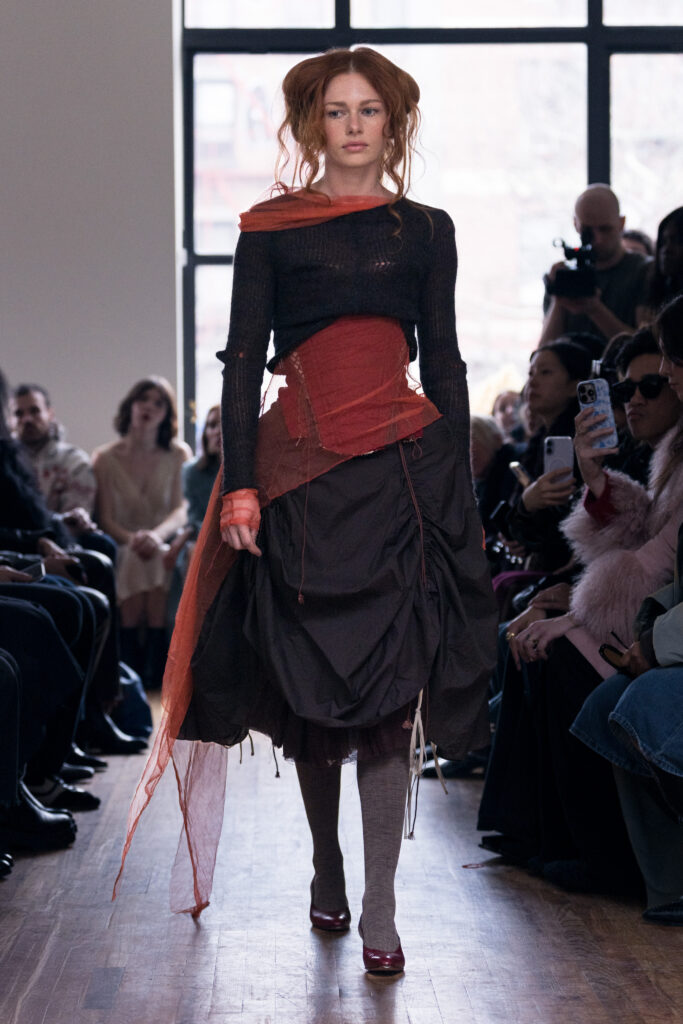
Each look in the collection is cut twice. Once in undyed materials – second-hand bleached linen, vintage nylon, dormant stocks – which form the basic palette of Whalen’s practice. A second time in red-dyed variants, hand-treated in the studio with pigments supplied by a local dyer. Hundreds of trials were conducted to map what Whalen calls “the complex palette of red” – a formulation that is not rhetorical: natural red, depending on the substrate, turns burgundy on thick linen, cherry on fine nylon, brick on unprepared cotton. Controlling a red on such heterogeneous materials is precisely the technical problem that this studio work solves.
This double-cut protocol says something essential: the same garment exists in two states. Not a daytime and an evening version, not an alternative color – the same piece, constructed twice, with the same pattern and materials whose response to dyeing is different each time. It’s a reflection on the identity of the clothing object, carried out through manufacture rather than discourse.
Parade structure as dramaturgy
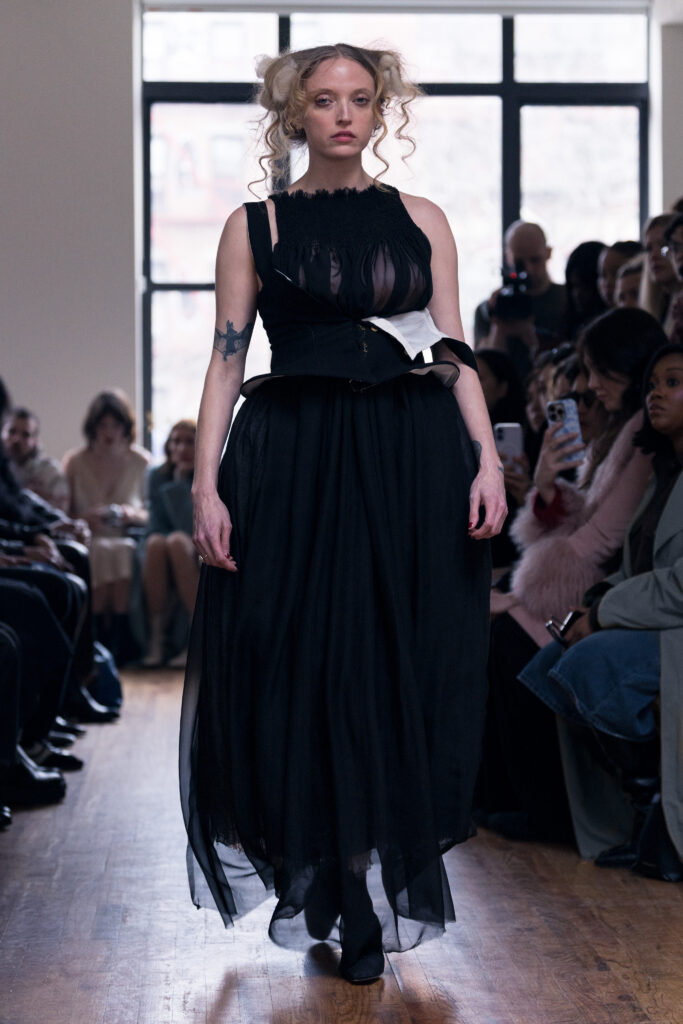
The fashion show unfolded in three chromatic acts: white, then red, then black – ending with a plunge into a claw-footed bathtub. This progression is not decorative. It follows the logic of a bodily narrative that the collection notes explicitly formulate: arrival, transformation, crossing. Whalen’s references – pre-industrial pregnancy corsets, sanitary belts, maternity garments – belong to a history of women’s clothing that fashion rarely treats with the rigor it deserves. These pieces were not objects of desire. They were devices for managing the body, designed to conceal it, contain it and make it socially acceptable in its most intimate states.
Whalen uses these objects not to rehabilitate them aesthetically, but to subject them to formal questioning: what is corsetry when it is no longer constrained? What is a utilitarian skirt when utility is redefined? The collection extends the house’s usual vocabulary – hitherto focused on pieces close to the body – to pants, coats and outerwear. It’s an expansion, not a break.
What the text says, and what fashion can say
Birthing Circle ‘s collection notes are a personal text – explicitly so. They evoke an unfulfilled pregnancy, mourning, gratitude for “a city where you can bleed and weep in peace and safety”, the memory of a “person possibility” that presented itself at the wrong time. This kind of content often destabilizes fashion, which doesn’t quite know what to do with direct sincerity – it tends to turn it into an aesthetic or ignore it.
What Whalen succeeds in doing is not asking the garment to tell this story for him. Undyed linen and hand-pigmented red do not “symbolize” loss and life. They are the result of work that has taken place, hundreds of dye tests, double cuts, hours in the studio. The garment exists independently of the text. Which is rare.
Detail – Natural pigments on untreated natural fibers migrate over time. A red color on second-hand, non-etched linen will change when washed, worn or exposed to light. This aging is not a manufacturing defect: it’s a property of the material, accepted and integrated as such. Each piece will continue to transform itself after the show.
The question Birthing Circle poses beyond this season is this: can independent fashion maintain this manufacturing requirement – double-cutting, hand-dyeing, second-hand sourcing – as a house grows? Whalen isn’t there yet. But the direction is set with a clarity worth remembering.








Cette publication est également disponible en :

