
For spring-summer 2027, AFEW Rahul Mishra imagines a young woman’s return to a family home in India. Across the forty looks, the idea holds up in two precise places: the cut of the check and the fold that opens onto a landscape.
The House sets out its starting point with clarity. A young woman has lived far from India, in London, New York or Paris. She returns to a house that has fallen silent, where she recognises what she saw in the photographs of an album: a television covered with a crocheted doily, a wooden wardrobe, the patterned glass of a window, a red oxide floor. The House presents the collection as a work of editing memory. It states that the young woman is not trying to dress like the women in the photographs, but to choose what she carries away from their world.
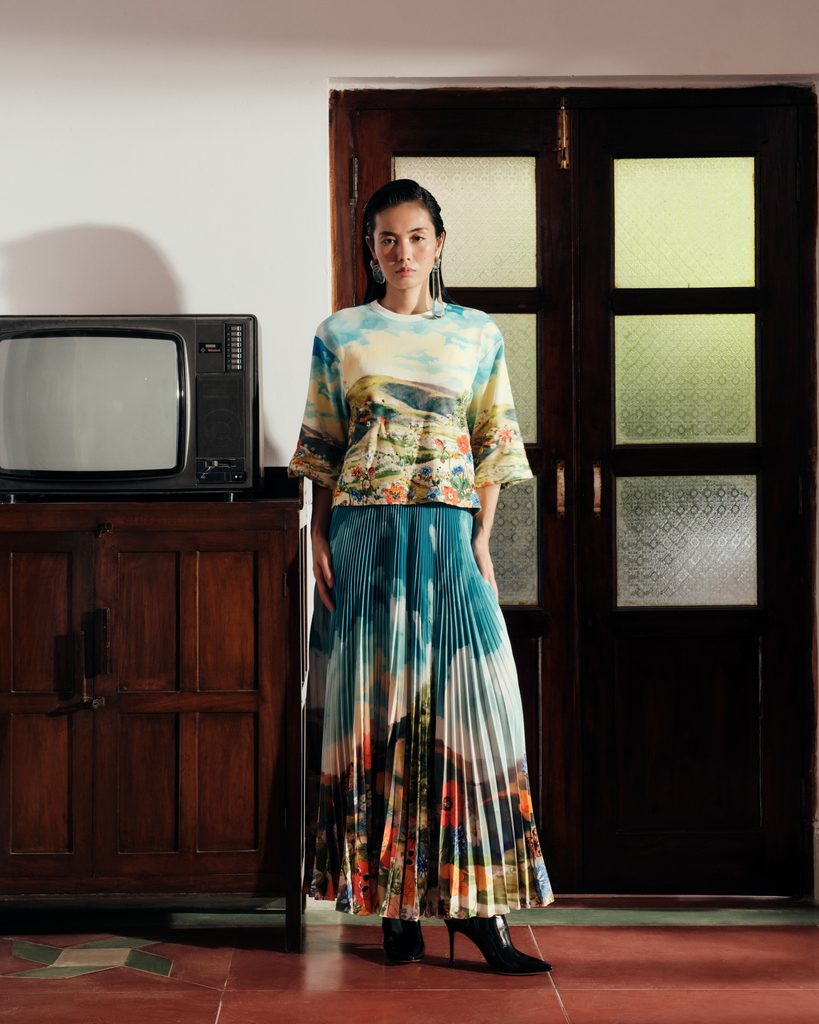
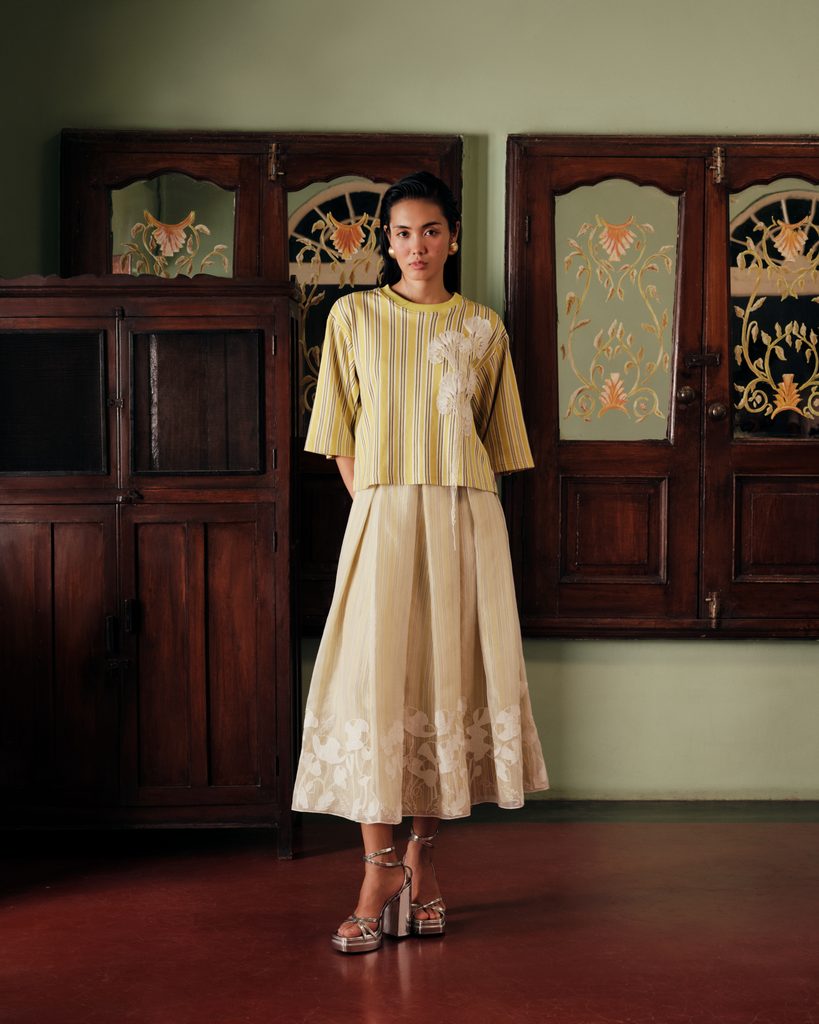
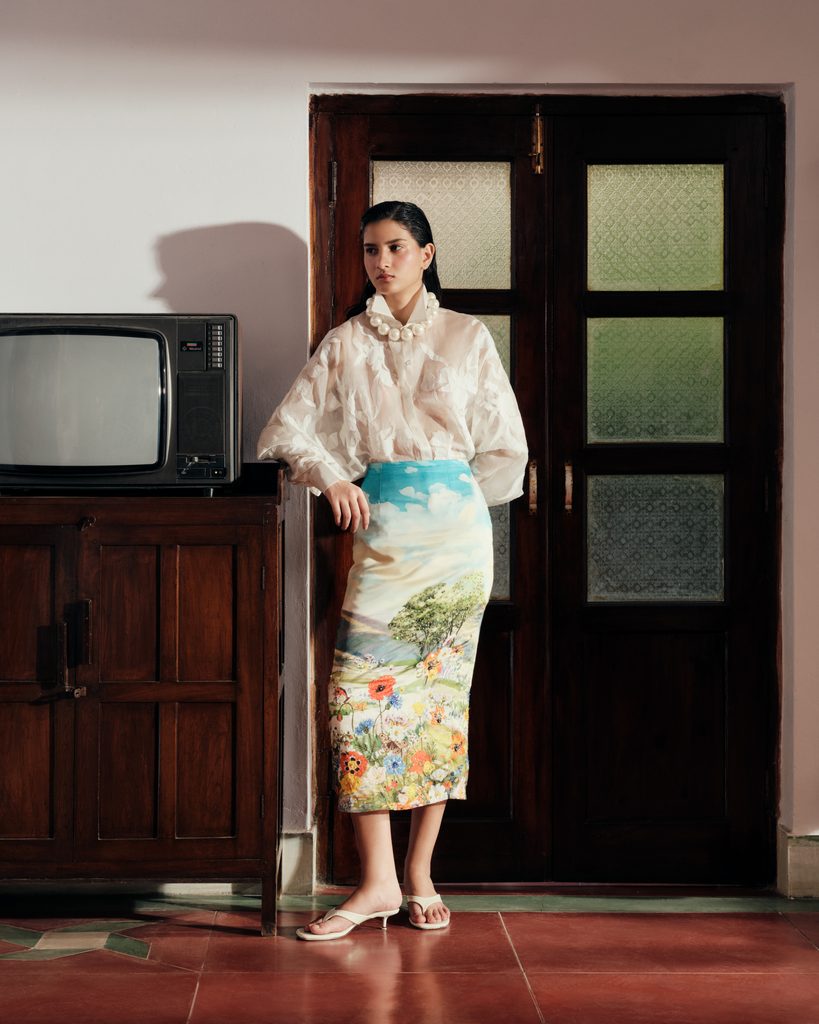
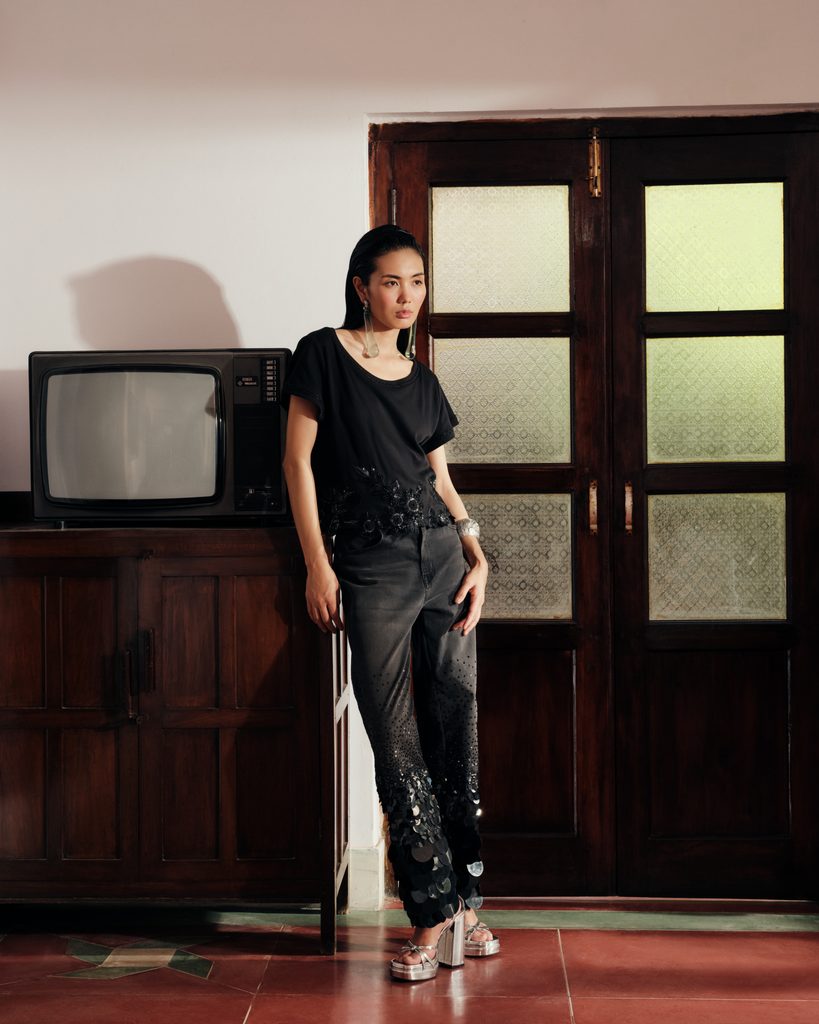
The collection’s images take up this setting: a tube television placed on a cabinet, glazed wardrobes, frosted-glass doors, a red floor. The setting says nothing about the garment. The useful question is what the dresses have retained from it.
The clearest answer lies in the gingham. It appears in a short blue-checked shirt with white organza sleeves, then in a bustier, then in a pleated skirt whose hem carries white appliqué flowers. The check is that of the shirts in the family albums, which the House says it rediscovers “in unexpected proportions”. The yellow stripes work in the same way: at least six looks take them up, in a knotted shirt, a blazer, an asymmetric tunic and trousers, with a white plant motif appliquéd on the shoulder or the chest. The fabric remains that of the house, and it is the cut that moves it on a generation.
The decisive detail is the pleated landscape. Several looks carry the print of a sky, hills and flowers: a top and pleated skirt, a long shirt, a jacket, a dress. In others, the same landscape appears only when a garment opens: on the side of a cream trouser, and above all beneath a white shirt-coat whose hem parts to reveal pleated panels. The House announces pleats that open to reveal landscapes, and these looks bear it out. The postcard that opens the presentation offers the same landscape, rendered in sequins.
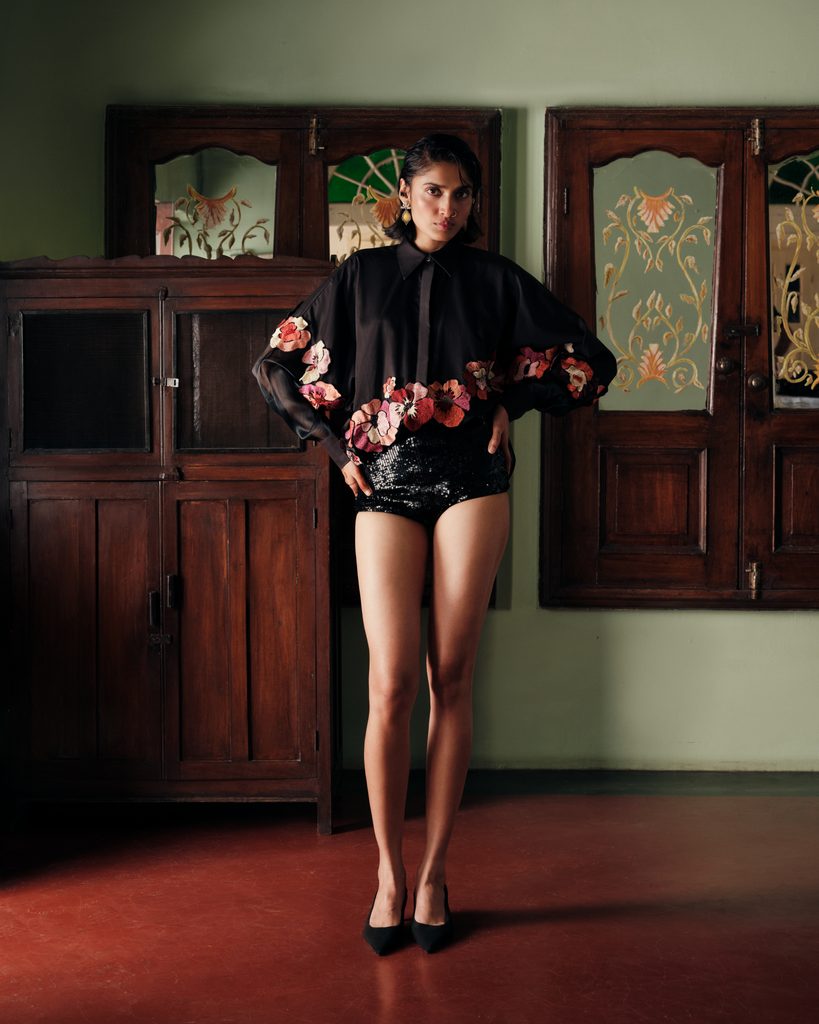
The embroidery is placed with the same economy. On the black looks, pink, coral and garnet flowers run along a line of sheer organza, at the neckline and hem, or settle on a sleeve or a shoulder, the rest left plain. This choice answers what the House describes: embroidery that appears in fragments and sometimes dissolves into the garment. It claims couture-level craftsmanship for these motifs, which photographs do not allow us to verify.
The second, black half loosens the link. Sequins, mini-skirts, shorts and ruffles belong more to the evening wardrobe than to that of a family interior, and only the floral fragments tie these looks to the story. This judgement rests on images: fabrics, weight of the cloth, finish of the embroidery and movement remain out of reach.
The editing of memory is therefore read here in a check whose proportions have changed and in a landscape seen only when the cloth opens. For the rest, the pieces will have to be seen and touched.
Cette publication est également disponible en :


