
In Champagne, there is a constant tension between the art of blending and the desire to highlight a specific terroir. One builds a signature, year after year. The other isolates a specific origin, embracing its contours, its limits, and its imperfections. With two new single-village champagnes, Avize 2020 and Tours-sur-Marne 2020, Champagne Boizel continues to shift its focus: away from the cuvée as the House’s signature style, and toward the village as the foundation.
This approach is no small matter for a House founded in Épernay in 1834, now led by the sixth generation of the family. Boizel has long been part of this Champagne tradition, where precision stems from blending. The Monocrus collection, launched prior to these two new releases, offers a different approach: selecting a single village, a single grape variety, and a single vintage, then allowing the wine to express itself without excessive intervention. The press release specifies that both cuvées are aged for five years on the lees, a period that frames the tasting experience as an exercise in patience rather than one focused on immediate impact. On its official website, Maison Boizel also highlights its family continuity dating back to 1834, with six generations at the helm.
Avize 2020 is part of the Côte des Blancs, the land of Chardonnay and chalk. The village is one of the seventeen communes in Champagne historically classified as Grand Cru, alongside Cramant, Le Mesnil-sur-Oger, and Oger, among others, in the Côte des Blancs. For Boizel, Avize also holds special family significance: the house notes that the village is one of the family’s ancestral homes and that it still owns several plots there. In the glass, the press release describes a Blanc de Blancs Grand Cru made exclusively from Chardonnay, with a pale gold color, green highlights, and notes of acacia, hawthorn, citrus, followed by brioche and toasted almond. On the palate, it features a crisp attack, a precise texture, chalky minerality, and a delicate salinity.
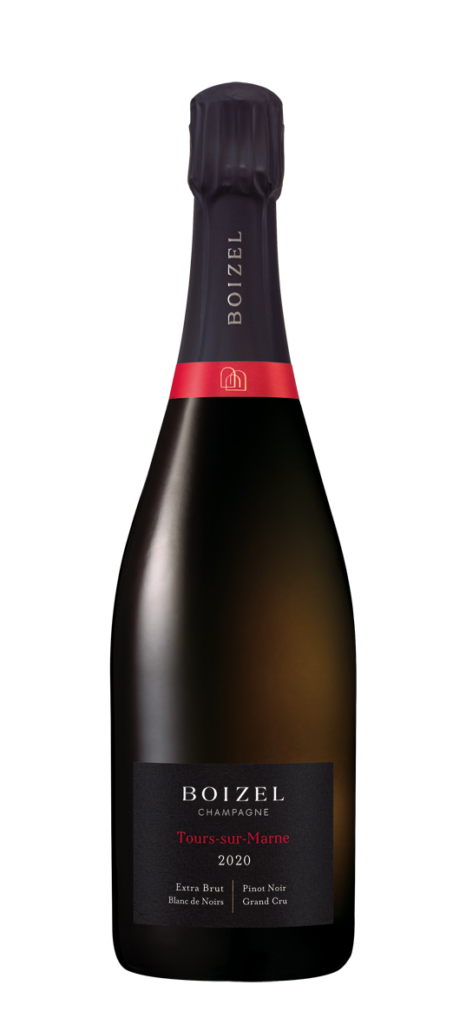
Tours-sur-Marne 2020 is taking a new direction. Here, Pinot Noir takes center stage. The village is located at the junction of the Montagne de Reims and the Marne Valley, in a clay-limestone terroir rich in chalk. While Avize focuses on the verticality of Chardonnay, Tours-sur-Marne gives the wine a fuller structure. The press release describes a golden color with amber highlights, a nose of ripe fruit, brioche, fresh butter, and praline, with spicy and slightly roasted notes. The palate is driven by the volume of the Pinot Noir, crisp red fruit, spices, and a lingering finish.
This side-by-side comparison may be the true appeal of these two cuvées. It’s not about pitting white against black, finesse against structure, chalk against clay, but rather about reminding us that Champagne remains a region of nuanced interpretations. Ever since the region reinforced its narrative around the vineyards, houses, and cellars designated as a UNESCO World Heritage Site in 2015, the discourse on Champagne has shifted: the bottle alone is no longer enough; one must now understand the soil, the village, the slope, the cellar, and time. Boizel’s single-vineyard wines are part of this broader movement—one in which Champagne is no longer content to merely project an image of elegance, but seeks to make its geography legible.
That leaves the question of balance. A single-village wine is not a demonstration of absolute purity; it is a deliberate narrowing of the scope of expression. In Champagne, where blending has long been considered a fine art, singling out a single village is almost tantamount to accepting a form of vulnerability. Avize 2020 and Tours-sur-Marne 2020 do not merely represent two aromatic profiles. They represent two ways of giving voice to time: one through the chalky tension of Chardonnay, the other through the depth of Pinot Noir.
Each vintage is released as a limited edition of 4,000 bottles, available in restaurants and bars, at the estate, and through the company’s online store. This figure matters less as an argument for rarity than as an indication of method: it serves as a reminder that a vintage, when taken seriously, cannot be produced on a large scale. It is crafted plot by plot, vintage by vintage, and through decisions made in the cellar. In an era when champagne is often reduced to its social function, Boizel chooses a quieter path: that of a wine that begins with a specific location.
Cette publication est également disponible en :

