
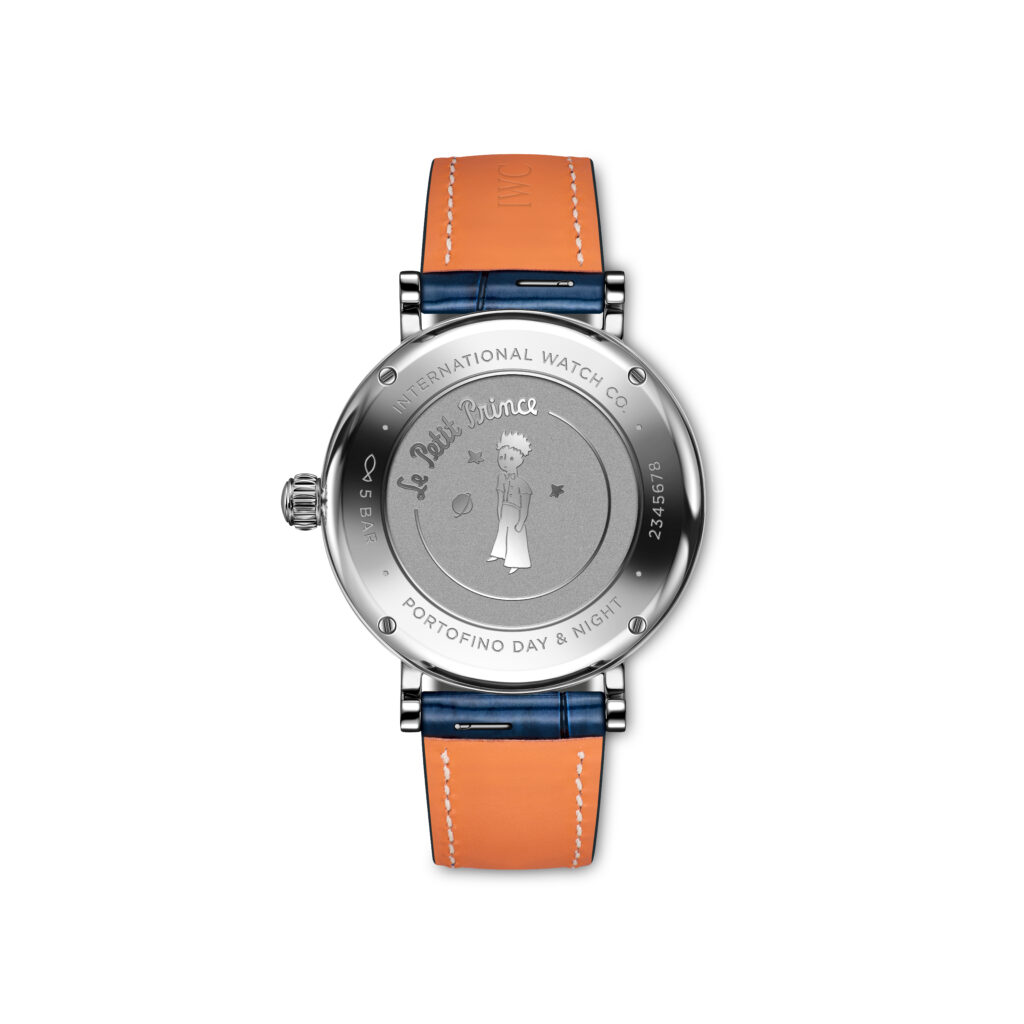
The Portofino Automatic Day & Night 34 Le Petit Prince is not the first watch to draw inspiration from the world of Saint-Exupéry. However, this is the first time that IWC Schaffhausen has featured this character in its Portofino collection—and the choice of movement says more about the piece’s conceptual intent than any reference to the novel.
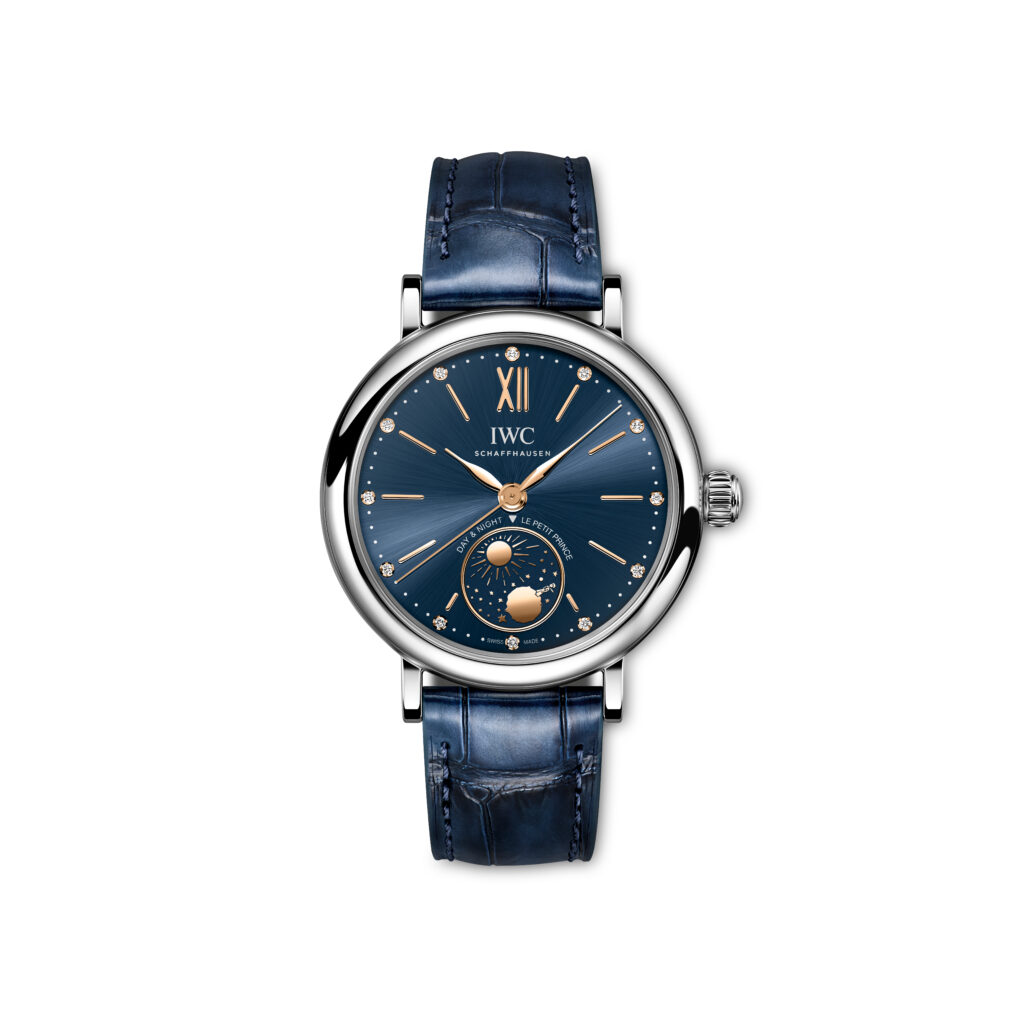
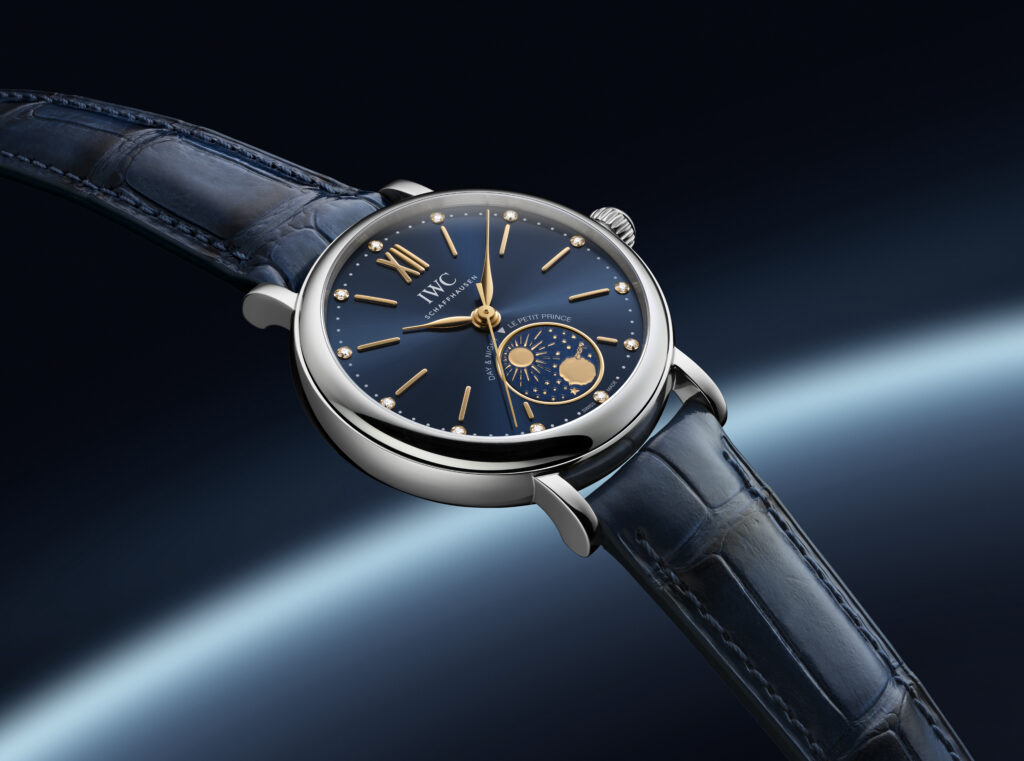
The central feature of this timepiece is a day-night disc positioned at 6 o’clock, which completes a full rotation every 24 hours. At noon, the sun appears in the upper window. At midnight, the moon. Between the two, a continuous transition, without any mechanical interruption. On this disc, the Little Prince is depicted standing on the golden moon—not as an ornament, but as a hand: the figure indicates the moment in the cycle.
The connection between the source text and the complication is not coincidental. *The Little Prince*, published in 1943, opens with a narrator obsessed with sunsets—forty-four in a single day, as seen from his asteroid. Saint-Exupéry’s obsession is not with the passage of time, but with time made visible. IWC’s day/night indicator addresses precisely this issue: making perceptible what conventional time obscures—the position of the sun, the fact that it is night or day, here and now.
Technical details: The 35180 caliber beats at 28,800 vibrations per hour, features 24 jewels, and has a 50-hour power reserve. The case measures 34 mm in diameter and 8.9 mm in thickness—proportions referred to as “dress” in the Manufacture’s terminology, distinct from its sport lines. The domed sapphire crystal features an anti-reflective coating on both sides. The calfskin strap is hand-dyed by Santoni, a leather goods workshop founded in Civitanova Marche in 1975; the quick-change system allows for strap replacement without tools.
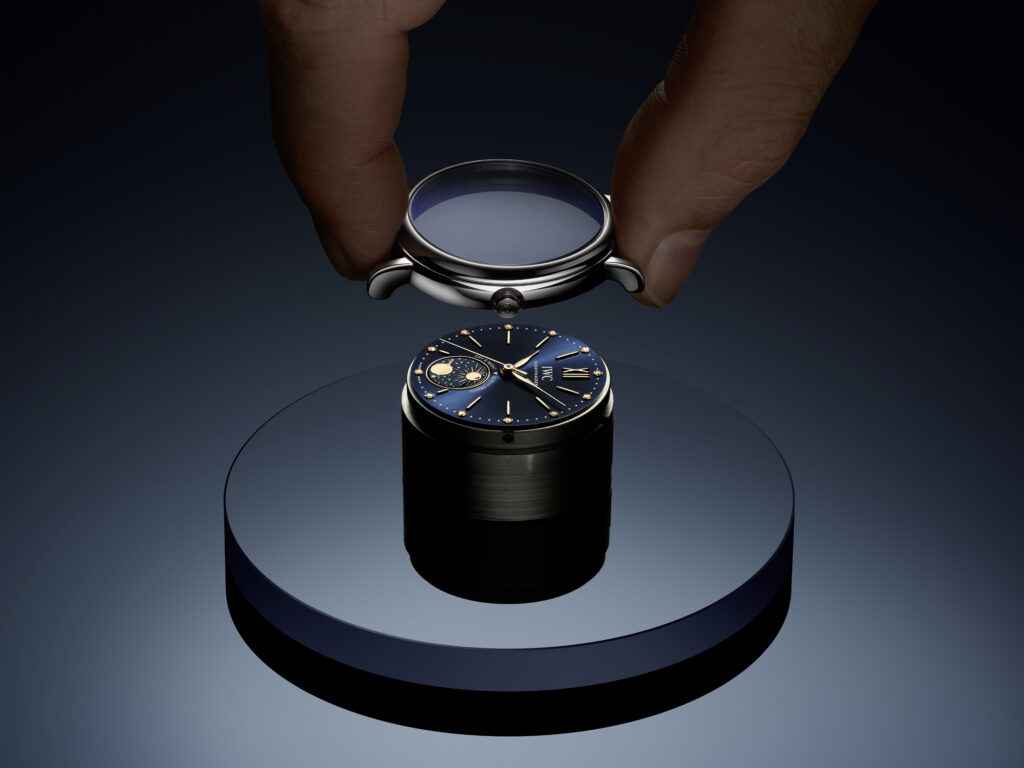
The blue dial features a sunray finish—a circular polishing technique radiating from a central axis, which causes the intensity of the light to vary depending on the angle of incidence. It is not a uniform dial: it comes alive depending on the ambient light.
IWC Schaffhausen was founded in 1868 in Schaffhausen by the American engineer Florentine Ariosto Jones, who was convinced that rigorous industrial techniques and watchmaking expertise could coexist. The Manufacture has since developed several “The Little Prince” series, primarily within the Pilot’s Watches and Portugieser collections. The Portofino collection, whose design is featured here, belongs to a different category—more elegant, less utilitarian—which alters the meaning of the literary reference: the aviator gives way to the contemplative traveler.
The question raised by this timepiece is not a new one in the history of watchmaking: what is the point of a complication if it tells the wearer nothing they didn’t already know? The day/night indicator is useful for those who travel across time zones or sleep during the day. For everyone else, it’s something else entirely—a way to glance at one’s wrist and know, without having to do the math, whether it’s the sun or the moon that’s shining.
Cette publication est également disponible en :

