
Some gemstones define the color, while others primarily play with light. Aquamarine belongs to the latter category. In Lili, Cris Porto uses it not merely as a touch of blue, but as a transparent volume: a light, almost liquid material that white gold and diamonds frame without weighing it down.
The set consists of three pieces—a ring, earrings, and a necklace—all designed around this contrast between the weight of the gemstones and visual lightness. The ring, crafted in 18-karat white gold, features a 21-karat aquamarine surrounded by 95 diamonds totaling 0.85 carats. The design here plays on a halo effect: not to conceal the central stone, but to highlight its depth and allow its color to radiate outward.
The earrings shift the design language toward verticality. Two aquamarines totaling 30.32 carats take on a teardrop shape, accompanied by pear-shaped diamonds weighing 1.01 carats each and 375 diamonds totaling 3 carats. The aquatic motif, often too literal in jewelry, finds its justification here in the very cut of the stones: the teardrop is not merely decorative; it defines the drape, the movement, and the way the piece frames the face.
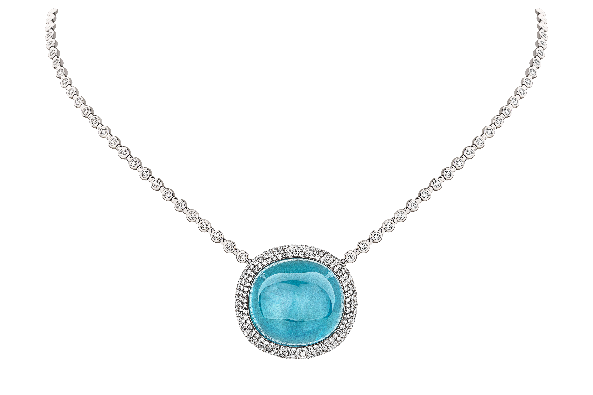
The necklace is the most striking piece. A 57-carat aquamarine is set on an 18-karat white gold chain, surrounded by 232 diamonds totaling 3.35 carats. On this scale, the stone is no longer merely a detail; it becomes architecture. Lili’s appeal lies precisely in this ability to maintain a sense of restraint despite the stone’s significant carat weight. The piece does not seek to be spectacular through excess, but through the clarity of its composition.
Aquamarine, a blue-green to blue variety of beryl—the same mineral group as emerald—is prized for its ability to form large, well-formed crystals. The Gemological Institute of America notes that the finest-quality aquamarines must exhibit high visual clarity, as visible inclusions are less acceptable than in emeralds. This requirement explains Cris Porto’s choice: a clear stone tolerates neither a rough cut nor an overly showy setting.
Brazilian designer Cristiane Porto, originally from Uberlândia in Minas Gerais, founded a jewelry house bearing her name after studying art and gaining hands-on experience in the field. Her official website emphasizes artisanal craftsmanship and a personal connection to gemstones, which often serve as the starting point for the creative process. This approach is consistent with Lili’s work, where the design seems less imposed on the gemstone and more organized around how it behaves in the light.
In the contemporary jewelry scene, Cris Porto’s appeal also stems from her Brazilian roots. Brazil is not merely a tropical fantasyland for European houses; it remains a land of gemstones, gem cutters, and vibrant colors. FashionNetwork had already noted, upon Cris Porto’s arrival in Paris, her work with tourmalines and aquamarines sourced and cut in Brazil, paired with gold and diamonds. Lili follows this same aesthetic: colorful fine jewelry that does not seek to imitate the codes of Place Vendôme, but rather to shift them toward a more radiant clarity.
One editorial caveat remains: the precise origin of the aquamarines in this set is not specified in the information provided. This is a shortcoming, as a stone’s provenance, cut, any treatment it may have undergone, and certification are no longer considered secondary details in contemporary jewelry. They are now integral to the cultural interpretation of the piece, just as much as the design or the setting.
With “Lili,” Cris Porto presents not so much a set of ceremonial jewelry as an exercise in controlled transparency. Three pieces, three masses of stone, one idea: to hold the sky within a white setting, without robbing it of its silence.
Cette publication est également disponible en :

