
The much-anticipated Louvre Abu Dhabi opened to the public on Saturday, November 11, 2017, with a week of spectacular festivities and celebrations.
It is the first museum of universal ambition in the Arab world, and opens up a new perspective on the history of art in a globalized world. An architectural icon designed by Jean Nouvel, the museum is located on Saadiyat Island, a district dedicated to culture and the arts.
In its spacious permanent galleries, the inaugural show features 600 works, of which 300 are from the collection, and 300 are on loan from 13 French partner museums. The Louvre Abu Dhabi will launch its temporary exhibition program in December. The Louvre Abu Dhabi is the result of an exceptional collaboration between Abu Dhabi, the capital of the United Arab Emirates, and France. The new museum’s collections span the entire history of mankind, and are presented to explore a universal narrative, drawing on works and artifacts from all regions of the world.
The chronological tour of the inaugural presentation, which draws on the collection from prehistory to the present day, covers universal themes in 12 chapters, from the birth of the first villages to universal religions, or from the establishment of industrial civilization to the globalized world. His Excellency Mohamed Al Mubarak, Chairman of the Department of Culture & Tourism and Tourism Development and Investment Company (TDIC) said: “The United Arab Emirates is proud of its rich heritage, while embracing progress and change. Abu Dhabi society is dynamic, vibrant 2 life and multicultural, and its citizens live in harmony and tolerance.
This diversity is reflected in the Louvre Abu Dhabi collection, which celebrates mankind’s innate fascination with discovery. Every visitor will discover extraordinary works of art and artifacts from different cultures around the world, both familiar and surprising. Louvre Abu Dhabi is a gift from the United Arab Emirates to the world, and we look forward to welcoming our first visitors.” Manuel Rabaté, Director of Louvre Abu Dhabi, said: “Louvre Abu Dhabi has set a new standard in the region and acts as a magnet for the next generation of museum professionals. Louvre Abu Dhabi reinvents the notion of the universal museum, born in the 18th century, and reinterprets it for the 21st century. In a multipolar, globalized world with multiple narratives, these notions are more important than ever. By exhibiting works from different cultures side by side, the Louvre Abu Dhabi museum project underlines the interconnections between civilizations and highlights the links between different ideologies, aesthetics and artistic techniques.
The narrative conveyed by the museum takes visitors on a journey through the history of mankind, backed by a collection of exceptional treasures.” Jean-Luc Martinez, President-Director of the Musée du Louvre and Chairman of the Scientific Council of Agence France-Muséums said: “Today sees the inauguration of the Louvre Abu Dhabi, a museum like no other, which can be described as the most ambitious cultural project of the early 21st century. It conveys a message of openness that is vital in our time. At the outset of this incredible project, the Emiratis had a desire for France, a desire for the Louvre. Today, we are proud that the expertise of French museums and the union of extraordinary works of art have contributed to the creation of a museum that will dazzle the world and mark the history of museums.
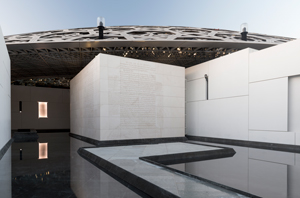
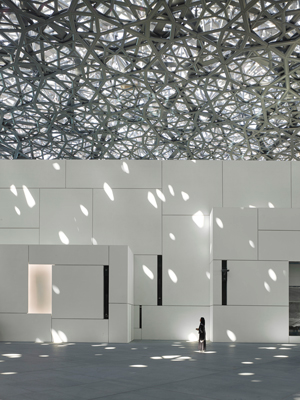
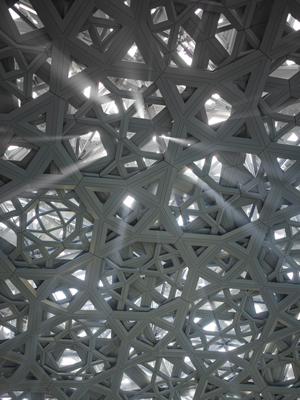
Architect Jean Nouvel conceived the Louvre Abu Dhabi as a city-museum (medina) that combines traditional Arab inspiration, contemporary design and cutting-edge engineering to control energy consumption. Visitors can take promenades overlooking the sea, sheltered by the building’s emblematic dome. The dome is made up of 7,850 different metal stars, assembled in a complex geometric structure. The sun filtering through this structure creates a “rain of light” evoking the shadows of intertwining palms in the oases of the United Arab Emirates. Jean Nouvel, architect of the Louvre Abu Dhabi, commented: “The Louvre Abu Dhabi embodies an exceptional program in the literal sense of the word. Its vocation is to express the universal through the ages. Its architecture is intended as a place of convergence and interference between the immense sky, the sea-horizon and the desert territory. Its dome and cupola imprint the place with an awareness of time and the moment, through a light evocative of a spirituality all its own.”
The collection
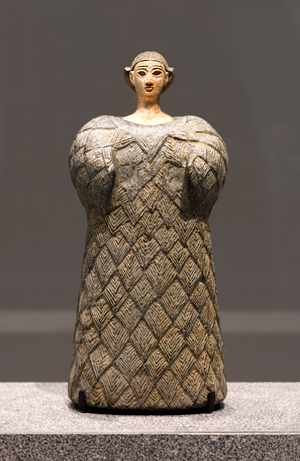
The museum’s collection is constantly growing, and already includes more than 600 masterpieces and first-rate artifacts, ranging from archaeological finds to decorative art objects, neo-classical sculptures, paintings by modern masters and contemporary commissions. Half of these works will be displayed in the 6,400 square meters of permanent galleries for the opening year. Jean-François Charnier, Scientific Director of Agence France-Muséums, commented: “At the Louvre Abu Dhabi, works of art are the most eloquent testimony to the passage of time, offering visitors a retrospective reading of the eras that have shaped the world in which they live. Encounters with works from different cultures give rise to emotions and questions, making this universal museum the ideal place to initiate a global history of humanity. 3 Among the ancient masterpieces in the collection are a Princess of Bactria created in Central Asia at the end of the 3rd millennium BC, a Greek Sphynx from the 6th century BC, and an Iranian gold bracelet in the shape of a lion. As for the exploration of universal religions, visitors can discover extracts from sacred texts, such as a leaflet from the “Blue Koran”, a Gothic Bible, a Bodhisattva from the 2nd or 3rd century and a white marble Buddha head from China.
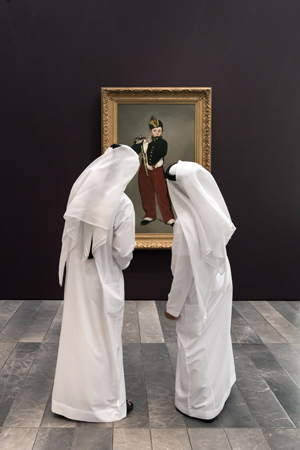
Major pieces from later periods include an ancient astrolabe displayed in the room dealing with the science of cosmography; a Chinese red lacquer commode made in France by Bernard II van Risenburgh, testimony to the cultural interactions that accompanied transcontinental trade; a Madonna and Child by Giovanni Bellini illustrating the emergence of religious art and its iconography. Other works, such as a bronze Oba Head from the Kingdom of Benin and The Good Samaritan by Jacob Jordaens, illustrate the magnificence of royal courts around the world. A series of iconic paintings capture the emergence of modernity, including Gustave Caillebotte’s La Partie de bésigue, Paul Klee’s Douceur d’Orient, Manet’s Le Bohémien, Gauguin’s Les Enfants luttant, Osman Handy Bey’s Jeune Émir à l’étude, Piet Mondrian’s Composition en bleu, rouge, jaune et noir, René Magritte’s La Lectrice soumise and Picasso’s Portrait d’une dame.
The contemporary art collection includes nine paintings by Cy Twombly, a monumental sculpture by internationally renowned artist Ai Weiwei, and monumental site-specific installations by Jenny Holzer and Giuseppe Penone, the first commissions in an ongoing program. These works, exhibited outside under the shelter of the dome, are integrated into the museum’s architecture.
The intergovernmental agreement between the United Arab Emirates and France guarantees the Louvre Abu Dhabi access to the expertise and training provided by 17 French partner institutions and to loans from 13 major French museums over a 10-year period. The Louvre Abu Dhabi will also benefit from the organization of temporary exhibitions by these institutions, over a 15-year period. Marc Ladreit de Lacharrière, Chairman of Agence France-Muséums, commented: “What more exciting challenge could there be for French museums and cultural institutions than to work together with their partner, the Louvre Abu Dhabi, to invent a new museum like no other? This collective commitment to the birth of the Louvre Abu Dhabi reminds us that culture and education remain priceless fundamentals that are embodied in a multitude of ways in this museum, which is now accessible to all”. The French partner museums are lending 300 major works for the inaugural exhibition. These include Leonardo da Vinci’s La Belle Ferronnière (Musée du Louvre), Vincent van Gogh’s Self-Portrait (Musée d’Orsay et de l’Orangerie), a rare ivory salt cellar from the Kingdom of Benin (Musée du Quai-Branly – Jacques Chirac), a Globe by Vincenzo Coronelli (Bibliothèque nationale de France), a pair of mistletoe vases (Musée national des arts asiatiques Guimet), Bonaparte franchissant les Alpes by Jacques-Louis David (Château de Versailles), Jean d’Aire, from the Bourgeois de Calais group by Auguste Rodin (Musée Rodin), a 13th-century reliquary (Musée de Cluny – Musée national du Moyen Âge), a Persian-shaped Chinese ewer (Musée des arts décoratifs), 4 Marmesse armor (Musée d’archéologie nationale – Saint-Germain-en-Laye), Primaticcio’s Apollo du Belvédère (Château de Fontainebleau) and Alberto Giacometti’s Femme debout II (Centre Pompidou). Works from regional institutions and the United Arab Emirates will also be on display at the opening. The National Museum of Ras Al Khaimah is lending several major works, including a pendant dating from 2,000 – 1,800 BC, a Neolithic painted vase discovered at the 8,000-year-old site of Marawah Island, off the coast of Abu Dhabi. The Al Ain National Museum is lending an important fragment of stucco from an ancient church on Abu Dhabi’s Sir Bani Yas Island. Other masterpieces on loan from regional museums include a prehistoric stone tool dating from 350,000 BC, a milestone with inscriptions in kufic script indicating the distance to Mecca, and a funerary stele from Mecca dating from 700-900 AD (100-200 years after Hegira) from the collections of the Saudi Commission for Tourism & National Heritage. A collection of over 400 silver dirhams from the Abbasid Caliphate of Iraq, the Samanid and Saffarid dynasties, discovered at Sidamah (al-Waqba) and on loan from the National Museum – Sultanate of Oman. An eight-millennium-old two-headed figurine, the Ain Ghazal Statue, kept at the Department of Antiquities in Jordan.
Children’s Museum
The Louvre Abu Dhabi Children’s Museum will also open to the public. The space provides families and young audiences (aged 6 to 12) with an opportunity to discover the Louvre Abu Dhabi collection. It will feature original works of art, displayed at children’s height in specially designed showcases, and interactive mediation tools. The Children’s Museum offers hands-on activities and educational workshops in a range of immersive, interactive spaces. The inaugural exhibition at the Children’s Museum is entitled Traveling Shapes and Colours. It explores shapes and colors, such as floral and geometric ornamentation, through a selection of works from different artistic traditions around the world, ranging from 16th-century Turkish ceramics to 18th-century French decorative vases and a 19th-century painting by German artist Paul Klee.
Inaugural exhibition Entitled From One Louvre to Another: Opening a Museum for Everyone (“D’un Louvre à l’autre : ouvrir un musée pour tous”), the inaugural temporary exhibition will open on December 21, 2017. It traces the birth of the Musée du Louvre in 18th-century Paris. Conceived in three parts, the exhibition explores the royal collections at Versailles during the reign of Louis XIV; the presence of the Académie and the Salons at the Louvre, converted into an artists’ palace; and the creation of the Musée du Louvre. The exhibition brings together some 150 paintings, sculptures, decorative arts objects and other masterpieces from the Louvre and Versailles collections. The exhibition is curated by Jean-Luc Martinez, President and Director of the Musée du Louvre, and Juliette Trey, Curator of the Department of Graphic Arts at the Musée du Louvre. Practical information In addition to its 23 permanent galleries, the museum has a temporary exhibition space and a Children’s Museum, a 270-seat auditorium, a restaurant, a store and a café. Museum and exhibition hours: Saturday, Sunday, Tuesday and Wednesday, 10am-8pm; Thursday and Friday, 10am-10pm. Last admission 30 minutes before closing time. The museum is closed to the public on Mondays. Admission to the museum is AED 60 for general admission; AED 30 for visitors aged 13 to 22 and UAE education professionals. Free admission for children under 13, ICOM and ICOMOS members, journalists, disabled visitors and their companions. Membership of the Louvre Abu Dhabi’s Art Club offers a range of attractive benefits and discounts, as well as the opportunity to become part of the museum’s dynamic cultural membership community. 6 Louvre Abu Dhabi offers a number of guided tours enabling visitors to explore the museum’s collection and architecture – including ‘Discover Louvre Abu Dhabi’ tours for children. The museum’s audio tours are available in Arabic, English, French, German, Hindi, Japanese, Korean, Russian and Spanish.
For information on tickets and tours, please visit the website www. Louvreabudhabi.ae
Cette publication est également disponible en :

