
The EY Exhibition: Impressionists in London, French artists in exile (1870-1904)
November 2, 2017 – April 29, 2018
Tate Britain | London, United Kingdom
The Franco-Prussian War of 1870 triggered a wave of emigration of French artists across the Channel, including Claude Monet, Camille Pissarro, Alfred Sisley and James Tissot. The themes of The EY Exhibition: Impressionists in London, French Artists in Exile (1870-1904) include the influence that London and British society had on their work, the emergence of a microcosm of exiles that fostered encounters and support, the influence of some of these artists on art education across the Channel, and the permanence of subjects linked to the British capital. From November 2017 to April 2018, this exhibition brings together a selection of 100 key works and the largest group of Claude Monet’s Views of Parliament since 1973 in Great Britain. The EY Exhibition: Impressionists in London, French Artists in Exile (1870-1904) aims first and foremost to reveal how French artists in exile viewed the codes of British society and culture, notably different from the “café culture” of Paris and France at the time. Evocative depictions of park scenes – such as Pissarro’s Kew Green (1892) – feature in the exhibition. They illustrate an atmosphere different from that of Parisian public gardens, where walking on the lawns was forbidden. Regatta scenes by Alfred Sisley and James Tissot also bear witness to the way in which British traditions and customs aroused the interest of Impressionist artists. During their stays in London, some artists recreated a microcosm of nationals in which leading personalities helped them develop their careers and provided financial support. The exhibition focuses on Charles-François Daubigny’s role as mentor to Claude Monet, and reveals the key role played by opera singer and patron Jean-Baptiste Faure, whose works from his personal collection – Molesey Weir, Hampton Court, Morning 1874 – are featured in the exhibition. The exhibition also focuses on the art dealer Paul Durand-Ruel. Indeed, it was in London in 1870-71 that the great Impressionist dealer first met Monet and Pissarro. Over the course of his career, Durand-Ruel was to acquire more than 5,000 Impressionist works, which, Monet himself admitted, saved these artists from starvation. The exhibition also recalls Jean-Baptiste Carpeaux’s stays in London, organized to remain close to his great patron, the former emperor Napoleon III. Part of the exhibition is also devoted to the little-known role played by certain French artists in the teaching of the fine arts in Great Britain. Painter and engraver Alphonse Legros, who taught at London’s Slade School from 1876 to 1893, had a notable influence on art education in Great Britain. His influence was particularly decisive in the depiction of peasant life, as evidenced by The Tinker, an 1874 painting. Legros also introduced his patrons, Constantine Alexander Ionides and George Howard, 9th Earl of Carlisle, to the sculptor Aimé-Jules Dalou, who, along with Edouard Lantéri, another exiled sculptor, strongly influenced the teaching of modeling in Great Britain. The final and most important part of the exhibition is devoted to the River Thames. In particular, it presents the largest gathering of representations of the London Parliament since 1973. Such views of the Thames and London became a recurring theme for French artists. A selection of paintings by André Derain on the same subject, executed decades later in direct response to those by Claude Monet, demonstrates their enduring appeal. The exhibition concludes with Monet’s Entente Cordiale, which marked the culmination of the artistic project begun by the painter in 1870. The EY Exhibition: Impressionists in London, French Artists in Exile (1870-1904) is curated by Caroline Corbeau-Parsons in collaboration with the Petit Palais and Paris Musées. The exhibition is accompanied by an illustrated catalog and a program of lectures and events at Tate Britain.
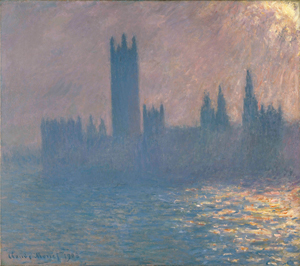
Claude Monet (1840-1926)
Le Parlement, effet de soleil, 1903
Oil on canvas
813 x 921 mm
Brooklyn Museum of Art, New York
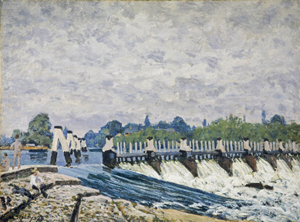
Alfred Sisley (1839 – 1899)
Molesey Weir, Hampton Court, Morning, 1874
Oil on canvas
511 x 688 mm
National Galleries of Scotland (Edinburgh, UK)
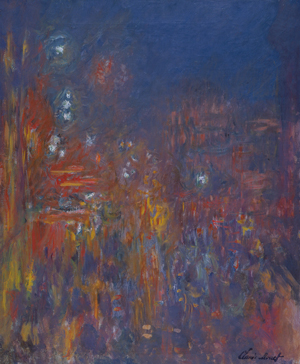
Claude Monet (1840 – 1926)
Leicester Square, 1901
Oil on canvas
805 x 648 mm
Coll. Fondation Jean et Suzanne Planque (in deposit at Musée Granet, Aix-en-Provence)
Photo: © Luc Chessex
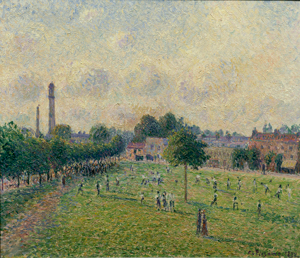
Camille Pissarro (1830 – 1903)
Kew Green, 1892
Oil on canvas
460 x 550 mm
Musée d’Orsay (Paris, France)
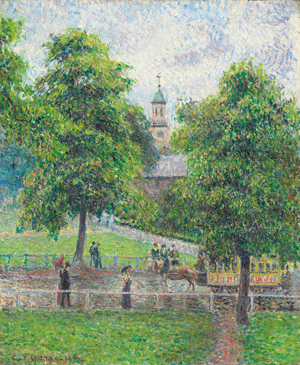
Camille Pissarro (1830 – 1903)
Saint Anne’s Church in Kew, London, 1892
Oil on canvas
548 x 460 mm
Private collection
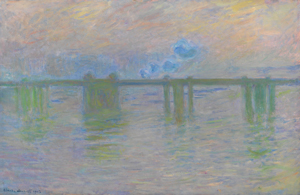
Claude Monet (1840 – 1926)
Charing Cross Bridge, 1899 – 1902
Oil paint on canvas
650 x 1000 mm
Private collection
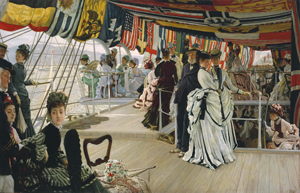
James Tissot (1836-1902)
Ball on a boat, c.1874
Oil on canvas
1012 x 1476 x 115 mm
Tate
Presented by the Trustees of the Chantrey Bequest 1937
Cette publication est également disponible en :

