
For its thirtieth anniversary, the Maison Européenne de la Photographie opens its walls to Irving Penn. Under the title Penn & Fashion, the exhibition does not merely recount a career: it documents the moment when fashion photography stopped illustrating and began to sculpt.
There is one date on which the exhibition Penn & Fashion, presented at the MEP from 30 September 2026 to 17 January 2027, does not dwell, but which the visitor reconstructs alone while walking through the rooms: 1947, the year Irving Penn photographed a Christian Dior coat with the same frontal rigour he would apply, sixty years later, to a red lacquer lid. Between these two images, one conviction does not vary: fashion deserves the same gaze as any other noble subject in the history of art.
The exhibition, produced with The Irving Penn Foundation and the Nicola Erni Collection, unfolds a chronological route that crosses the decades without ever changing its visual grammar. The 1950s belong to Parisian haute couture, Dior and Balenciaga above all, magnified by Lisa Fonssagrives and Jean Patchett. The 1970s swing towards the extravagance of Ungaro and Courrèges, with silhouettes worn by Marisa Berenson or Lauren Hutton. Then come Yves Saint Laurent and Karl Lagerfeld in the 1980s, before a more unexpected collaboration: the one with Issey Miyake, whose sculptural volumes find in Penn a photographer able to treat them as architectural objects rather than as worn garments.
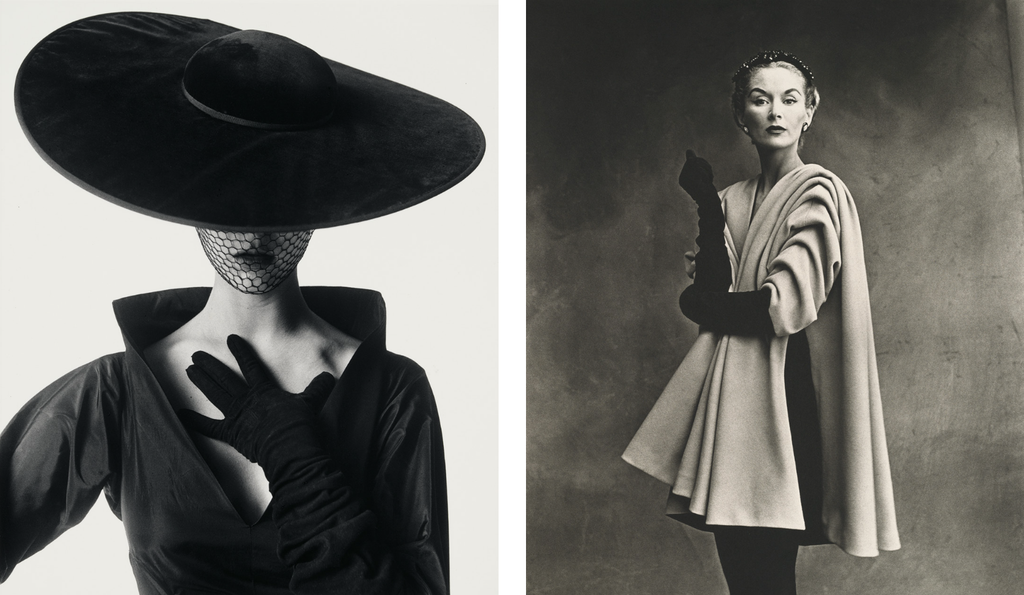
Irving Penn, Balenciaga Mantle Coat (Lisa Fonssagrives-Penn), Paris, 1950, MEP Collection, Paris. Acquired in 1992 © Condé Nast
What strikes the visitor as the hanging progresses is the constancy of a method rather than the evolution of a style. Penn does not seek to follow his era; he imposes on every era the same protocol: neutral backdrop, controlled light, long time. Whether the subject is a Balenciaga dress in 1950, an embroidered Yves Saint Laurent cape inspired by Braque in 1988 or a Chanel feather headdress in the 1990s, the approach remains identical: isolating the form from all context to reveal what it owes, alone, to the hand that conceived it. It is this discipline, more than the glamour of his clients, that allowed his images to pass through Vogue without ever dissolving into it.
The MEP does not present Penn as a fashion photographer who attained the status of artist through an accumulation of prestige, but as an artist who chose fashion as his material, just as he photographed crushed cigarettes or skulls. It is a reversal of perspective that helps explain why his images of the Paris collections of the 1950s continue, seven decades later, to circulate as absolute references: not because they document a vanished fashion, but because they extracted from it a geometry that does not go out of fashion.
The exhibition is accompanied by a programme at MEP Studio: Nanténé Traoré, a rising figure of the French scene, presents pays des merveilles there from 30 September to 29 November, followed by the first solo exhibition in France of the American artist David Gilbert, Apparitions, from 4 December to 17 January 2027. Two contemporary voices that extend, each in their own way, the question Penn has been asking since 1947: how far can an image transform its subject without betraying it? The retrospective does not settle it. It simply lets the prints, lined up over sixty years, answer in its place.
Cette publication est également disponible en :


