
A few kilometres from La Romana, Catalina is about to change status in the imagination of Caribbean travel.
Not because a new beach has been discovered there, but because a site classified as a natural monument is becoming an organised, repeated and equipped port of call.
The challenge will be less to manufacture spectacle than to prove that a tourist infrastructure can remain legible within a protected landscape.
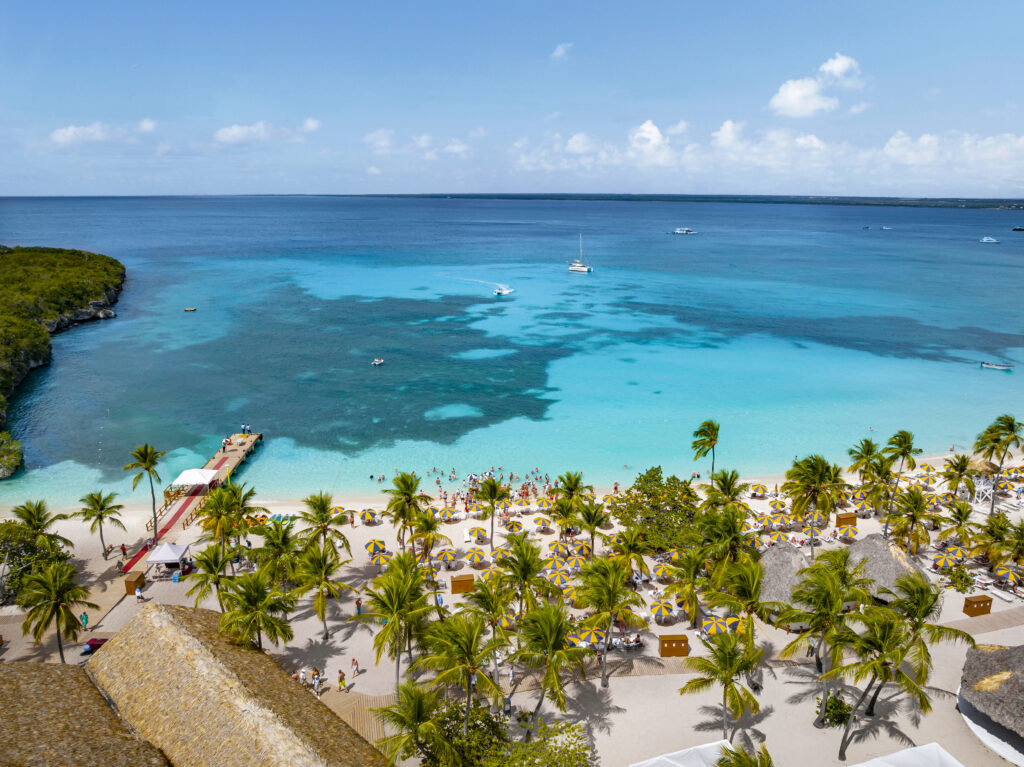
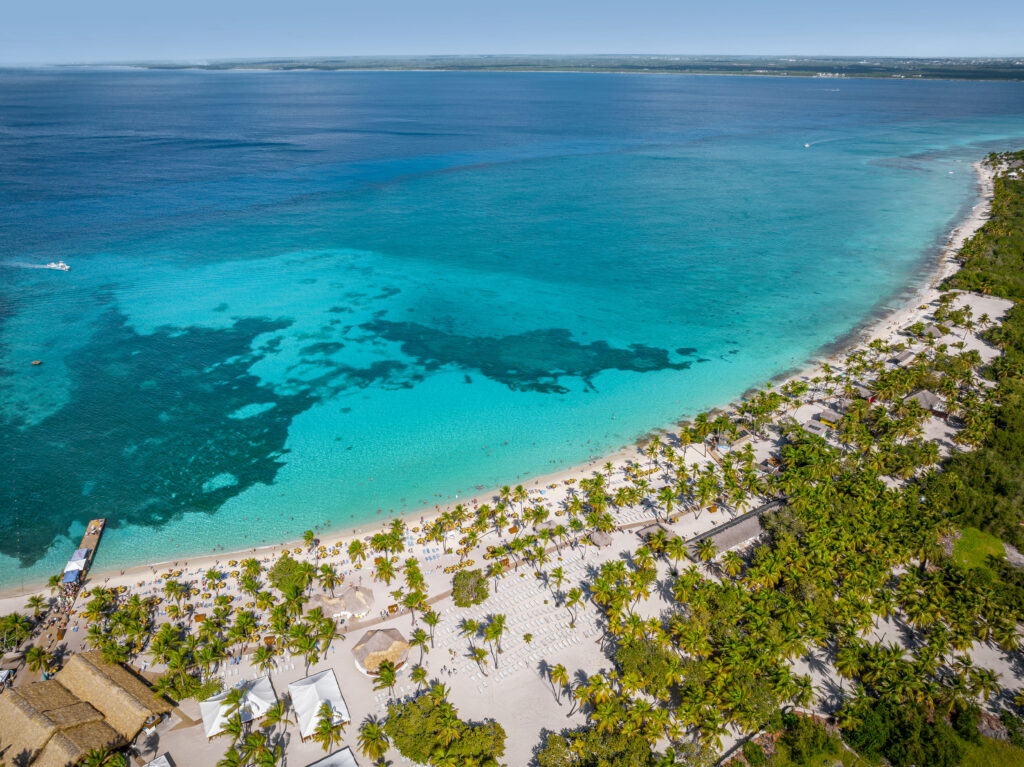
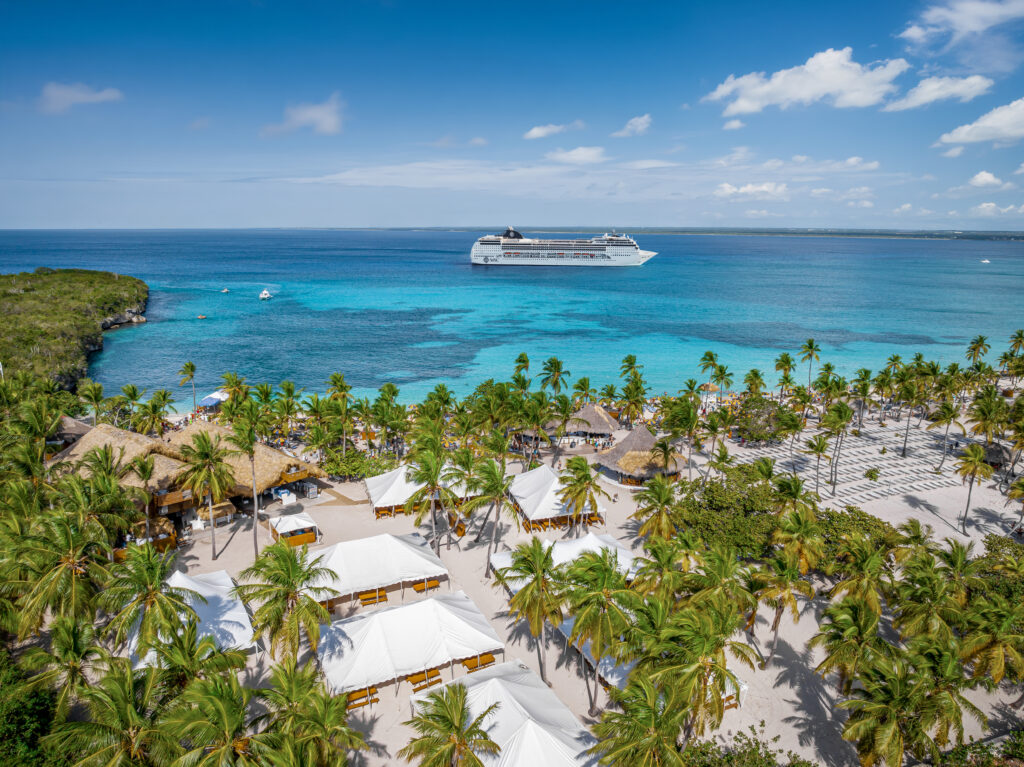
The opening of Catalina Sugar Beach is announced for November 2026 on Catalina Island, off La Romana, in the Dominican Republic. The project is being developed in partnership with CTL Maritime and Casa de Campo Resort & Villas. It is meant to welcome passengers of MSC Cruises and Explora Journeys, as well as guests of Casa de Campo. Behind the expected vocabulary of the Caribbean beach, the most interesting fact lies elsewhere: Catalina is a protected natural monument. The new port of call will therefore have to find its place in a territory whose primary value precedes the hospitality installed there.
This tension is at the heart of the project. The announced development does not rest on a grand architectural gesture, but on a succession of facilities intended to organise uses: a buffet set in an open beach pavilion, two bars including a palapa, a water-sports centre, cabanas and day beds for hire, as well as modernised changing rooms, showers and toilets. To this is added a landscaped trail running through the vegetation, punctuated by educational signage devoted to the tree species and to viewpoints on the island.
Taken separately, each of these elements belongs to seaside infrastructure. Together, however, they outline a very contemporary way of producing the port of call: no longer simply landing on a beach, but scripting the time spent ashore, distributing flows, making services immediately accessible and giving the landscape a guided reading. Luxury here is not that of ostentation. It lies in the ability to make the logistical effort disappear behind an experience that must seem self-evident.
This logic will take on a particular dimension from November, when MSC Opera will use La Romana as its home port and include Catalina Sugar Beach in each of its weekly itineraries. The announced voyages run for seven nights, with the possibility of linking two rotations to form a fourteen-night journey. The island will therefore not be an occasional call: it will become a regular point in a system of tourist circulation.
This change of scale matters. An island destination can long keep the image of an untouched elsewhere as long as visitor numbers remain occasional or diffuse. Repetition transforms the relationship to the place. It requires thinking about carrying capacity, maintenance, waste management, water, energy, movement on site and, above all, the way visitors are concentrated or dispersed. Yet these data have not yet been communicated. They will nevertheless be decisive in judging the coherence between Catalina’s protected status and the new role assigned to it.
The choice to also offer excursions to Saona Island, the Cueva de las Maravillas or Altos de Chavón extends this logic. Catalina Sugar Beach becomes less an isolated destination than a gateway into a tourist territory already structured around La Romana. The beach then works as an interface: it condenses the short time of the call while opening onto a network of natural and cultural sites. For Explora Journeys, whose calls at Catalina will be more selective, the same geography can be read differently, with more room left for the rhythm of the voyage and the rarity of the stop.
What is taking shape at Catalina thus belongs to a broader evolution of maritime hospitality: the shoreline is no longer merely a backdrop, it becomes an edited infrastructure. What the traveller sees, the way they move around, what they learn about the place and what remains out of frame are all chosen. The announced educational trail is, in this respect, a telling detail. In a protected area, naming the species and explaining the landscape can be a first gesture of mediation. But mediation is worth only as much as the concrete data on the impact of visitor numbers that accompany it.
Catalina Sugar Beach will therefore be worth watching after its opening, when the promise can be set against actual use. The number of simultaneous visitors, the coastal protection measures, the consumption of resources and the place given to local actors will say more about the project than the image of a perfectly ordered beach. In the Caribbean, where the very idea of escape has become an industry, the next frontier of rigour may well be this: organising access without making disappear what made the place desirable before it was developed.
Cette publication est également disponible en :


