
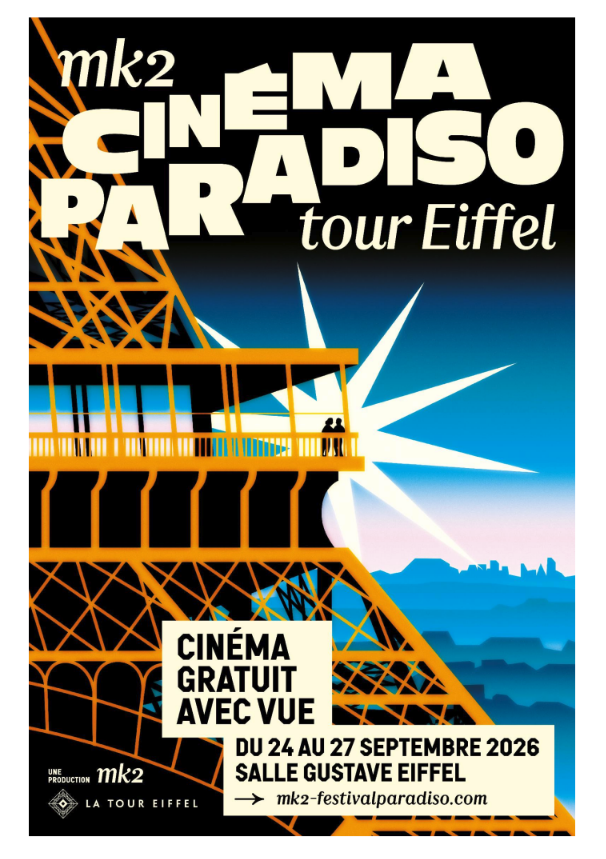
From September 24 to 27, 2026, Cinéma Paradiso will take over the Salle Gustave Eiffel, on the first floor of the Eiffel Tower, for the first time. The most interesting aspect, however, is not the arrival of a film festival at a spectacular venue. It lies in the way mk2 has been transforming heritage landmarks into temporary cinema spaces since 2013—and what this strategy reveals about the cultural role of Paris’s major landmarks.
Following the Grand Palais, the Louvre, La Seine Musicale, the Villa Carmignac, and the 24 Hours of Le Mans circuit, the Eiffel Tower, in turn, becomes both a screen and a symbol.
Cinéma Paradiso was born from a simple idea: to take cinema out of the dark theater without reducing it to an open-air experience. The choice of venues matters just as much as the programming. Each edition combines film screenings, architecture, and a collective experience, shifting the focus: people no longer come just to watch a movie, but to observe how the film transforms the venue that hosts it—and vice versa.
The first edition at the Eiffel Tower follows this same approach. The festival will take place in the Salle Gustave Eiffel, on the first floor of the monument, from September 24 to 27. Admission will be free, via a lottery whose opening is set to be announced on September 8, along with the full lineup and guest list. On September 24, the festival will kick off with a private evening event organized in partnership with Armani Beauty to celebrate the launch of a men’s fragrance.
This commercial partnership might seem at odds with the goal of offering a free cultural event. Rather, it reveals a now-familiar tension at major heritage sites: how to fund and curate new experiences without reducing the institution to a mere “activation” strategy. The Eiffel Tower is not a museum in the traditional sense, but its symbolic power surpasses that of many cultural venues. Any initiative there immediately becomes a public relations move.
Elisha Karmitz, CEO of the mk2 Group, sums up the intention by referring to places “that belong to the collective imagination.” The expression is apt. The Grand Palais, the Louvre, and the Eiffel Tower are not neutral spaces. They are images already saturated with stories. Bringing cinema into these spaces is less about setting the stage for a screening than about sparking a dialogue between two forms of popular memory.
The Eiffel Tower, in fact, has a long-standing connection to the seventh art. Patrick Branco Ruivo, CEO of the Société d’Exploitation de la Tour Eiffel, notes that the monument has inspired generations of filmmakers. This new festival takes that connection a step further: the tower is no longer just being filmed; it becomes the very venue for the screenings.
The strategy is consistent with mk2’s evolution. Founded in 1974, the cinema company has developed an integrated model that encompasses production, distribution, international sales, exhibition, media, hospitality, and cultural experiences. Its catalog includes over a thousand films, and its theaters welcome more than seven million moviegoers each year. Cinéma Paradiso, produced since 2013 by mk2 agency, serves as the events arm of this film culture: a way to reach audiences outside the theaters without compromising its curatorial approach.
The choice of the Eiffel Tower also follows the sixth edition of Cinéma Paradiso Louvre, held July 1–4, 2026, in the Cour Carrée. Thus, a temporary cultural network is taking shape among several major monuments, with each location becoming a different chapter of the same narrative. This interplay creates a form of urban soft power: Paris is no longer just a movie set, but a platform where cultural heritage serves new cultural purposes.
It remains to be seen how the programming will actually make use of this framework. A selection that is too predictable would reduce the project to nothing more than a pretty picture. Programming developed in dialogue with the tower’s cinematic history, its architecture, or its on-screen depictions would give the project added depth.
That is where the cultural success of this first edition will be determined: in the ability to make people forget, for a few hours, the prestige of the venue and rediscover what cinema does best—creating a shared experience through a shared perspective.
Cette publication est également disponible en :

