
At Nujuma, the most significant distinction concerns neither the number of villas nor the sophistication of the services. It lies in a resource that has become rare: darkness. By obtaining one of the first DarkSky Approved Resort certifications, the Ritz-Carlton Reserve on the Red Sea makes the night sky an element of architecture, biodiversity and hospitality.
Located in the Ummahat Islands, off the Saudi coast, Nujuma has sixty-five beach or overwater villas, each with a private pool. The whole was designed in a marine environment where artificial light is never a mere aesthetic choice. It alters the movements of wildlife, disrupts nocturnal rhythms and can disorient young sea turtles, naturally drawn to the brightness of the horizon.
The certification issued by DarkSky International therefore recognises a system more than a promise. The programme assesses the design of outdoor lighting, the limitation of unnecessary emissions, the preservation of sky visibility and the continuity of operational practices. In the case of a resort, the difficulty lies in maintaining safety and comfort without turning every walkway, façade or terrace into a permanent source of light pollution.
This requirement is cultural as much as environmental. For several decades, luxury hospitality has often equated presence with light: spectacular entrances, staged façades, gardens lit until dawn. Nujuma proposes the opposite. The place becomes more legible when it accepts to partly disappear after nightfall.
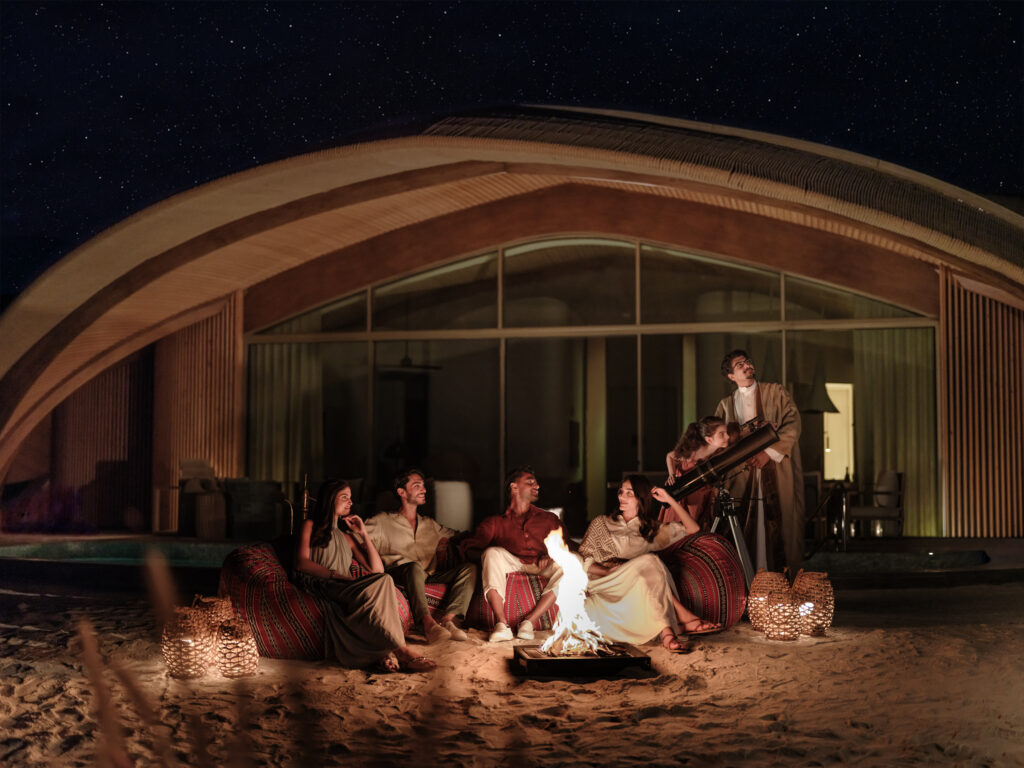
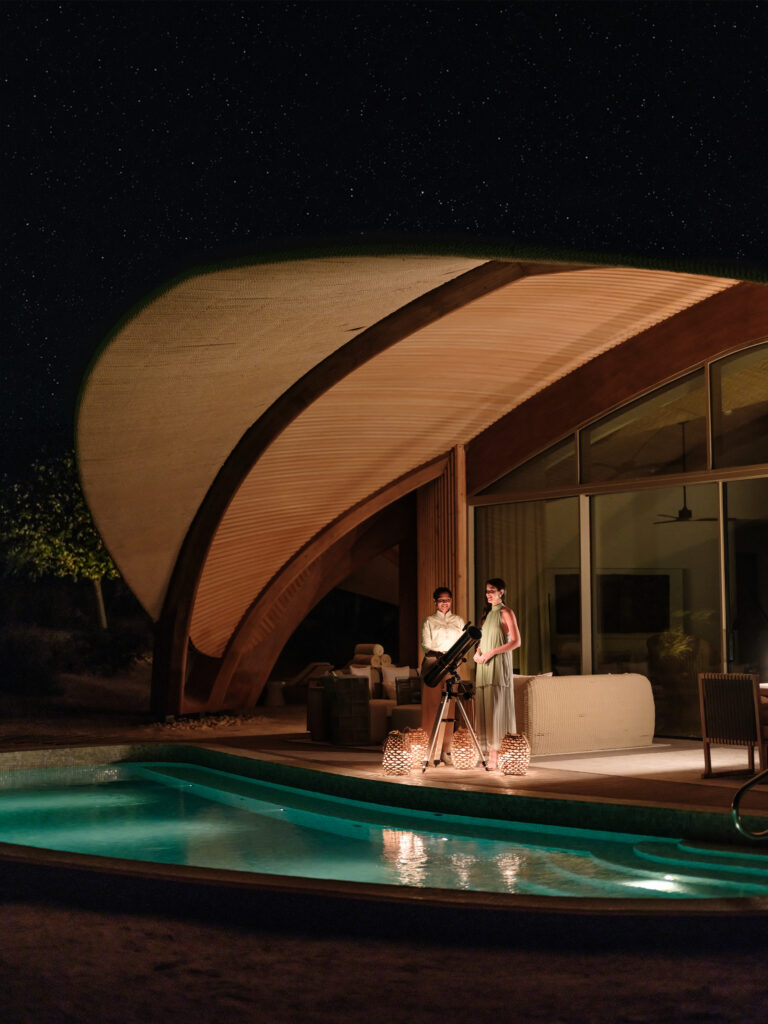
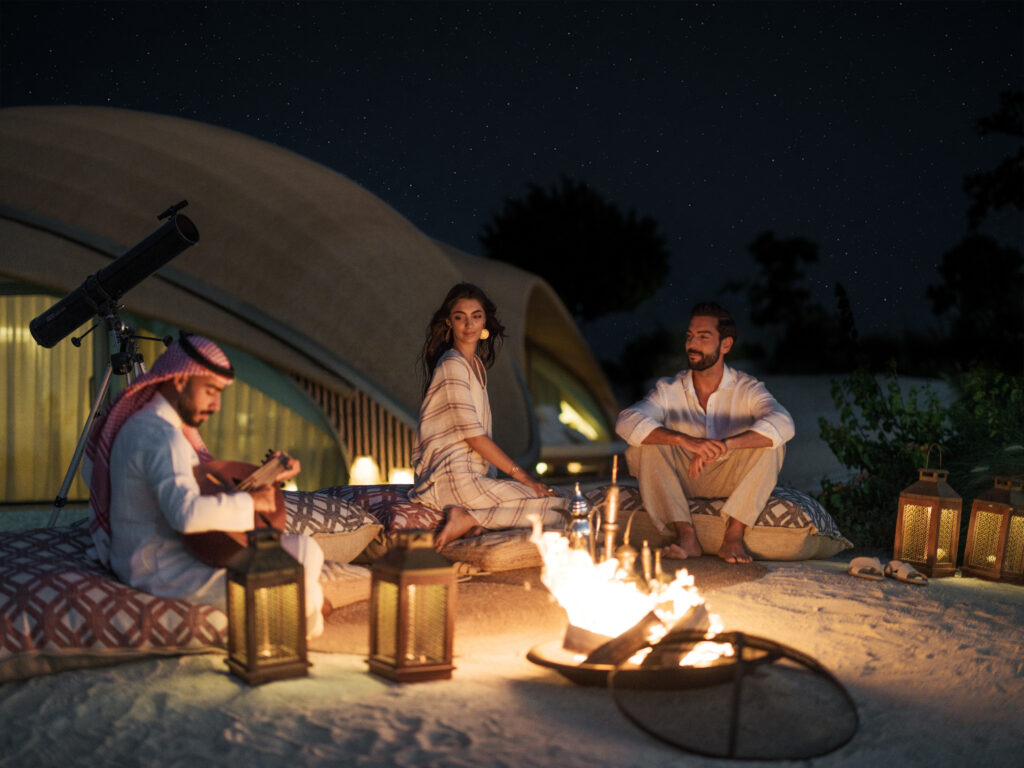
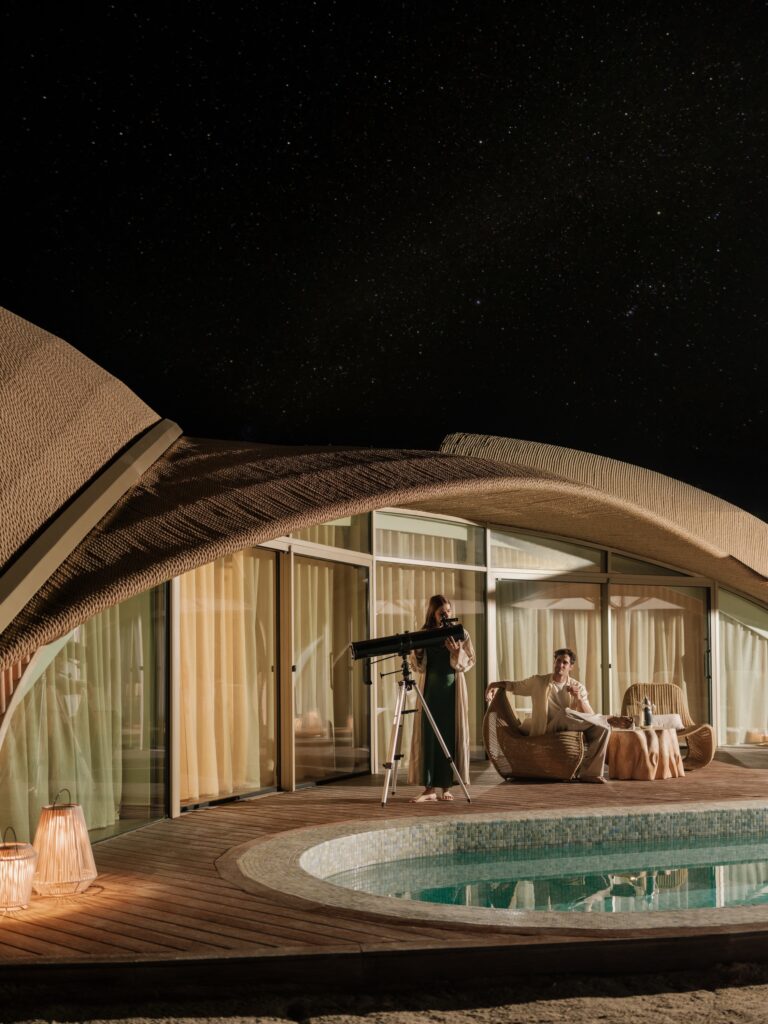
The very name of the resort, which means “stars” in Arabic, gives this approach a particular coherence. The stargazing sessions are not added as one activity among others; they depend directly on the way the site is operated. Dennis Sorensen, the resort’s director, stresses that the night sky is an essential part of the experience and that the certification recognises the care taken to protect it.
The DarkSky Approved Lodging programme, launched in 2023, was adapted in 2026 to large hotel complexes through a collaboration between DarkSky International and Red Sea Global. This development matters, because it establishes a specific framework for destinations more complex than an isolated lodge. The demands of circulation, dining, maintenance and guest reception are more numerous there, and therefore harder to control.
According to Ruskin Hartley, chief executive of DarkSky International, this cooperation made it possible to define lighting practices suited to resorts while maintaining the strict criteria for protecting the night. Raed Albasset, head of environment and sustainability at Red Sea Global, for his part insists on integrating responsible lighting from the earliest stages of development.
The subject thus goes beyond Nujuma. Red Sea Global seeks to make environmental constraint a design principle for all of its destinations. This ambition has yet to be judged on precise indicators and over time, but the choice to make darkness measurable already constitutes a break with the vague discourse on regenerative tourism.
For the connoisseur, the value of a place no longer lies only in what it adds: spa, dining, architecture or service. It also lies in what it decides not to occupy. Not lighting more, not artificially prolonging the day, not dominating the landscape through visibility becomes a form of restraint.
The DarkSky certification gives this restraint a method and an external check. That is precisely what keeps it from remaining a communication argument. As luxury destinations multiply in fragile territories, the ability to preserve a natural experience without turning it into a backdrop could become one of the most credible criteria of contemporary hospitality.
Cette publication est également disponible en :


