
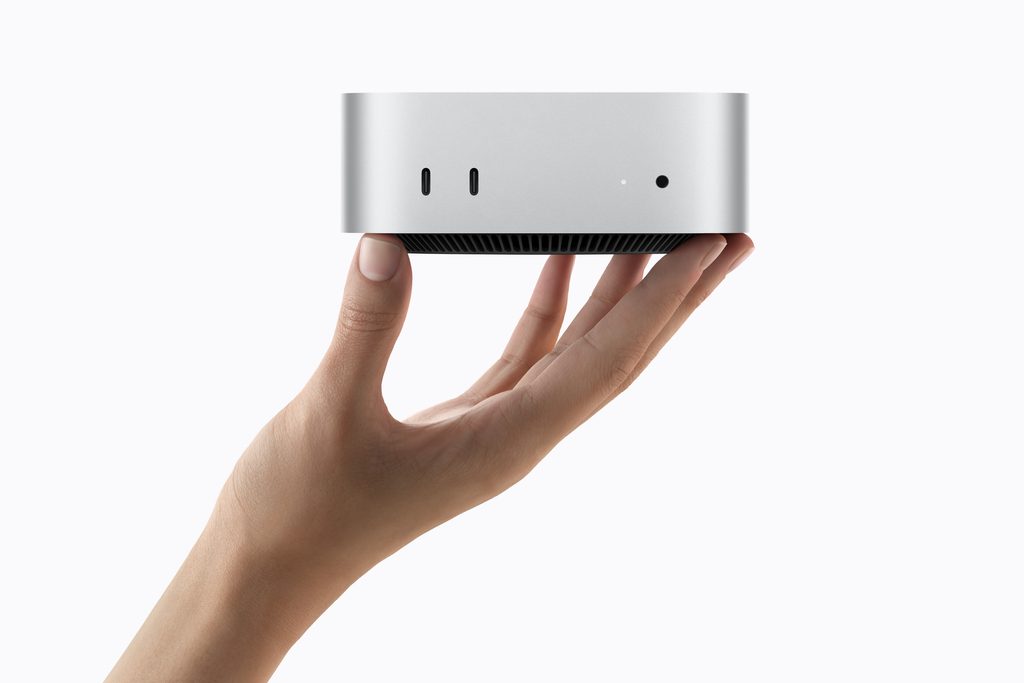
The form factor has remained virtually unchanged; its use, however, is changing in nature.
With the M6 chip, Apple is transforming the Mac mini into a machine capable of running local AI models and agent-based tasks continuously.
The real issue is no longer miniaturization, but the computational density that Apple has managed to pack into this device.

The new Mac mini, announced on August 25, 2026, and available starting September 22, comes with either an M6 or M5 Pro chip. The former combines a 12-core CPU, a 12-core GPU with Neural Accelerators, and a dual 16-core Neural Engine. Unified memory starts at 16 GB and can go up to 32 GB, with a bandwidth of 170 GB/s.
Apple claims AI performance up to four times faster than the previous generation and, in LM Studio, prompt processing up to thirteen point five times faster than on an M1 Mac mini. While these figures are based on internal tests, they shed light on the product’s repositioning: the Mac mini is no longer just a compact and affordable computer; it’s becoming a local computing hub designed to run for long periods of time—or even continuously.
This trend is also evident in the connectivity options. The M6 model features three Thunderbolt 4 ports, while the M5 Pro version upgrades to Thunderbolt 5. Both include Wi-Fi 7, Bluetooth 6, a 2.5-Gigabit Ethernet port that can be configured for 10 Gigabit, two front-facing USB-C ports, and an HDMI output. For the M5 Pro model, Apple highlights the ability to have multiple Mac minis work together to run large models locally.
Choosing the M5 Pro expands the possibilities even further: up to eighteen CPU cores, twenty GPU cores, sixty-four GB of unified memory, and three hundred seven GB/s of bandwidth. For creative studios, developers, or small organizations that want to keep part of their AI workflows out of the cloud, this combination makes a lot of sense.
The Mac mini also boasts some interesting material specifications. Apple reports that 50 percent of the materials used are recycled, the aluminum chassis is made from 100 percent recycled aluminum, and the magnets contain 100 percent recycled rare earth elements. Again, these figures should be viewed in the context of the full production and usage footprint, but they reinforce the rationale behind a device that seeks to pack more power into a smaller form factor.
Prices start at 1,049 euros for the M6 model and 1,999 euros for the M5 Pro. This pricing strategy maintains a clear distinction between advanced everyday use and compact professional workstations. But the line becomes blurrier once on-device AI and agents running continuously enter the equation.
The Mac mini has long been the most unassuming entry point into the Mac ecosystem. With this generation, it could become something more strategic: a small personal or studio infrastructure, powerful enough to run an increasing share of software intelligence locally.
Cette publication est également disponible en :

