
Since the early 1930s, one formulation has remained unchanged through shifting trends in perfumery: strips of paper impregnated with benzoin resin that are lit, then extinguished, and left to smolder.
La Carta d’Armenia is not a perfume. It is a tool—and this distinction, rarely made, explains its longevity.
Aromatic papers have a long and practical history. From the 17th century to the early 20th century, they were widely used throughout Europe as medicinal papers: strips impregnated with resins or plant extracts, burned indoors to purify the air or mask the odors of daily life. Their use at that time was by no means decorative; it was a matter of hygiene and pharmacology.
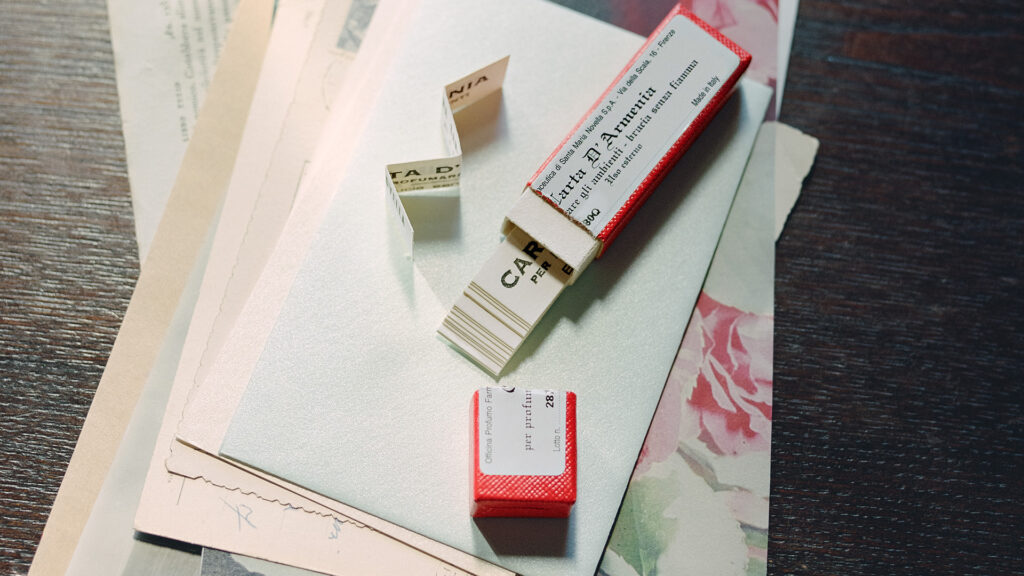
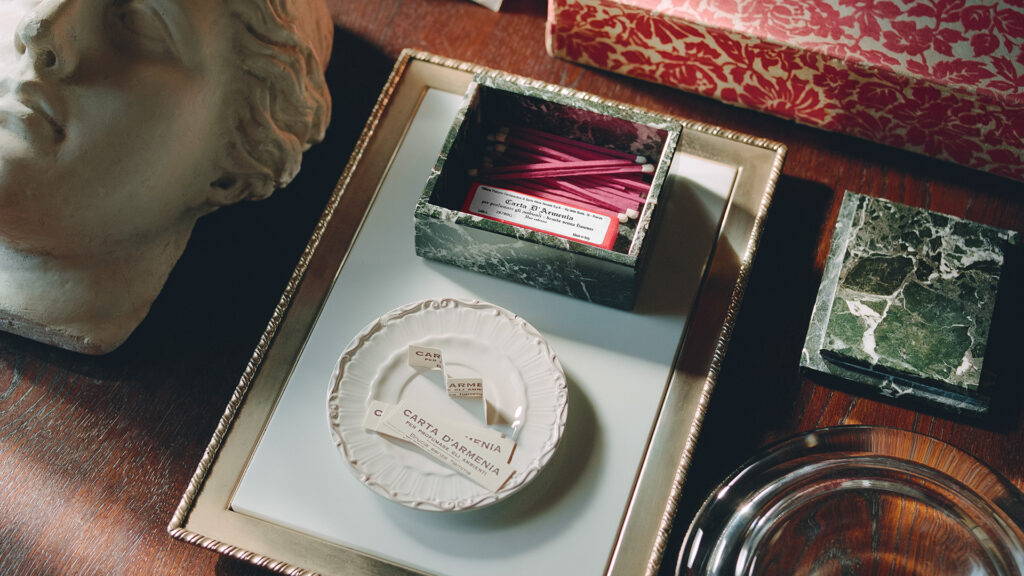
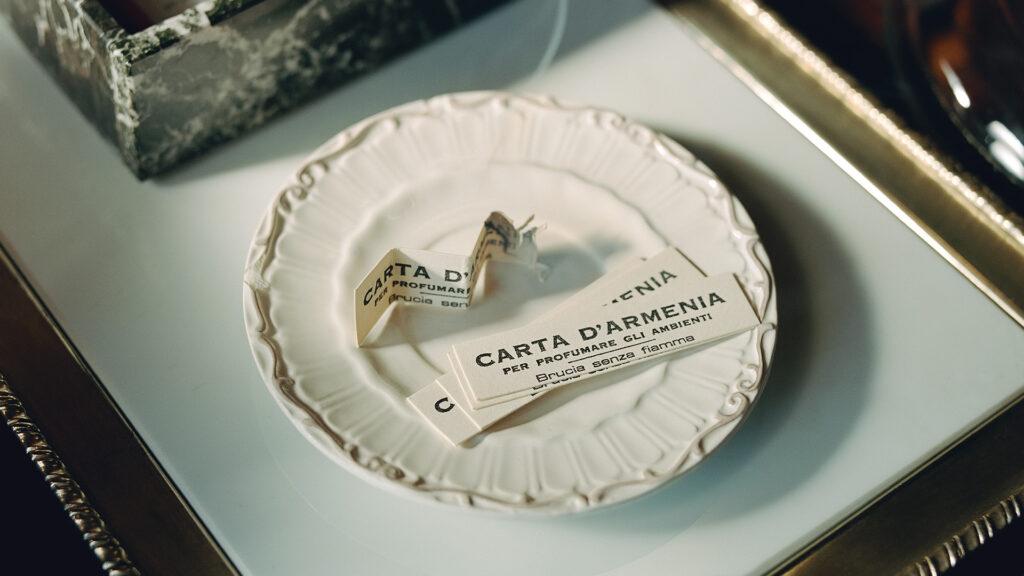
It is within this legacy that the Officina Profumo-Farmaceutica di Santa Maria Novella—a Florentine institution whose origins date back to the 13th century—found its place when it incorporated the Carta d’Armenia into its production in the early 1930s. The formula: paper impregnated with benzoin resin and aromatic extracts. The ritual: fold the strip, light it for a few seconds, then extinguish it. The flameless combustion does the rest.
Benzoin resin is extracted from Styrax benzoin, a tree native to Southeast Asia. When burned, it produces benzoic acid and benzyl benzoate, the molecules responsible for its characteristic balsamic scent. Unlike resins that burn vigorously (such as olibanum-type incense), benzoin burns slowly at a low temperature without a sustained flame.
The same item works in two distinct ways. When burned, the strip releases a resinous scent into the air—one that is long-lasting without being overpowering. When placed intact in a drawer or suitcase, it works through slow contact with fabrics—a method that leaves no residue or trace. Eighteen strips per box. No interface, no settings, no refills to schedule.
This operational minimalism is what stands out the most today. While the home fragrance market has fragmented into a multitude of devices—ultrasonic diffusers, capsule-style burners, double-wick candles—Carta d’Armenia, on the contrary, calls for a deliberate choice. You don’t just set it down. You choose it.
Nearly a century of uninterrupted production is not merely a feat of preservation. It is a sign that a formulation has managed to remain useful without being reformulated. In an industry where novelty is structurally valued, this stability constitutes a statement in and of itself.
What the Carta d’Armenia says about the future of home fragrances remains an open question. But it already puts forward a hypothesis: longevity can be a selling point—provided it isn’t shouted from the rooftops.
Cette publication est également disponible en :

