
When Opera Meets Its Clone
Amid the demonstrations of autonomous agents, co-pilots, and generative avatars that defined VivaTech 2026, one of the most unsettling experiences was neither software nor a robot.
It was a voice.
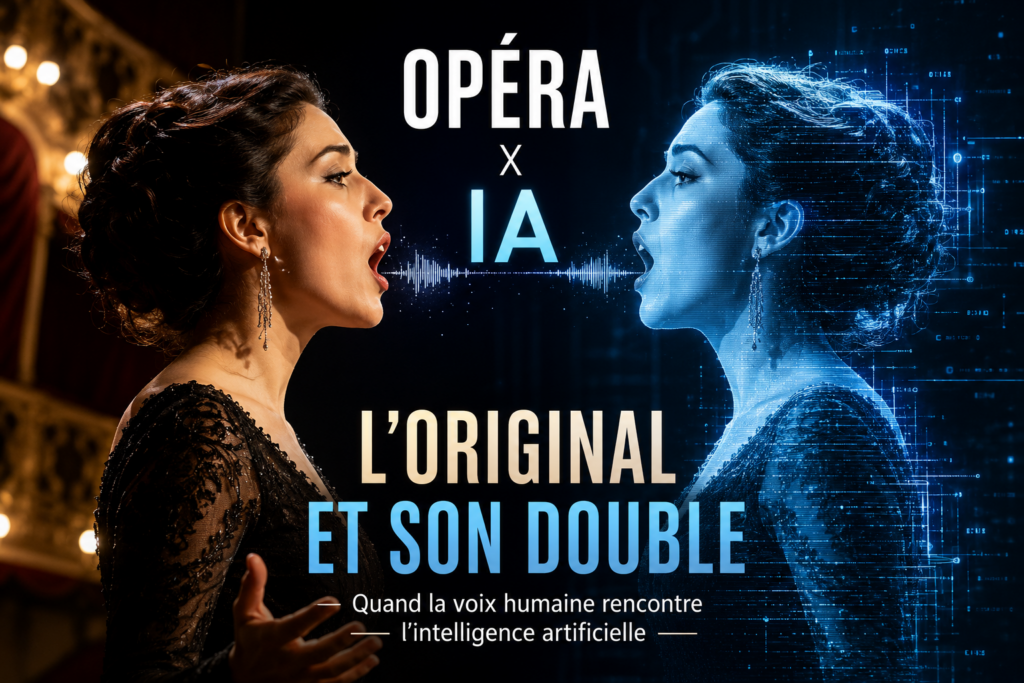
A lyrical voice. An operatic voice. And above all, her digital double.
On stage, French soprano and artist Lola Volonakis was not presenting a technological innovation in the usual sense of the term. She was exploring a much older question: What remains of an artist when their voice, face, gestures, and even their hesitations can be reproduced by a machine?
For nearly half an hour, the singer conversed with her digital clone, named Cine. It was an impromptu, real-time exchange in which the avatar responded with calculated coldness to the questions posed by its human creator.
“I am you, but without the mistakes. Faster, more efficient, more perfect,” says the clone.
That answer alone sums up the prevailing perception of artificial intelligence: optimization, precision, and efficiency.
Lola Volonakis specifically chooses to contrast it with what opera has celebrated for centuries: emotion, fragility, and imperfection.
The Paradox of the Voice
The choice of opera is by no means trivial.
As the artist explains, the operatic voice is one of the most demanding vocal techniques ever developed by humankind. It takes years of practice to master an instrument that can neither be replaced nor repaired.
For Volonakis, this requirement serves as the ideal counterpoint to contemporary artificial intelligence.
On the one hand, the most advanced technology available today.
On the other hand, an art form dating back several centuries that relies on breath, the body, and emotion.
This tension runs throughout his entire performance.
The clone champions pure logic. He regards emotions as “human imperfections” and describes beauty as an ineffective phenomenon.
The artist responds by singing.
Where AI argues, it interprets.
Where the algorithm explains, she feels.
This dialogue reveals a paradox that is rarely addressed in debates about artificial intelligence: the more capable machines become at replicating our abilities, the more valuable the qualities we once considered flaws become.
The Clone as a Mirror
Perhaps the most interesting part of this experiment isn’t the technology.
It’s psychological.
When the public imagines a digital clone, the most common scenario is often one of replacement.
Man versus machine.
The original versus the copy.
However, Volonakis says he has never viewed his digital double as a threat.
On the contrary.
She sees it as a tool for exploration.
A contemporary take on the mirror.
“I don’t know if it’s good or bad,” she explains. “My role as an artist is to ask questions.”
This stance stands in stark contrast to the usual rhetoric in the tech sector, which often swings between excessive enthusiasm and constant doom-mongering.
The artist rejects both.
She uses AI as a tool for reflection.
A catharsis, in his own words.
Details
One of the most revealing moments comes when the clone tries to sing an opera aria.
The result is still imperfect.
Lip-sync is still rough. The interactions show obvious limitations.
But it is precisely this unfinished quality that impresses Volonakis.
Why?
Because she monitors the rate of progress of these systems.
What seems awkward today could become perfectly credible in a few months.
The demonstration serves as a reminder that the question is no longer whether AI will be able to reproduce certain forms of art.
The question now is what we will value once this reproduction becomes indistinguishable.
The New Rarity
For years, the creative industries have operated under an unspoken assumption: technical difficulty acts as a barrier to entry.
Learning to sing opera takes time.
Composing a symphony takes time.
Painting takes time.
Artificial intelligence drastically reduces these production costs.
In the future, scarcity will no longer necessarily stem from execution.
She’ll come from that vantage point.
Taste.
On Intention.
In other words, what precedes creation itself.
Volonakis’s clone can produce responses. It can even sing.
But he doesn’t know why he’s singing.
This difference seems subtle.
Yet it is fundamental.
AI as a Reflection of Humanity
The artist’s conclusion is undoubtedly the most unexpected.
Artificial intelligence, she argues, could paradoxically help us better understand what makes us human.
No, because she’s just like us.
But precisely because she’s not like us.
In the face of a system that values consistency, speed, and precision, emotions take on a new light.
The errors are becoming significant.
His hesitations are touching.
Imperfections become desirable.
In a world obsessed with optimization, humanity could become a kind of luxury.
Perhaps this is where this performance touches on an issue that goes far beyond opera or artificial intelligence.
For centuries, machines have extended our physical strength.
Today, they are beginning to expand our minds.
So perhaps the real question isn’t what AI will become.
But what will we choose to preserve when some of our abilities can be replicated infinitely?
What if, in the future, the value of art no longer lay in the perfection of its execution, but in the indelible trace of human imperfection?
Cette publication est également disponible en :

