
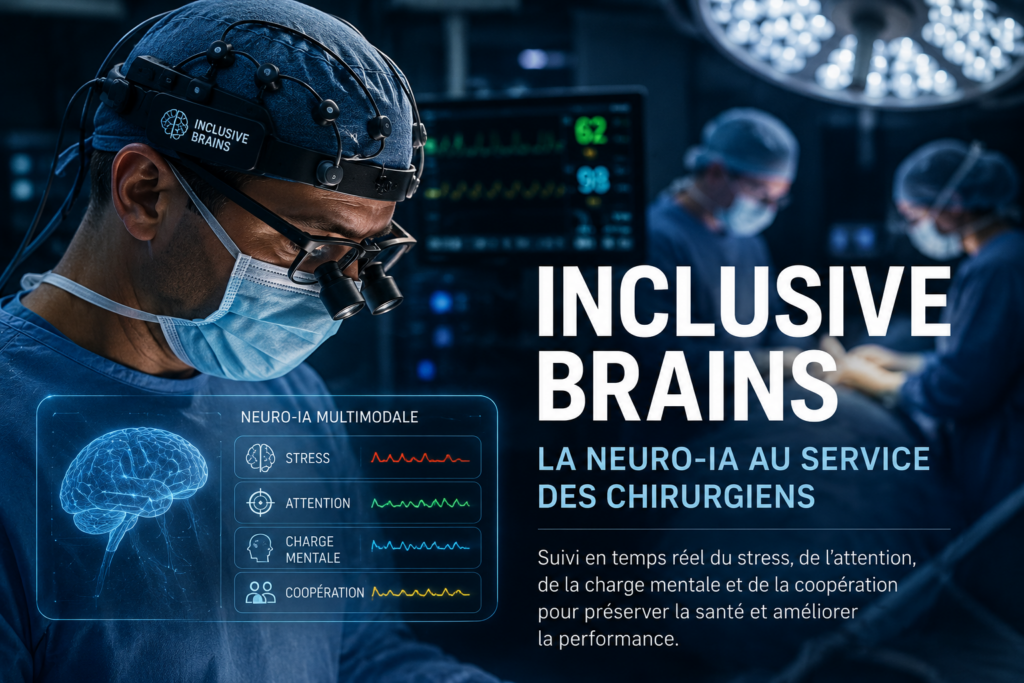
At VivaTech, Inclusive Brains showcased a multimodal neuro-AI capable of monitoring stress, attention, mental load, and cooperation in the operating room in real time. Behind the demonstration lies a broader question: if medicine demands actions of extreme precision, why does it still leave human exhaustion out of the picture?
In an operating room, everything already seems to be measured. The patient’s heart rate, blood pressure, oxygen levels, and depth of anesthesia—every vital sign is displayed on a screen, a graph, or an alert. The body undergoing surgery has become transparent.
The body of the person operating it, however, remains invisible for a long time.
It is in this blind spot that Inclusive Brains is making headway. Founded in Marseille by neuroscientist Olivier Oullier and Paul Barbaste, the startup develops non-invasive brain-machine interfaces, initially designed to enable people who are paralyzed or unable to communicate, and later expanded to other critical environments. Its philosophy can be summed up in one sentence: it is no longer just up to humans to adapt to machines; machines must learn to adapt to humans.
Precision isn’t just about the hand
The story begins with impossible feats made possible. A Formula 1 car controlled without hands, an exoskeleton operated by mind control, an Olympic torch carried using a brain-machine interface: these are all scenes that leave a lasting impression because they are almost symbolic. But their true significance lies elsewhere. They demonstrate that a brain signal, a facial expression, an eye movement, or a physiological change can become a form of intention that can be harnessed.
Inclusive Brains is not referring here to implants or invasive neurosurgery. Sensors measure the brain’s electrical activity, eye movements, certain bodily signals, and—when the context allows—facial expressions or the voice. This data is then analyzed using artificial intelligence models to estimate states such as stress, attention, mental load, or fatigue in real time.
The shift to surgery changes the nature of the subject. It is no longer a matter of moving an object with one’s mind, but of understanding what is at stake in the sustained effort of a professional facing extreme responsibility. A seven-hour surgery is not just a matter of technique. It requires cognitive endurance, careful management of pressure, and continuous cooperation among several people whose coordination must never falter.
The Operating Room as a Critical Workshop
The decision to undergo surgery is no trivial matter. The operating room is one of the most tightly controlled environments in existence. Any new technology introduced there is viewed with suspicion until it has proven its unobtrusiveness, usefulness, and safety. A system that beeps at the wrong moment, a misplaced alert, or an interface that’s too intrusive can all become sources of disruption.
Inclusive Brains seems to have grasped this basic principle: in high-precision fields, the best technology is often the one that stays in the background. The feedback provided to the surgeon is not designed to be a constant prompt. It can be consulted, but it does not impose itself. It provides support without interrupting.
This is a crucial distinction. The goal is not to replace the surgeon’s judgment with a metric. Rather, it is to provide the surgeon with an additional perspective at a time when fatigue and stress can sometimes be difficult to recognize from within. Taking a breath, taking a micro-break, adjusting the team’s pace: these actions are nothing spectacular. Yet they can have a significant impact on the quality of care.
Details
The technology presented is based on a multimodal approach: brain activity, eye movements, heart signals, facial expressions, voice, and body movements can be combined depending on the context. The goal is not merely to collect data, but to enable the system to remain functional even when one modality is unavailable—for example, when the face is covered during surgery.
Mental Health as an Operational Parameter
What this demonstration reveals goes beyond the specific case of the ward. For years, the healthcare system has been discussing exhaustion, burnout, and the mental workload of healthcare workers. But these issues are often addressed only after the fact—as HR or psychological consequences—and rarely as operational factors.
Multimodal neuro-AI is shifting the perspective. It suggests that a practitioner’s mental health is not separate from the quality of care. It is an integral part of it. Not in the form of punitive surveillance, but as a protective measure—provided that its governance is clear: who sees what, when, for what purpose, and with what right to be forgotten?
This is where the issue becomes sensitive. Measuring attention or stress can serve as a protective measure. It can also be used as a means of control. The line isn’t technical; it’s political, medical, and managerial. In a hospital, a clinic, an industrial facility, or a cockpit, the same data can serve as a safeguard or a tool for exerting pressure.
The challenge, therefore, is not just to train better models. It is to devise an acceptable terms-of-use agreement. Responsible neurotechnology must be as rigorous in its governance as it is in its sensors.
Science Before Performance
Olivier Oullier’s closing statement perhaps best sums up the spirit of the project: science first, technology second. In a landscape saturated with promises about AI, this hierarchy matters. It serves as a reminder that brain-machine interfaces are not valuable for their showmanship, but for their ability to address situations where humans cannot be reduced to mere variables in an execution process.
Surgery offers a broader lesson here. Professions that demand excellence don’t just lack tools; they sometimes lack instruments capable of doing justice to their complexity. Recognizing a surgeon’s fatigue does not diminish their authority. It acknowledges that a highly precise procedure also depends on an inner state of mind, a ready focus, and a well-coordinated team.
Tomorrow, these interfaces could leave the operating room and find their way into other critical environments: construction sites, driving, industry, emergency response, defense, and aviation. The question will remain the same. To what extent do we want machines to “read” us? And above all, who writes the rules for this “reading”?
Cette publication est également disponible en :

