
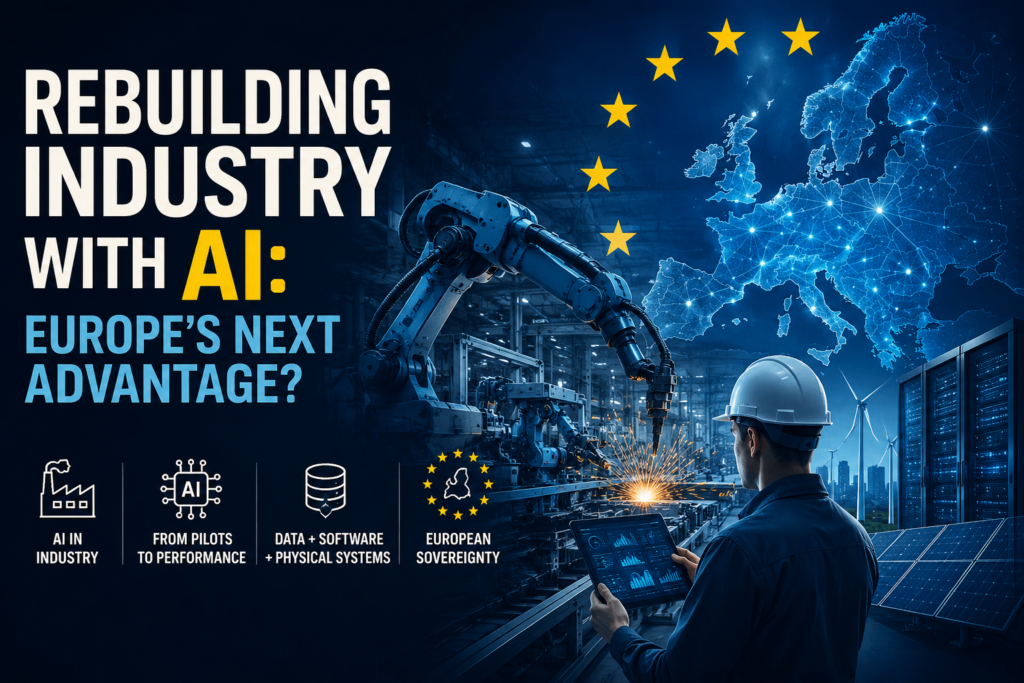
While media attention remains focused on the race to develop language models, another battle is being waged far from conversational interfaces. In factories, logistics centers, and critical infrastructure, AI is gradually moving from the experimental stage to the realm of productivity. This may be where Europe’s advantage lies.
One statistic quietly emerged during the discussions at VivaTech: the United States has about six times more supercomputing capacity dedicated to AI than the European Union. At the same time, only 15% of the world’s hyperscale data center capacity is located in Europe, compared to more than half in the United States.
At first glance, the situation seems dire. Europe appears to have lost the battle for artificial intelligence.
Yet the executives gathered on stage—from SAP to Siemens, from Volvo to Mistral—put forward a radically different perspective. In their view, the issue is no longer about the next generation of models. It is about industrial adoption.
And in this area, Europe still has strengths that neither Silicon Valley nor China can quickly replicate: decades of manufacturing expertise, complex industrial infrastructure, and, above all, a wealth of unique operational data.
Europe’s true treasure is not technological
For the past two years, the conversation about AI has centered mainly on models.
Who has the best GPUs? Who is training the largest LLMs? Who is funding the next data centers?
For Marjorie Janiewicz, Chief Revenue Officer at Mistral, this interpretation misses the point. The value lies not only in general-purpose models but in their ability to incorporate decades of industrial intellectual property: drawings, simulations, maintenance histories, production data, and design processes.
In other words, Europe’s future competitive advantage may stem less from the algorithms themselves than from what they learn from the continent’s industrial heritage.
This logic resonates particularly strongly in the luxury sector. A luxury brand does not create its desirability through technology alone. It builds it through the accumulation of expertise, methods, archives, and techniques passed down through several generations.
European industry has a comparable heritage.
But you still have to know how to turn it into actionable intelligence.
The End of Software as We Know It
One of the most revealing discussions of the session concerned the future of software.
For several months now, there has been a growing chorus of voices proclaiming the “death of SaaS.” AI agents are said to be gradually replacing traditional applications.
Neither SAP nor Siemens shares this view.
For Sebastian Steinhauser, SAP’s COO, AI represents, above all, an expansion of the software market. The global market, currently estimated at approximately one thousand billion euros, could reach four to five thousand billion in the coming years thanks to the automation of tasks that were previously impossible to industrialize.
At Siemens, Cedric Neike prefers to talk about the “evolution of SaaS” rather than an “apocalypse.”
Transactional systems aren’t going away. ERP, CRM, and design platforms will continue to exist. What’s changing is the interface.
Users will no longer interact with static screens but with agents capable of dynamically generating the necessary information.
A transformation that echoes a trend already observed in the luxury sector: the gradual disappearance of catalogs in favor of more seamless, personalized, and context-driven experiences.
The object remains the same. The way we access it changes radically.
The real obstacle isn’t AI
One of the most insightful moments of the discussion came from SAP and Siemens.
The two executives made a statement that was almost counterintuitive: the main barrier to AI adoption is no longer technological.
These are the processes.
“A bad automated process is simply a bad process on fast forward,” summarized one of the speakers.
Behind the excitement of the demonstrations, many companies are discovering a more complex reality. AI exposes existing organizational inefficiencies rather than correcting them.
The companies that achieve the best results today are rarely the ones with the most sophisticated models. They are the ones that simplify their processes before automating them.
A lesson that Volvo is putting into practice on a large scale.
According to Jens Holtinger, the group’s CTO, the main challenge is now a cultural one. The technologies exist. The use cases exist. The investments exist.
What is still lacking is the ability of organizations to change their behaviors, work methods, and decision-making models.
Technology is advancing faster than businesses.
Details
Electricity is becoming the raw material of AI.
Volvo provided a telling figure. A next-generation electric truck requires up to 750 kW during ultra-fast charging.
If 1,500 vehicles plug in at the same time, the energy demand is equivalent to that of a small nuclear power plant.
Industrial AI faces the same challenge. Behind every data center, every model, and every agent lies an energy issue that has become strategic.
However, industrial electricity prices in the European Union remain significantly higher than those in the United States.
So the issue is no longer just about digital technology.
He’s energetic.
Europe suffers less from a technological deficit than from a lack of coordination
As the discussion progressed, a consensus began to emerge.
The problem in Europe is not a lack of talent, nor is it a lack of competitive companies.
Europe is home to SAP, Siemens, ASML, Airbus, Volvo, and Mistral. It has world-class universities and one of the most sophisticated industrial bases in the world.
The real problem lies in fragmentation.
Energy, data centers, public procurement, digital infrastructure: each of these issues continues to be addressed at the national level, even though competition is now taking place on a continental scale.
Several speakers highlighted a recurring paradox: Europe advocates for a single market but often continues to function as a collection of national markets.
In industrial AI, this fragmentation becomes a structural obstacle.
The luxury of tomorrow could be industrial
The panel’s conclusion stands in stark contrast to the pessimism usually associated with European debates.
No speaker claimed that Europe would catch up to the United States in the consumer platform sector.
This might not be the right fight.
The challenge would be, rather, to transform Europe’s vast industrial heritage into a competitive advantage in the age of AI.
From this perspective, AI is no longer seen as a standalone technology but as an additional layer that enhances existing expertise.
Much like in the luxury sector, where value never stems solely from innovation, but from its ability to engage with a legacy.
So perhaps the question is no longer whether Europe can win the AI race.
The real question is whether it will be able to turn its industrial heritage into knowledge before others do it for it.
Cette publication est également disponible en :

