
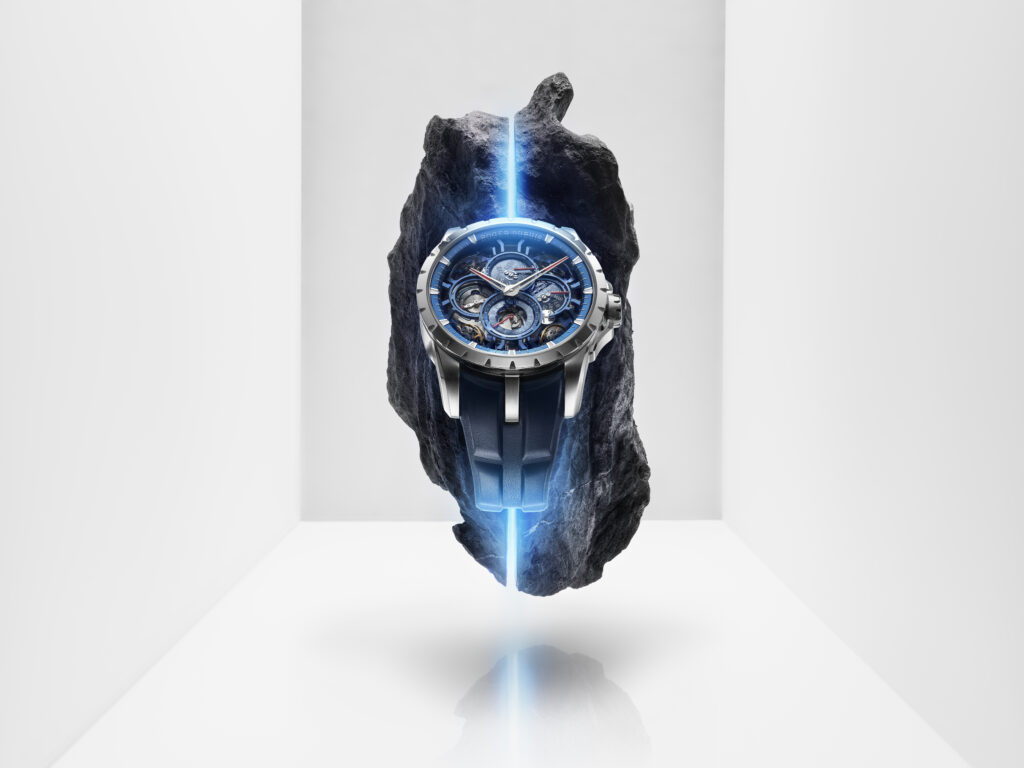
At Roger Dubuis, time has never really sought to be discreet. Since 1995, the Geneva-based Manufacture has been crafting a form of watchmaking that is expressive—and at times theatrical—where the complication becomes a visible architectural feature as much as an exercise in chronometry. With the Excalibur Perpetual Calendar Quatuor, unveiled at Watches and Wonders Geneva 2026, this approach takes on a particularly striking form: bringing together, for the first time in a single timepiece, the Quatuor system and a perpetual calendar.
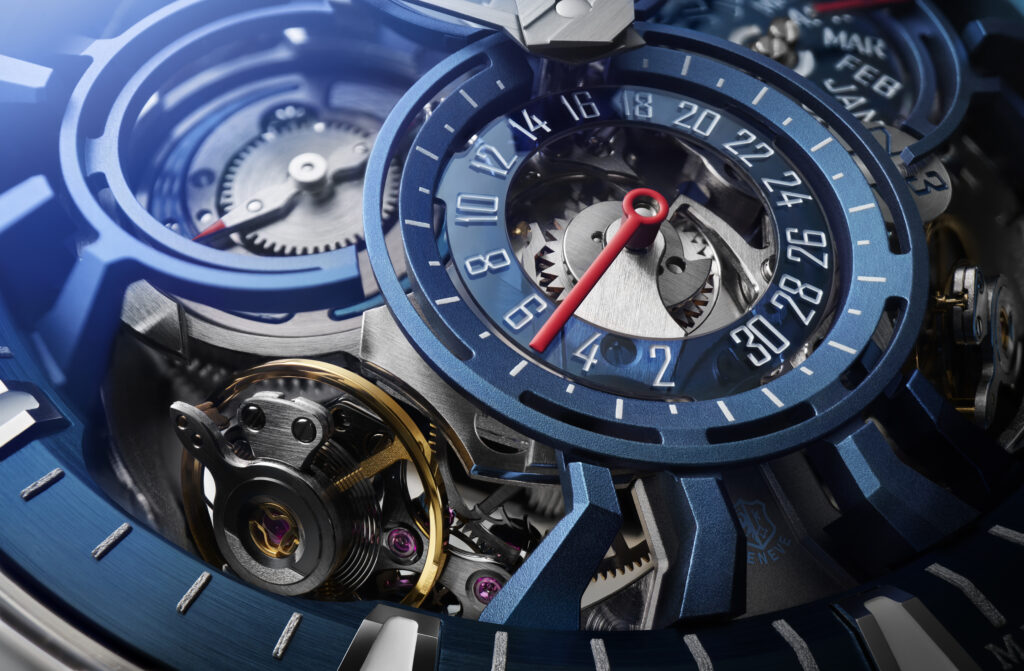
The issue is not merely the combination of two complications. It lies in their contrasting natures. The Quatuor, introduced by Roger Dubuis in 2013, addresses an immediate physical problem: the effect of gravity on the balance wheel’s regularity depending on the position of the wrist. Whereas the classic tourbillon seeks to average out this effect through rotation, Roger Dubuis chose a different approach: four inclined balance wheels, arranged in pairs at 90°, connected by five differentials. The principle, already documented at the launch of the Excalibur Quatuor, consisted of distributing the effects of gravity across several regulating organs rather than having them rotate around a single axis.
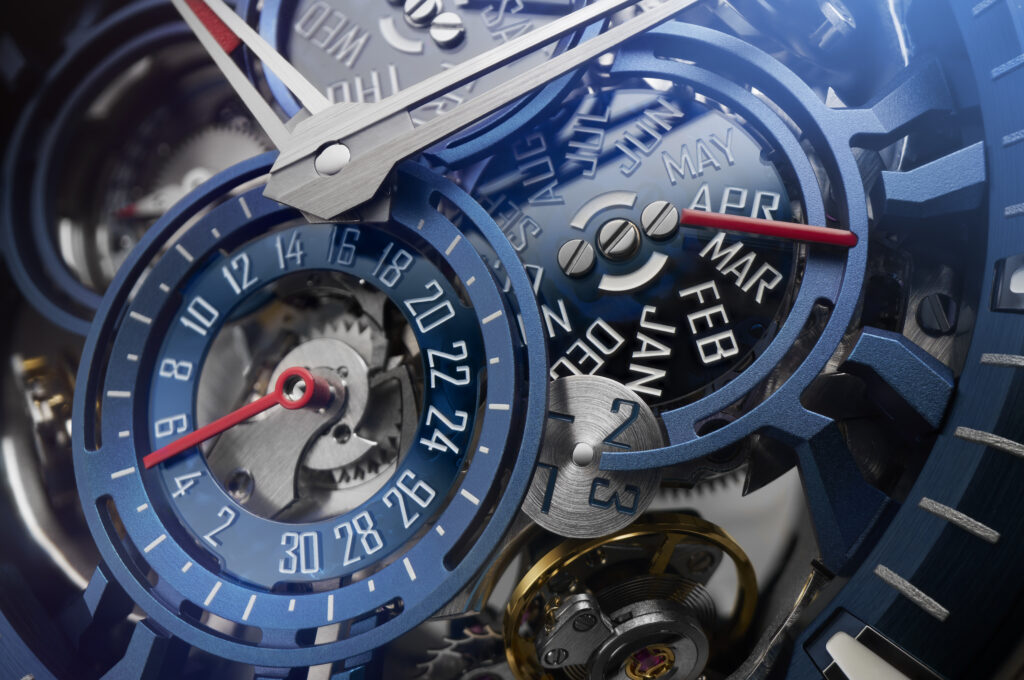
Set against this mechanism of the moment is the perpetual calendar, a complication that requires patience. It does not correct the second, but rather the duration: days, dates, months, and leap years. In the RD116 caliber, this display unfolds in a symmetrical quadrant around the calendar indicators and the power reserve. The press kit specifies that the movement comprises 758 components and employs fourteen manual finishing techniques, including beveling, graining, circling, flat polishing, end polishing, and internal and external drawing. The virtuosity is therefore not merely kinematic; it is also evident in the surface finishing—that often-overlooked aspect of fine watchmaking, yet one that is decisive for the Geneva Seal.
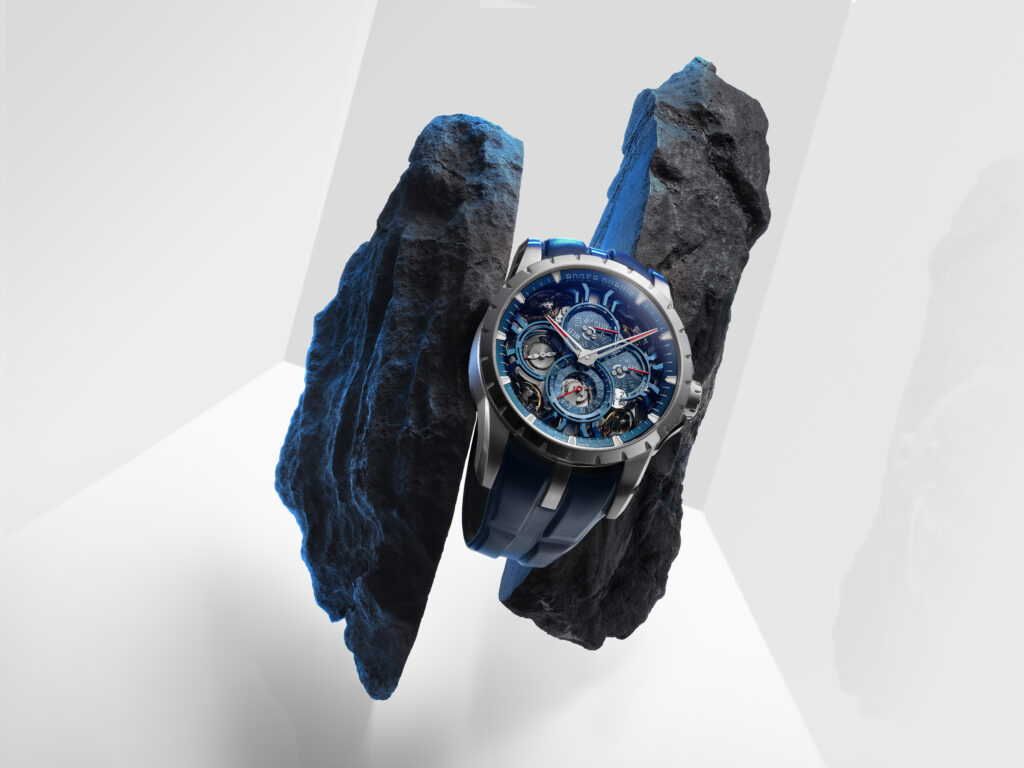
The choice of cobalt-chrome gives this Excalibur a whole new dimension. Roger Dubuis has been using this alloy as its signature material since 2017, particularly for certain components related to the tourbillon cages. Here, the 48-mm case is entirely crafted from Cartech® Micro-Melt® Biodur® CCM® cobalt-chrome, an alloy derived from industries where strength, stability, and anti-magnetic properties matter more than traditional preciousness: automotive, aerospace, aerospace. The blue of the flange and counters evokes the color of natural cobalt; the blue calfskin strap, equipped with a Quick Release system, extends this material theme.
Perhaps the most interesting detail is the power reserve. Positioned at 9 o’clock, it features a single-hand display and a dual 180° movement. The indicator and the hand do not move at the same pace, transforming a functional piece of information—the available energy—into a mechanical spectacle. The watch also comes with a winding device programmed for the RD116 caliber—a practical reminder that a perpetual calendar does not tolerate either stoppage or neglect.
Limited to eight pieces, the Excalibur Perpetual Calendar Quatuor is part of a broader series dedicated to celestial movements at Roger Dubuis for Watches and Wonders 2026. Here, watchmaking revisits one of its long-standing obsessions: translating into a wrist-sized object what the sky has always imposed on the human eye—the alternation of days, cycles, inclinations, deviations, and corrections. Roger Dubuis’s approach here is to reject the understated elegance of the classic perpetual calendar, instead placing it within an open, dense, almost orbital architecture. This is a watch designed not to hide its complexity, but to make it accessible.
Cette publication est également disponible en :

