
With the Ingenieur Tourbillon 41, IWC Schaffhausen does not merely seek to add a complication to a line that has become central to its contemporary design language. It poses a more specific question: what becomes of an engineer’s watch when its functional vocabulary is rendered in gold, and the mechanical precision of the tourbillon takes center stage on the dial as a visible mechanism?
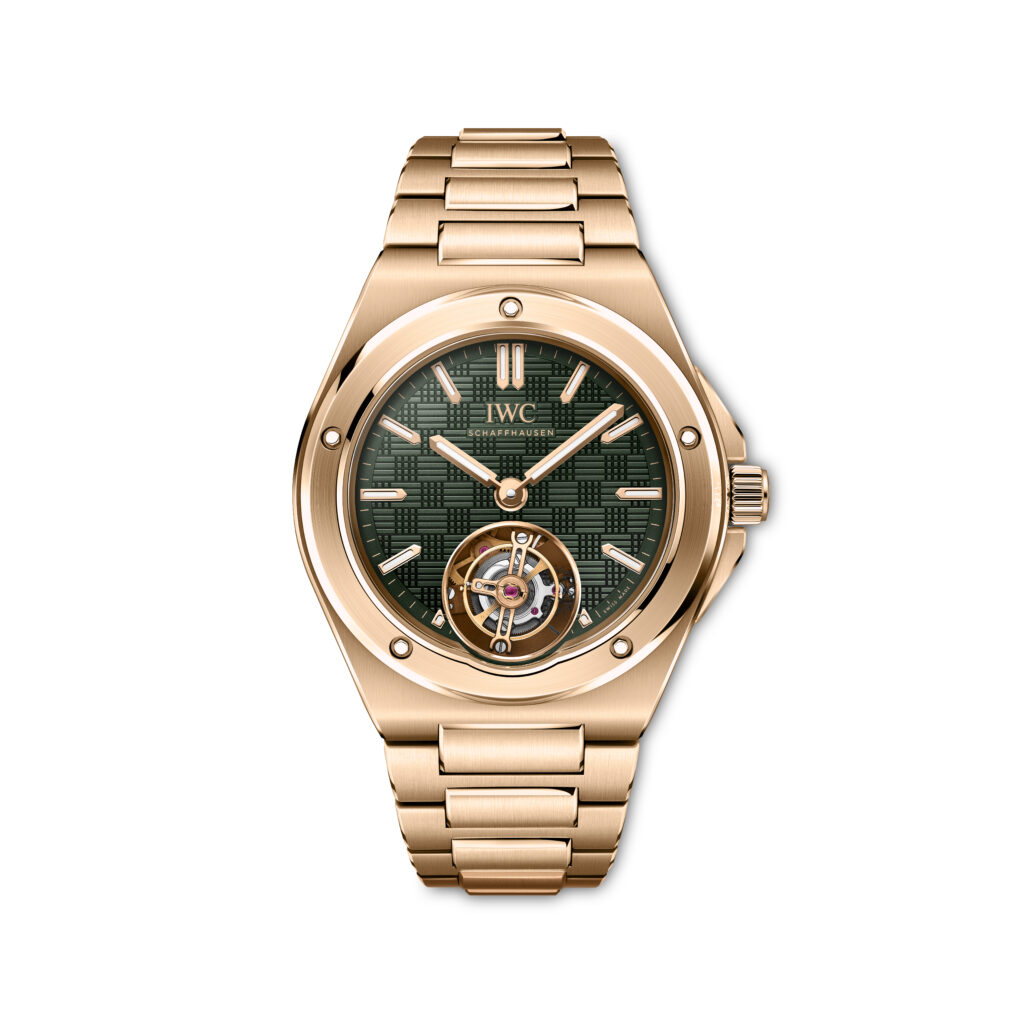
Unveiled at Watches and Wonders Geneva 2026, this new model, reference IW345901, retains the design of the modern Ingenieur but radically reimagines its aesthetic. The 41.6-mm case, integrated bracelet, bezel, crown, and crown guards are crafted from 18-karat 5N gold. The five functional screws that secure the bezel to the case back are crafted from 18-karat Armor Gold®, an alloy developed by IWC to offer greater hardness than conventional gold alloys. The watch is limited to 100 pieces.
L’Ingenieur porte une histoire particulière dans l’horlogerie sportive intégrée. Dans les années soixante-dix, Gérald Genta dessine l’Ingenieur SL, une pièce aux lignes tendues, à la lunette vissée et au bracelet intégré, dont IWC rappelle qu’elle fut d’abord pensée pour des ingénieurs, avant d’être redécouverte comme l’un des jalons les plus radicaux de cette typologie horlogère. Entre 1976 et 1983, seuls 598 exemplaires de cette Ingenieur SL auraient été produits et vendus, selon IWC.
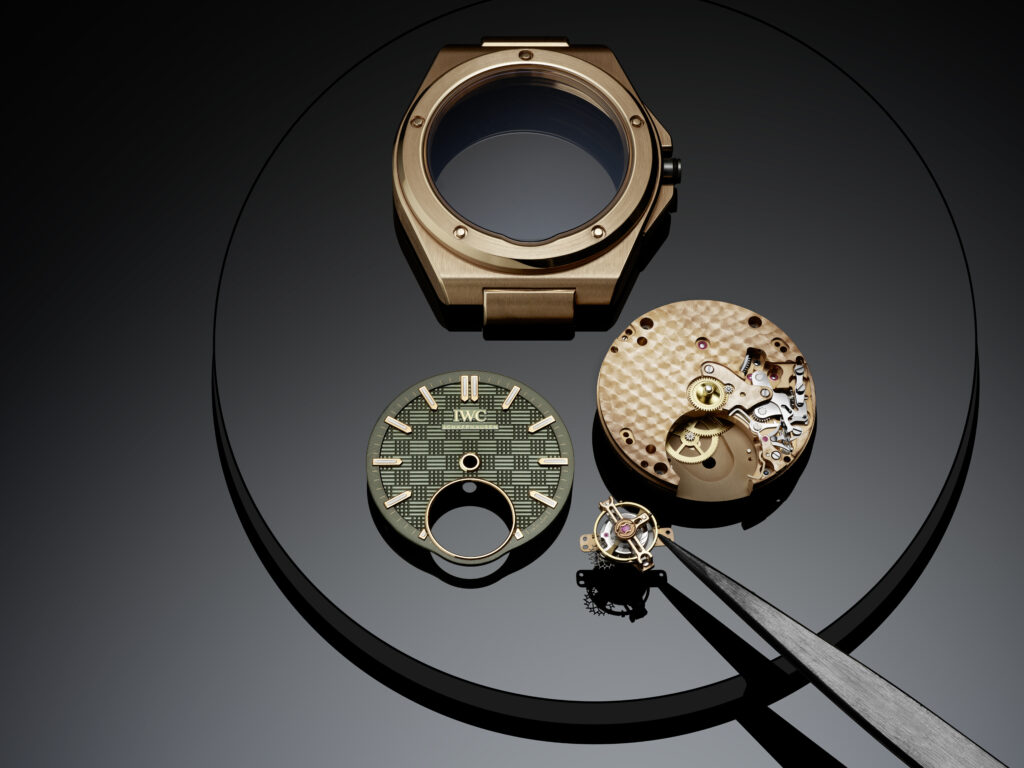
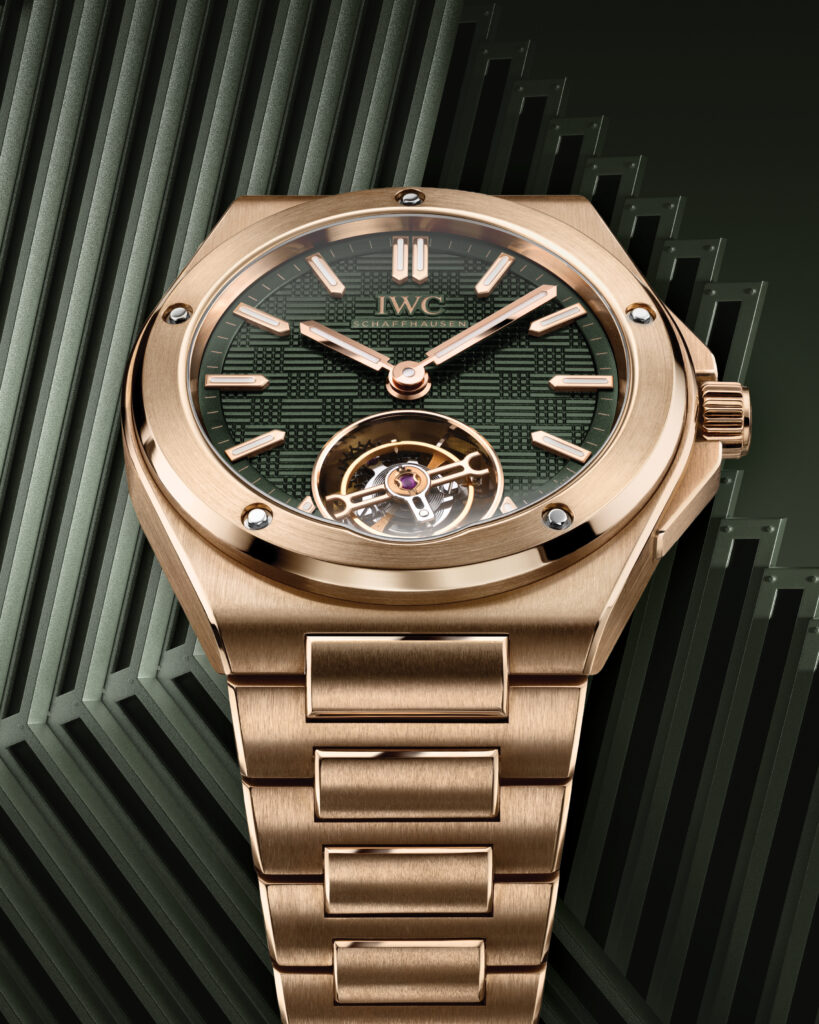
The 2026 version retains this architectural vocabulary, but the gold changes its tone. Where steel emphasized function, 5N gold reveals the angles. The satin-finished surfaces of the case, bezel, and links interact with polished edges; here, the precious metal serves not only to signify value, but also to make the construction more legible. On the olive-green dial, the “Grid” pattern creates an almost industrial grid, a way of reminding us that the Ingenieur was not born as a showpiece, but as a precision instrument meticulously crafted.
À six heures, le tourbillon volant impose une autre cadence. Sa cage effectue une rotation par minute, avec l’échappement et le balancier embarqués dans une structure composée de 56 éléments pour un poids de 0,635 gramme. IWC y ajoute un arrêt du tourbillon, permettant d’immobiliser le mécanisme pour un réglage à la seconde. Le levier d’ancre et la roue d’échappement reçoivent un traitement Diamond Shell®, conçu pour réduire les frictions et améliorer la circulation de l’énergie dans le mouvement.
This detail is less spectacular than it seems, and that is precisely what makes it interesting. The tourbillon has long served as a vertical display: visible virtuosity, a moving cage, a promise of precision. In this Ingenieur, it becomes almost a counterpoint to the geometric design of the case. The cage rotates; the rest remains still. The grid-patterned dial imposes order, while the tourbillon introduces a moment of respite.
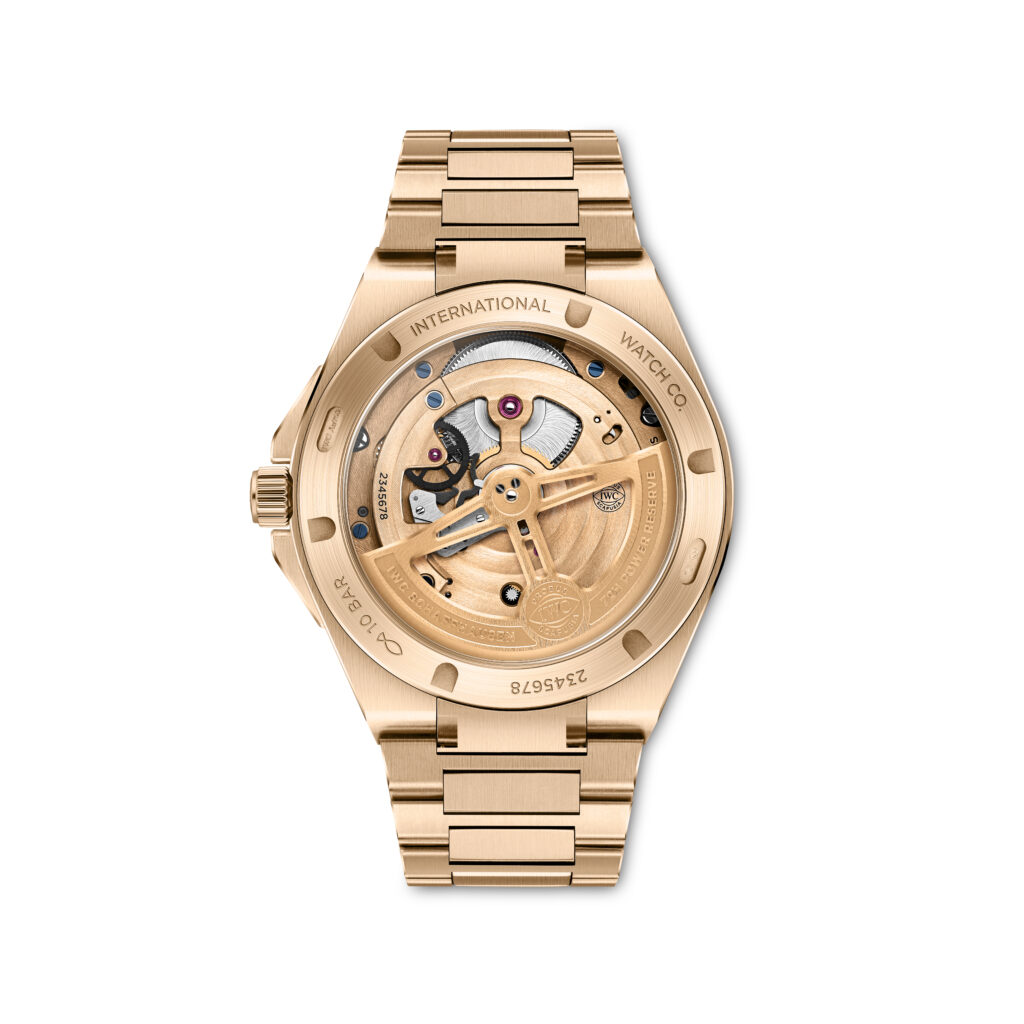
The 82905 caliber, developed by IWC, continues this approach. It beats at 28,800 vibrations per hour, operates at 4 Hz, features 25 jewels, and offers an 80-hour power reserve. Its automatic winding mechanism is based on the Pellaton system, which utilizes the rotor’s movements in both directions. The components subject to high stress—the automatic wheel, pawls, and rotor bearing—are made of zirconium oxide ceramic, either black or white depending on their function. The sapphire case back reveals the gold automatic bridge and rotor, decorated with Côtes de Genève, as well as a solid gold “Probus Scafusia” medallion.
The Pellaton system is part of IWC’s technical history. Developed by Albert Pellaton, then the Manufacture’s technical director, it is described by the Fondation de la Haute Horlogerie as an automatic winding mechanism patented in 1946 and subsequently improved in 1950. This point is important: the Ingenieur Tourbillon 41 is not merely the addition of a tourbillon, but rather a continuation of the mechanical tradition unique to Schaffhausen, where the efficiency of the winding mechanism is just as important as the choreography of the cage.
Founded in 1868 by the American watchmaker and engineer Florentine Ariosto Jones, IWC was built on the idea of combining Swiss craftsmanship with modern industrial methods. This origin partly explains the brand’s ongoing challenge: to transform precision into an aesthetic language without compromising the instrument’s readability.
The Ingenieur Tourbillon 41 succeeds when it does not try to hide this tension. It is no longer really a utility watch. Nor is it a complication piece detached from everyday life. It occupies a more ambiguous space: that of a sporty object that has become a precious piece, yet remains bound by the discipline of its construction. Gold is worked here as a structural material. The tourbillon appears as an exercise in micro-architecture. And the whole piece serves as a reminder that a watch can shift gears without betraying its fundamental design language.
À lire aussi sur Luxsure : IWC Ingenieur : 50 ans après Gérald Genta, l’hommage à un échec devenu icône · Gérald Genta Gentissima Oursin Fire Opal : quand le feu volcanique rencontre… · Gérald Genta Répétition Minutes : l’art sonore sublimé aux Geneva Watch Days 2025 · Le son comme architecture
Cette publication est également disponible en :

