
Nestled between the cliffs of Cap Canaille and the Mediterranean Sea, Clos Sainte Magdeleine occupies a unique place in the French wine-growing landscape. More than just a vineyard, it is a real-life demonstration of what a coastal vineyard can produce when it draws on a century-old heritage and a contemporary understanding of the terroir.
In Cassis, the landscape shapes viticulture.
The appellation’s vineyards, recognized as early as 1936, cover just 215 hectares. Notably, eighty percent of its production is devoted to white wines—a rarity in Provence, a region largely associated with rosés.
Clos Sainte Magdeleine is one of its most iconic expressions. The estate covers twenty hectares—thirteen of which are under cultivation—on terraced plots at the foot of Cap Canaille. From the highest terraces, the view plunges directly toward the Mediterranean. This physical proximity to the sea is not merely a backdrop: it shapes the wine.
The report highlights two key factors: limestone and sea spray. The vineyards are planted on clay-limestone soils where the bedrock forces the vines to develop deep roots. The sea breeze, meanwhile, exerts a constant climatic influence that helps maintain the wine’s acidity balance despite the particularly sunny Mediterranean environment.
Against the backdrop of global warming, which is driving many vineyards to seek higher altitudes and cooler climates, Cassis enjoys a historical advantage: here, the sea acts as a natural regulator.
White as Cultural Heritage
The estate’s mission statement highlights a clear ambition: to make Clos Sainte Magdeleine a benchmark for southern white wine. Behind this statement lies a more fascinating cultural reality. For decades, great French white wines were associated with Burgundy, the Loire Valley, or Alsace. Cassis is part of a different story—that of Mediterranean vineyards capable of producing age-worthy whites in a climate known for its warmth.
The estate also boasts a long history. The earliest written records of viticulture at this site date back to the 14th century, while the current property was developed in the early 20th century by Greek wine merchants before being passed down through several generations of the Zafiropulo family. Today, Jonathan Sack represents the fourth generation of winemakers at the estate.
Between Tradition and Experimentation
Another appealing aspect of Clos Sainte Magdeleine is its ability to combine heritage with research.
The underground cellars date back to the 19th century, but the winemaking process involves a variety of containers: stainless steel tanks, oval concrete vats, stoneware jars, and demi-muids. This technical diversity allows each plot to be handled according to its specific characteristics, rather than imposing a single method on the entire estate.
This approach is reflected in the vineyard’s management. Old vines are preserved through systematic mass selection whenever vines need to be replaced. This demanding practice prioritizes the continuity of the vineyard’s genetic heritage over clonal uniformity.
Detail
Estate area: twenty hectares
Area under production: thirteen hectares
Altitude: ten to two hundred meters
Soil: clay-limestone
Setting: Calanques National Park
Winemaking: stainless steel, egg-shaped concrete tanks, stoneware, demi-muids
Percentage of white wines in the Cassis appellation: eighty percent
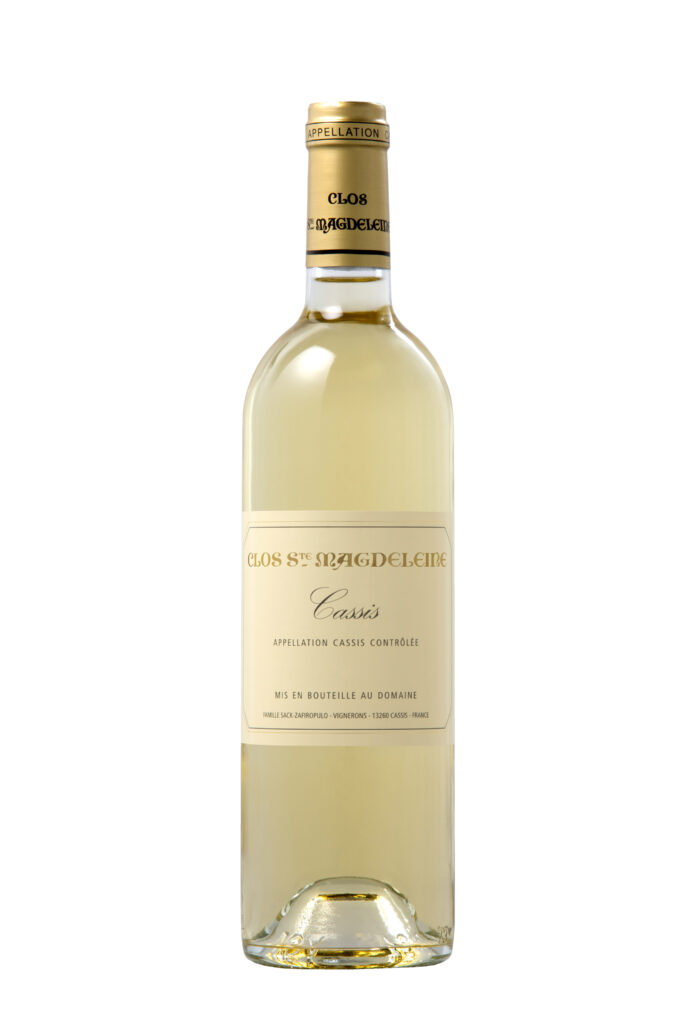
Among the estate’s wines, the Cassis Blanc Tradition best embodies this philosophy. A blend of four grape varieties, fermented using native yeasts and then bottled without fining or filtration, it represents an effort to convey the maritime terroir of Cassis as directly as possible.
Clos Sainte Magdeleine thus occupies a unique place in the French landscape. While many estates today seek to demonstrate their uniqueness, this one has a rare advantage: a vineyard whose geography already tells a story—that of a limestone promontory suspended between the cliffs and the Mediterranean, where white wine has established itself as the other signature wine of the South.
Cette publication est également disponible en :

