
A palace can have the most beautiful façades in the capital and still miss out on what some visitors today consider to be essential: the ability not to be heard. Quiet is not a pricing option. It’s an architectural posture, a service philosophy and, often, a location decision taken well before the opening.
Looking for a quiet palace in Paris doesn’t mean exiling yourself from the city. It means wanting to live it differently – from a room facing the courtyard, an interior garden sheltered from traffic, a lounge where staff know how to come and go without taking up space. The Palace distinction, defined by Atout France according to a reference system that goes beyond the simple counting of stars, recognizes this dimension in its service and architectural criteria. But calm is not something that can be certified. It has to be verified.
What acoustics reveal about a house
The first test is not visual. It’s the silence of the corridors. A palace that has worked hard on its floor plan isolates flows: the restaurant doesn’t cross the reception area, the bar doesn’t feed into the room corridor, the spa has its own entrances. The hotel thinks in terms of distinct scenes rather than a continuous space where everyone coexists.
The room’s orientation is then the most decisive factor – more so than floor standing or surface area. A room facing the street on a Haussmann boulevard, even with high-quality double glazing, is still subject to sound pressure that the glazing attenuates but does not eliminate. A room overlooking a courtyard, garden or patio solves the problem at source. Before booking, the question should be asked directly: what is the acoustic environment of the proposed room, and what is its exposure?
Discretion as a sign of maturity
The discreet palace is one that has stopped selling itself during your stay. No solicitations at reception, no permanent display of additional services in common areas, no continuous flow of staff in the corridors. It’s a question of occupancy density as much as design: a hotel that correctly manages its occupancy rates according to the season offers a different experience from one that is constantly pushed to maximum capacity.
This active calm, to use the expression applied to Le Bristol Paris as part of its partnership with La Mer, is harder to achieve than it might seem in a capital as dense as Paris. It requires choices: fewer place settings in the restaurant, less traffic in common areas, architecture that preserves blind spots where it’s possible to sit without being watched.
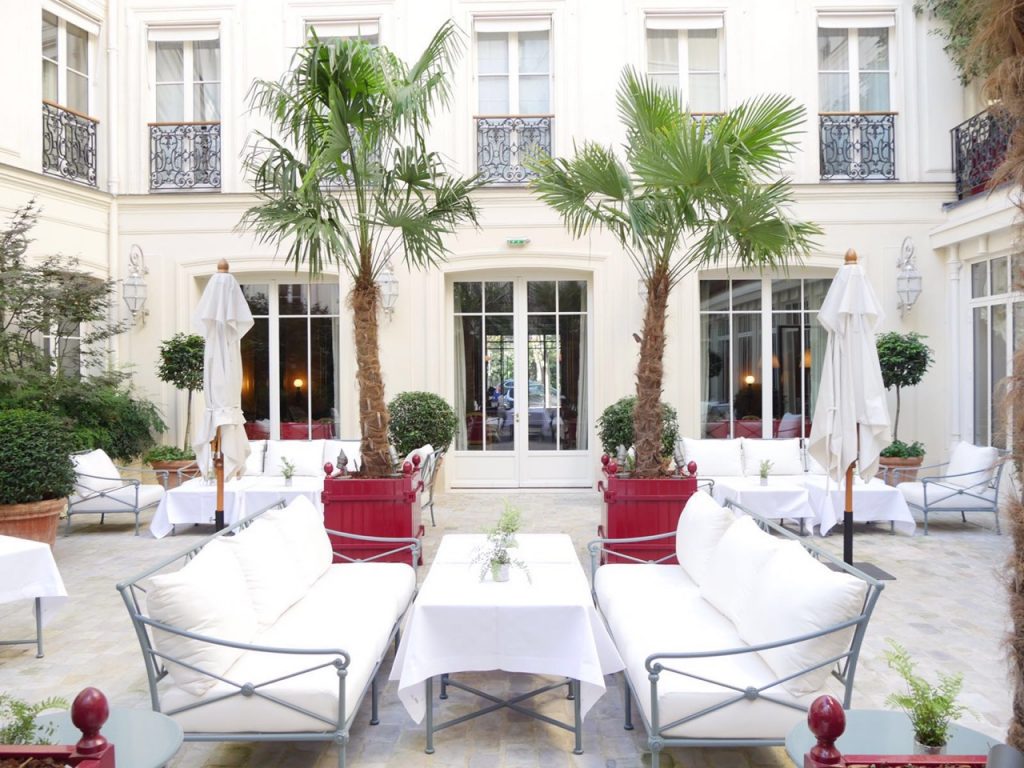
Right bank, left bank: two relationships to silence
Parisian geography structures the offer. The palaces on the right bank – concentrated around the Madeleine, Champs-Élysées, Opéra triangle – are located in the most exposed areas of the capital. This is not a disqualification: a hotel like Cheval Blanc Paris has built up the idea of an urban refuge precisely because it is located at the confluence of very busy areas. The island of calm is deliberate, elaborate, almost performative – and all the more remarkable for it.
Structurally, the Left Bank offers different acoustics: narrower streets, lighter traffic, different commercial density. The Lutetia, on boulevard Raspail, takes advantage of a boulevard less saturated than its counterparts on the right bank. The building’s Art Deco architecture, with its loggias and angles, naturally creates buffer zones.
But the riverbank doesn’t guarantee anything. What protects a stay is not a district – it’s a plan.
The right questions to ask before booking
A quiet palace can be recognized above all by the quality of the answers it provides to questions not usually asked. Ask for the exact orientation of the proposed room. Find out if an interior courtyard or garden is accessible from the floors. Ask about the opening hours of the bar and event space – a palace that hosts private evening dinners may be perfect during the week and very different at the weekend. Ask whether and how the clientele varies with the season.
A palace that answers these questions with precision, without trying to minimize, is already signalling something about its welcoming culture. Those who evade or generalize also give information.
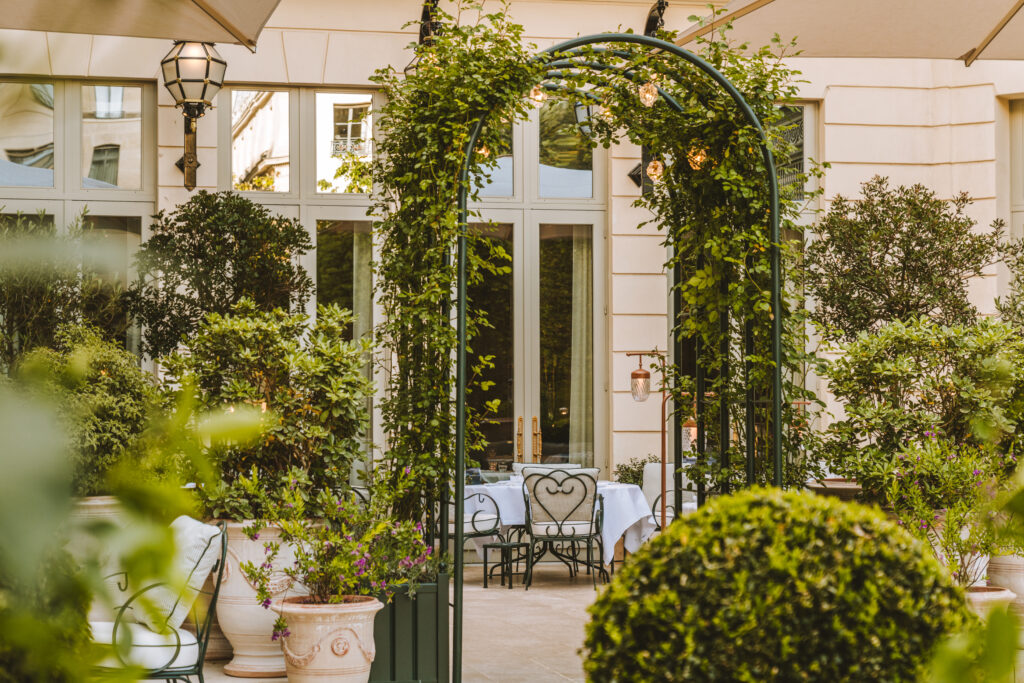
What calm costs, and what it brings back
Quietness in a Parisian palace comes at an indirect price: these are often the rooms that are least advertised in comparisons, suites without a direct view of the monument, and intermediate floors that benefit from double insulation. These are also the addresses that don’t need to position themselves in the rankings to fill their notebooks.
The traveler looking for a quiet palace in Paris is not necessarily the one looking for the least visible. He or she is often the one who has already made the rounds of the grand palaces and now knows that the quality of a stay is played out less in the lobby than in the first twenty minutes spent alone in the room. That moment – window ajar, city audible but distant, no pressure – is perhaps the truest definition of what Paris can offer to those who know how to ask.
Cette publication est également disponible en :

