
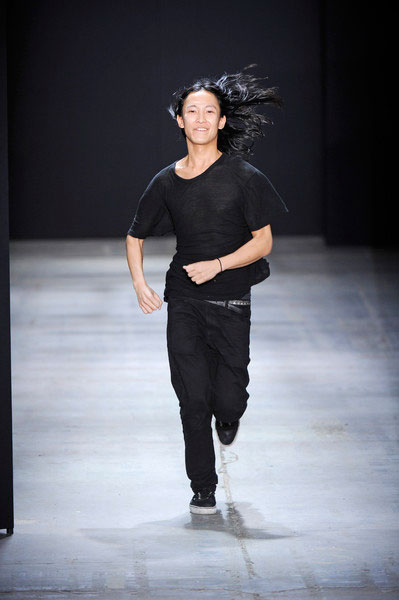
The young, energetic designer, with long brown hair and a close friendship with the most cutting-edge models (Erin Wasson…), quickly reached the top. After several collaborations, and catching the eye of the redoubtable Anna Wintour and Karl Lagarfeld, he launched his eponymous label in 2007. The bouncy designer offers a label aimed at a rather young target: mixing different urban inspirations in an often minimalist palette; his highly geometric dresses and sweets are so popular that the designer collaborates with H&M, offering his creations to the general public.
And it’s this closeness that appeals to Alexander Wang: complicity with his public, benevolence towards his models/muses. He seems perpetually delighted, and that’s a pleasure.
In 2012, he was named artistic director of the legendary Balenciaga house. Too young? Too Californian?

Cristobal Balenciaga (1895-1972). Brand: “Balenciaga”. Baby doll” evening dress. Three-quarter view. Fuchsia pink silk taffeta, 1958-1959. Galliera, musÈe de la Mode de la Ville de Paris.
The House of Balenciaga carries with it a prestigious history and designs that have forever marked fashion history. Cristobal Balenciaga, who moved to Paris in 1937, was born in Spain (not Paris). The climax of his career is often associated with the ’50s, when he created sack dresses, tonneau lines, balloon jackets and flowing, rounded dresses in opposition to Christian Dior’s “New Look”. He inspired many designers, from Ungaro to Hubert de Givenchy, and dressed renowned clients such as Princess Grace of Monaco and the queens of Spain and Belgium… Prestige, prestige: a heavy, heavy heritage. The icing on the cake: Alexander Wang is to succeed Nicolas Ghesquière, who has led and remounted the house for 15 years, imposing an avant-garde style, with futuristic design, and pieces that immediately became commercial successes.
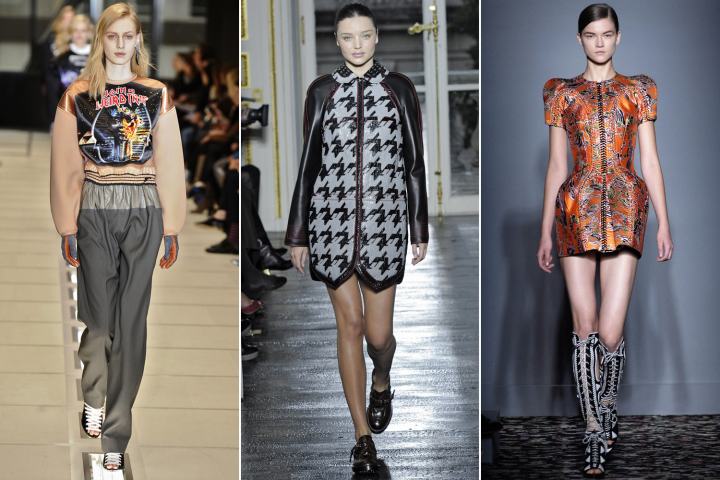
Balenciaga by Nicolas Ghesquière
The challenge seems daunting: the young Californian is eagerly awaited. His first collections combine the heritage of Cristobal Balenciaga: structured tops with rounded shoulders – a tribute to the balloon silhouette. He stuck to minimalist palettes (pastel or dark) and worked the materials of his dresses like sculptures. Everything seems to be working: in the house’s press release, the artistic director and Henri Pinault emphasize Alexander Wang’s contribution to the brand’s international renown, as well as the sustained growth that has taken place in recent years… And yet…
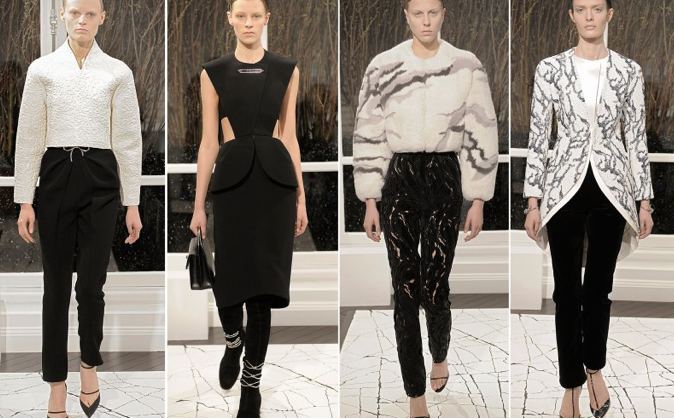
Alexander Wang’s first step at Balenciaga.
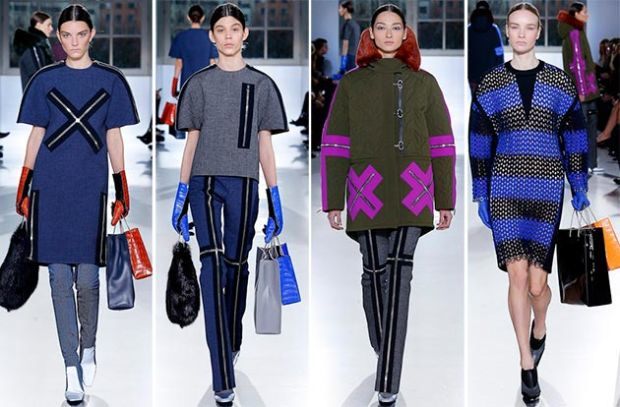
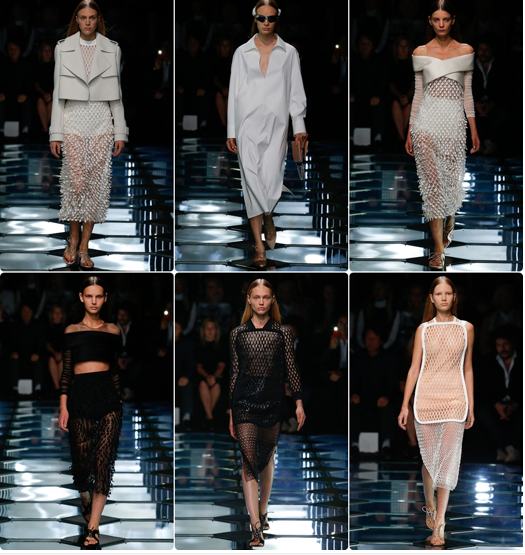
The rumor had been circulating on the Web for a few days, and now an official press release has arrived: Balenciaga has announced – by mutual agreement with Alexander Wang – that the collection to be presented at the next Paris Fashion Week (October 2, 2015) will be the designer’s last for the brand.
As for the replacement, his name remains unknown for the moment. In fact, it’s the word unknown that comes up when the question of a successor is raised on the Web. Balenciaga is said to be looking for an anonymous designer. It’s not a new gamble for Henri Pinault. He seems to have learned his lesson from the lacklustre success of Tom Ford’s appointment at Yves Saint Laurent in 1999, when the designer already possessed a strong reputation and a distinctive style, associating him with Gucci’s “Porno-chic”.
As for Alexander Wang, he says he is very grateful to Balenciaga: very happy to have been part of such a house.
What to remember?
-Alexander Wang wants to concentrate on developing his own label. After his time at Balenciaga, the designer undoubtedly knows better how to develop his brand: the direction to take.
-The weight of the name: Balenciaga is a heritage, a heritage that requires the designer to step behind a story. We know the brand, but not the designer’s name. Too much compromise?
-Yet Henri Pinault seems to prefer designers to luxury houses with big names. He prefers a brand to be built around its designer: Stella Mc Carntney or Alexander Mc Queen belong to his group. When Alexander Wang took over at Balenciaga, he already had his own brand. There’s no need to build his label or brand image…
-Alexander Wang wants to give his label a new lease of life. Already boasting 500 points of sale, a new one will soon open in London. A brand aimed at the general public and a young clientele. Not exactly the goal of the big fashion houses. Alexander Wang seems determined to strike a balance between high-quality ready-to-wear and more democratic distribution.
-Finally, we can speculate that the “Parisian” imaginary surrounding the house was stronger than Alexander Wang’s creativity – a recurring argument in most of the criticisms levelled at him. Too urban, not classic enough, lacking in delicacy, lacking a “French” edge: we don’t really know what that means… Two universes, two imaginations… Yet the meeting was fruitful.
Who decided to leave whom? The eternal question. Common agreement isn’t romantic enough: to each his own. Meanwhile, a wild horse continues to conquer the world, democratizing its vision of fashion with infectious gusto.
Cette publication est également disponible en :

