
In Milan, some collaborations don’t seek to produce a new object, but to shift the gaze on an existing one. The Rabbit Chair, designed by Stefano Giovannoni for Qeeboo, offers a demonstration of this at Salone del Mobile 2026, through a reinterpretation by Maison Fiorucci.
The Rabbit Chair belongs to this category of objects immediately identifiable by their silhouette. A simple shape: two upright ears, a hollowed-out body to accommodate the seat. Since its creation, it has moved between domestic use and decorative presence, oscillating between furniture and sculpture.
The version presented in Milan changes neither its proportions nor its function. It acts elsewhere.
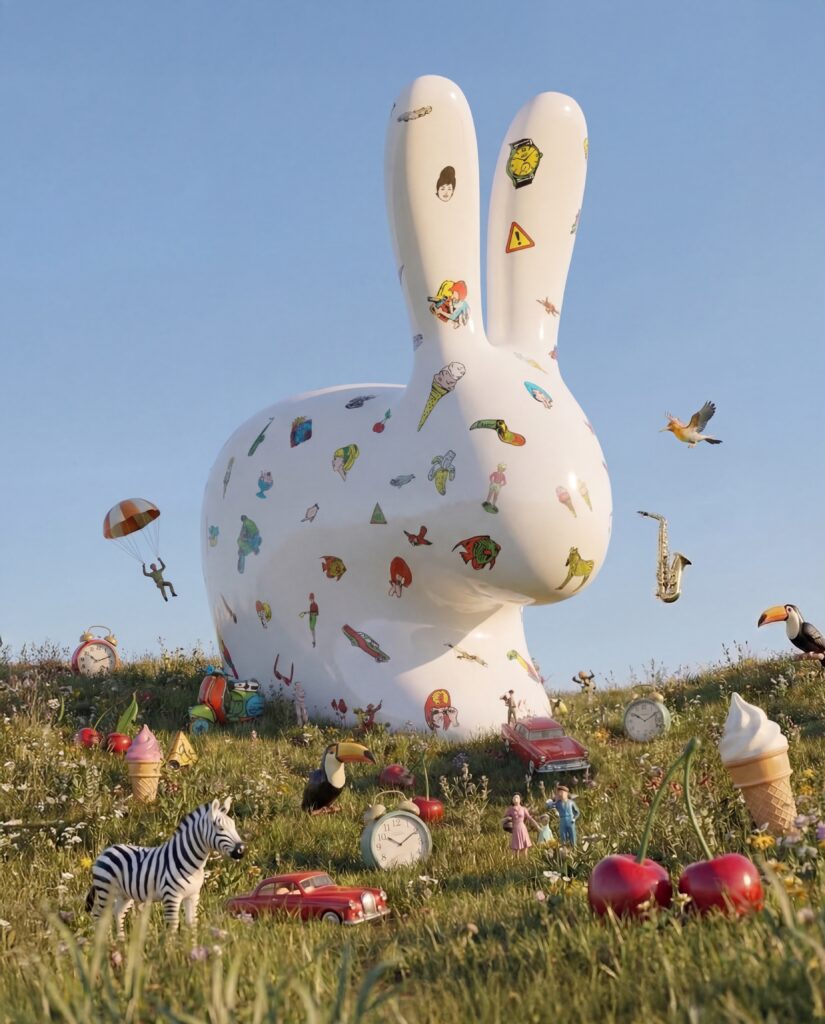
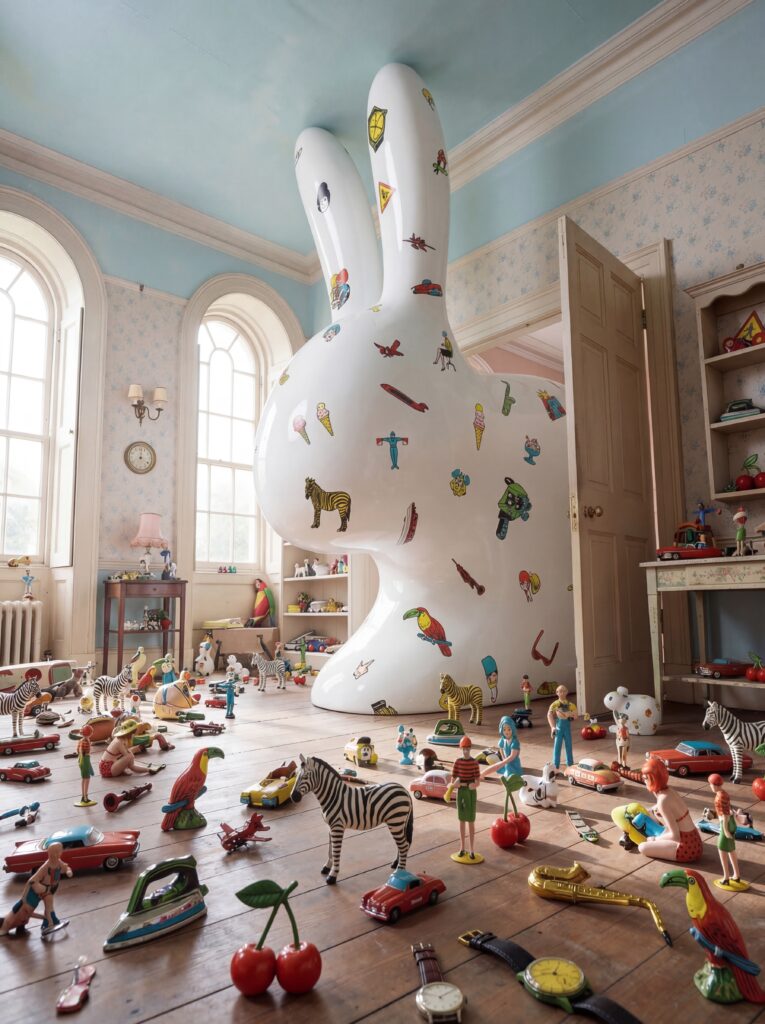
Fiorucci intervenes with a motif. More specifically, Toys, a drawing from the company’s archives dating back to the 1980s. This visual repertoire assembles heterogeneous elements – fruit, birds, lipsticks, cameras, female figures – in a logic of graphic accumulation.
The result is not an orderly composition, but a deliberate saturation inherited from both pop art and 1950s advertising imagery.
Applied in an all-over pattern to the surface of the chair, this motif does more than simply decorate. It reconfigures the reading of the object. The Rabbit Chair ceases to be an autonomous form and becomes a support.
The choice of ceramic accentuates this shift. Unlike the more conventional polymer versions, this material introduces a different temporality: firing, glazing, fixing the decoration. The surface becomes smooth, dense and slightly reflective. It catches the light and stabilizes the colors, enhancing the legibility of the motif.
This transition from plastic to ceramic is not insignificant. It shifts the object from the register of use to that of conservation. We don’t handle ceramics like an occasional chair; we sit on them, look at them, walk around them.
Detail
- Object: Rabbit Chair, design by Stefano Giovannoni
- Intervention: Toys motif (Fiorucci archive, 1980s)
- Technique: all-over graphic application on three-dimensional surface
- Material: ceramic edition
- Variants: standard format and extra-small version
This type of object reveals a broader evolution in contemporary design: the fusion of furniture and image. Where twentieth-century industrial design focused on function and reproducibility, some of today’s pieces shift their value to surface, narrative and visual impact.
From the outset, Qeeboo has followed this logic of objects with a strong formal legibility. Fiorucci, on the other hand, has been working with instantly recognizable iconography since the 1970s. Their meeting does not produce a synthesis, but a superposition: stable form on one side, visual flow on the other.
The Rabbit Chair becomes a volume saturated with images, a kind of three-dimensional collage frozen in ceramic.
Presented as part of the Salone del Mobile, this piece is also part of a precise context: that of an Italian design that continues to navigate between industry and popular culture. Not to arbitrate between the two, but to maintain their tension.
Cette publication est également disponible en :

