
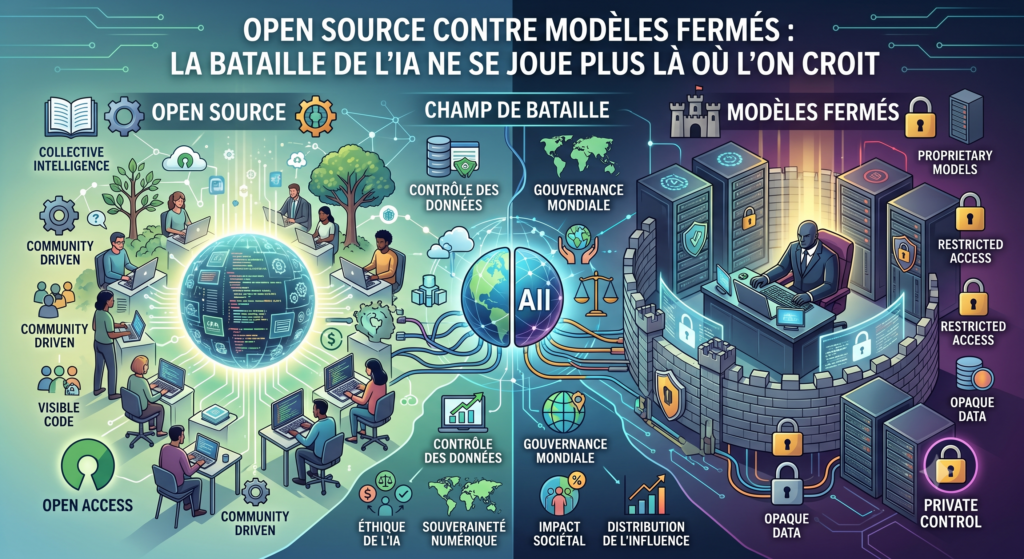
At first glance, the debate seems familiar. On one side are the American giants with tens of billions of dollars, massive data centers, and the most powerful models on the market. On the other is an open-source ecosystem that champions transparency, sovereignty, and distributed innovation.
But during the conference “Open vs. Closed: Who Gets to Build AI?,” featuring Thomas Wolf (Hugging Face), Danila Stahn, and Vladislav Tankov, one idea emerged: the real issue is no longer which model is the most powerful. It is about who controls access to intelligence.
The Paradox of Concentration
Never before has the AI industry concentrated so much capital.
The record valuations of closed-system players rest on a simple assumption: the best models will continue to create a technological lead sufficient to justify their economic dominance.
For Danila Stahn, however, this equation remains far from proven.
In his view, while current leaders are enjoying spectacular growth, the question of sustainable profitability remains unanswered. The industry is still in an exploratory phase where no one really knows which part of the value chain will capture long-term profits.
In this context, open source does not appear to be a marginal alternative but rather a mechanism for collective discovery—a global laboratory for exploring approaches that closed platforms have neither the time nor, at times, the interest to experiment with.
The Claude Fable Case: A Brutal Wake-Up Call for Developers
The debate quickly shifted to the incident that dominated the week at VivaTech.
Anthropic’s decision to restrict and then remove certain capabilities from its “Fable” model sent shockwaves through the developer community.
For Thomas Wolf, the problem isn’t so much the decision itself as what it reveals.
When a company can modify a model’s capabilities, restrict certain uses, or degrade certain responses without external oversight, the user becomes dependent on an infrastructure over which they no longer have control.
The issue goes far beyond technical performance.
A biotech startup mentioned during the discussion had to abandon certain uses of proprietary models due to new restrictions related to work on DNA and computational biology. Its response was immediate: migrate to an open model, train it on its own data, and regain control of its roadmap.
This episode serves as a wake-up call for the entire ecosystem.
For several years, the main question was:
Which model is the best?
Today, it becomes:
Can I build my business on a model that could disappear tomorrow?
The Commoditization of Intelligence
The most interesting idea in the discussion undoubtedly came from Thomas Wolf.
According to him, generative intelligence is becoming a commodity.
In other words, value no longer lies solely in the model itself but in what is built around it.
The most advanced companies are no longer simply seeking access to the best-performing model. They are seeking to create specialized systems:
- models refined using their data;
- agents tailored to their processes;
- proprietary workflows;
- exclusive domain expertise.
Following this logic, the base model becomes just one component among many.
Much like how Linux has become the invisible foundation for thousands of different products.
True differentiation is shifting toward data, orchestration, and business integration.
Europe Is Looking in the Wrong Place
On the issue of European sovereignty, the speakers expressed a surprisingly consistent view.
Yes, Europe needs computing capacity.
Yes, it needs data centers.
Yes, it needs companies like Mistral AI or Hugging Face.
But that won’t be enough.
For Danila Stahn, the European discourse is too focused on infrastructure.
Building data centers is like building roads.
But you still need cars to drive on them.
The real problem in Europe, then, isn’t a shortage of GPUs but a lack of demand, adoption, and the creation of AI-native companies.
This critique is particularly interesting because it flips the dominant narrative on its head.
Sovereignty isn’t just about owning infrastructure.
Above all, it involves creating an economic ecosystem capable of utilizing it.
The risk of a “two-tier future”
Thomas Wolf voiced the panel’s greatest concern.
If AI were to become dominated by just two or three companies controlling the models, the infrastructure, and the terms of access, we would witness an unprecedented form of concentration of technological power.
In such a scenario:
- Innovation would depend on private decisions;
- authorized uses could vary by region;
- certain sectors might be favored or restricted;
- Europe would become structurally dependent on foreign actors for its intelligence layer.
For open-source advocates, the issue is therefore no longer merely technical.
It has become political and economic.
Openness is seen as both a guarantee of competition and a driver of innovation.
The real lesson for entrepreneurs
The panel’s conclusion held a surprise.
Although the discussion focused on business models, none of the speakers advised entrepreneurs to create a new LLM.
The three experts offered essentially the same advice:
Build a product.
Not a model.
Not an infrastructure.
Not a new technological foundation.
A product that solves a real-world problem.
The business model can always be replaced.
The supplier may change.
Costs may go down.
But a product adopted by its users retains its value.
This idea likely sums up the actual state of the AI market in 2026.
While media attention remains focused on the race to develop massive models, value is already beginning to shift elsewhere.
Intelligence is gradually becoming a commodity.
Execution, however, remains rare.
And in this new economy, the question may no longer be who builds the best models.
The question is who will be able to build the best companies with them.
Cette publication est également disponible en :

