
Vhernier has built its new high jewelry collection around a single shape: a triangle, repeated and reoriented from one piece to the next. Freccia High Jewellery revisits a line launched by the Milan-based house in 2014 and adapts it into necklaces, rings, bracelets, and earrings—five collections born from the same geometric module.
The initial design is flat. Vhernier softens its contours, adds volume, and transforms it into a sculptural form without altering its original geometry. It is this repetition—oriented along different axes on each piece—that defines the collection: the same triangle, sometimes mirror-polished, sometimes entirely set with stones, and sometimes crafted to be translucent.
There are three distinct surface finishes. In polished gold, light flows across smooth, flawless surfaces. Set using the House’s signature two-prong pavé setting, the piece is encrusted with diamonds. Crafted using the Trasparenze technique—a process that layers colored semi-precious stones and rock crystal—it gains chromatic depth. The stones selected for this version—black jade, green jade, lapis lazuli, and mother-of-pearl—give each triangle its own distinct hue while maintaining the unity of the form.
The most technically sophisticated piece is still the convertible earring. A screw-fastening system allows the colored stone element to be separated from the diamond-set portion: the same earring can be worn as a discreet stud or as a dangle, depending on which of the two elements remains attached to the earlobe. The piece changes its look without changing owners or jewelry boxes.
The advertised sizes are generous, but the fashion house claims that the design is intended to follow the body’s movements—a necessary condition when a sculptural silhouette of this scale is meant to be worn, not just admired.
Freccia High Jewellery does not reinvent Vhernier’s vocabulary; rather, it makes its use more accessible. By separating the precious element from the everyday element within a single earring, the House responds to a demand that high jewelry has long ignored—that of a piece of jewelry that changes its function without ever leaving the display case where it was designed.
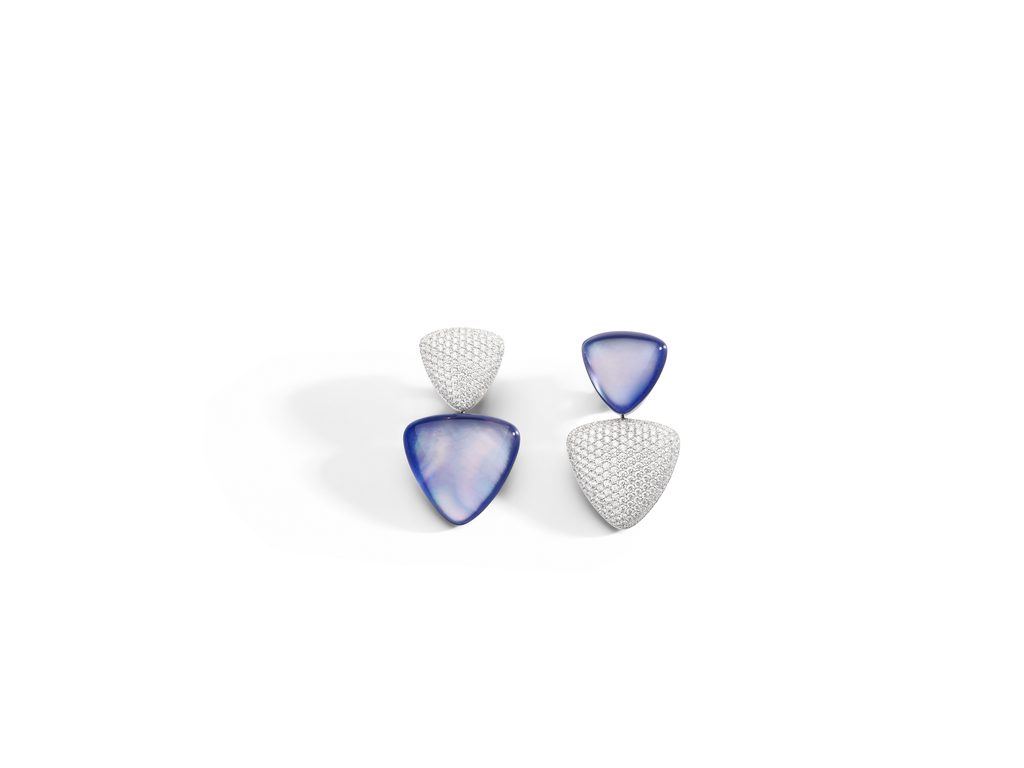
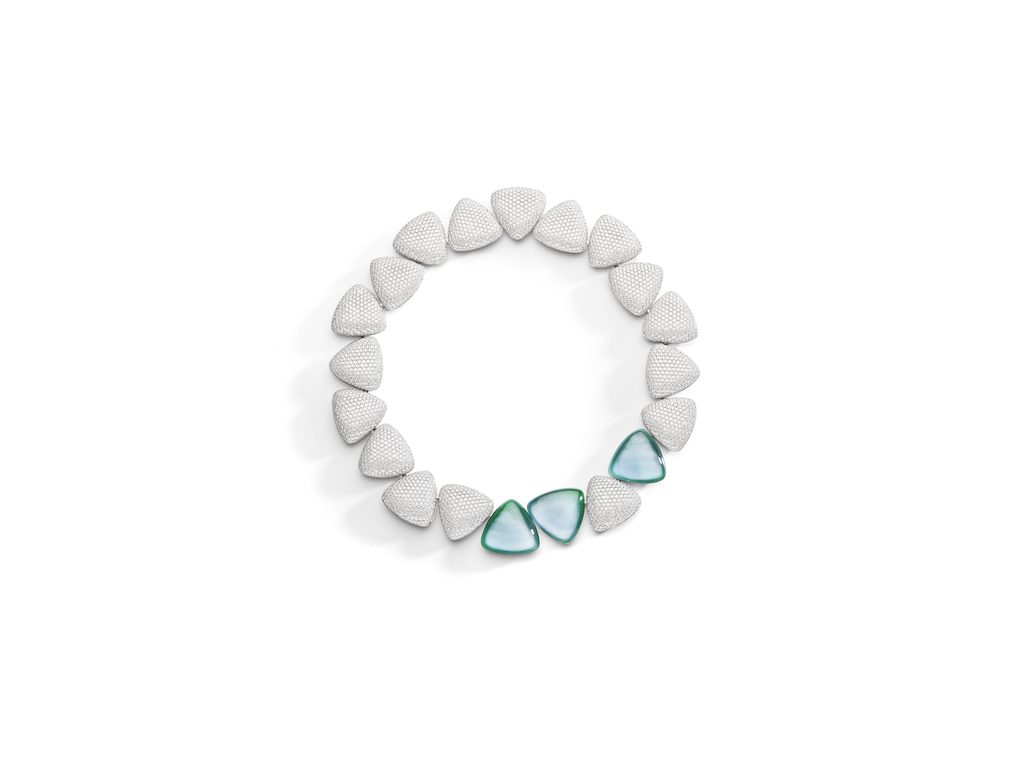
The process involves layering a colored semi-precious stone and a slab of rock crystal. This layering creates an effect of transparency and chromatic depth that the stone alone cannot produce, while preserving the visual lightness of the sculpted form.
Cette publication est également disponible en :

